
Several years ago, I came across an infographic that’s stuck with me ever since.
It was a visualization—elegant, striking, even beautiful in its design—that mapped hundreds of alleged contradictions across the entire Bible. Arcs swept from Genesis to Revelation, connecting passages that supposedly couldn’t both be true. The visual impact was undeniable. Here was the entire Christian Scripture, reduced to a tangled web of inconsistency.
The infographic came from an atheist organization. Its purpose was clear: to demonstrate, at a glance, that the Bible is hopelessly contradictory and therefore unworthy of serious intellectual consideration. For many viewers, this single image does more damage to biblical faith than a shelf of academic critiques. It presents the case against Scripture in a form that feels comprehensive, objective, and devastating.
I remember thinking: Someone needs to actually answer these. All of them. Systematically.
That thought never left. And now, years later, we’re finally doing it.
The Challenge We’re Accepting
This series is our response. Not a dismissive wave of the hand. Not a theological retreat into “it’s all about faith.” We’re engaging every alleged contradiction with the same rigor that skeptics bring to the attack—and then some.
Our goal is simple: demonstrate that every charge leveled against the Bible’s internal consistency has a good and sufficient answer.
Not that every answer will satisfy everyone. Not that every resolution will be immediately obvious. But that honest inquiry, rigorous methodology, and careful attention to the text will consistently reveal that the alleged contradictions dissolve under scrutiny.
To track our progress and present our responses visually, we’ve built an interactive resource that maps these contradictions—but this time, with answers attached. Where the original atheist visualization showed only alleged problems, ours shows problems addressed. Each arc links to a full article. Each response represents hours of research into the original languages, ancient Near Eastern context, manuscript traditions, and theological frameworks.
We’re taking back the visual argument.
Who This Is For
We write for several audiences, each with different needs:
The troubled believer. You’ve seen the lists. You’ve heard the accusations. Maybe you found that infographic yourself, and it shook something loose. You’re not looking to abandon your faith, but you need to know: Can I believe this Book with intellectual integrity? Yes. You can. And we’ll show you why, passage by passage.
The honest skeptic. You’ve heard Christians claim the Bible is inerrant, and you find that claim incredible given what you’ve read about its contradictions. Fair enough. We’re not asking you to accept our conclusions before examining our arguments. We’re asking you to engage the evidence. If you’re genuinely interested in truth, you’ll give us a fair hearing.
The student and apologist. You need resources. You need arguments. You need to know how to respond when someone throws a contradiction at you in conversation or online. This series is a reference library. Use it.
The pastor and teacher. Your people have questions. Some are afraid to ask. This series gives you material to address those questions from the pulpit, in small groups, or in private counseling.
What We Mean by “Inerrancy”
Before diving into specific contradictions, we need to establish what we’re actually defending. Much skeptical critique operates against a caricature of inerrancy that no serious Christian scholar holds.
Inerrancy means the Bible tells the truth and never affirms what is false.
That’s it. That’s the historic position of the Church, upheld by Augustine, Aquinas, Luther, Calvin, and the mainstream of Christian scholarship across two millennia.
What inerrancy does not mean:
-
It doesn’t mean dictation. The Bible wasn’t produced by God overriding human authors like a boss dictating to a stenographer. The human authors wrote with their own vocabularies, styles, concerns, and perspectives. Divine inspiration guaranteed the truth of what they wrote, not the elimination of their humanity.
-
It doesn’t mean technical precision. The Bible uses phenomenological language (the sun “rises”), round numbers, paraphrased quotations, and the ordinary conventions of ancient literature. These aren’t errors any more than your saying “sunrise” is an error in astronomy.
-
It doesn’t mean inerrancy of copies. We affirm the inerrancy of the original manuscripts (the autographa), not every copy made thereafter. Copyist errors exist—that’s why we have the science of textual criticism. But remarkably, the manuscript tradition is so robust that we can identify and correct transmission errors with high confidence.
-
It doesn’t mean every difficulty is immediately solvable. Some passages are genuinely difficult. Some resolutions require specialized knowledge of ancient languages, customs, or literary conventions. The claim isn’t that the Bible is simple; it’s that it’s trustworthy.
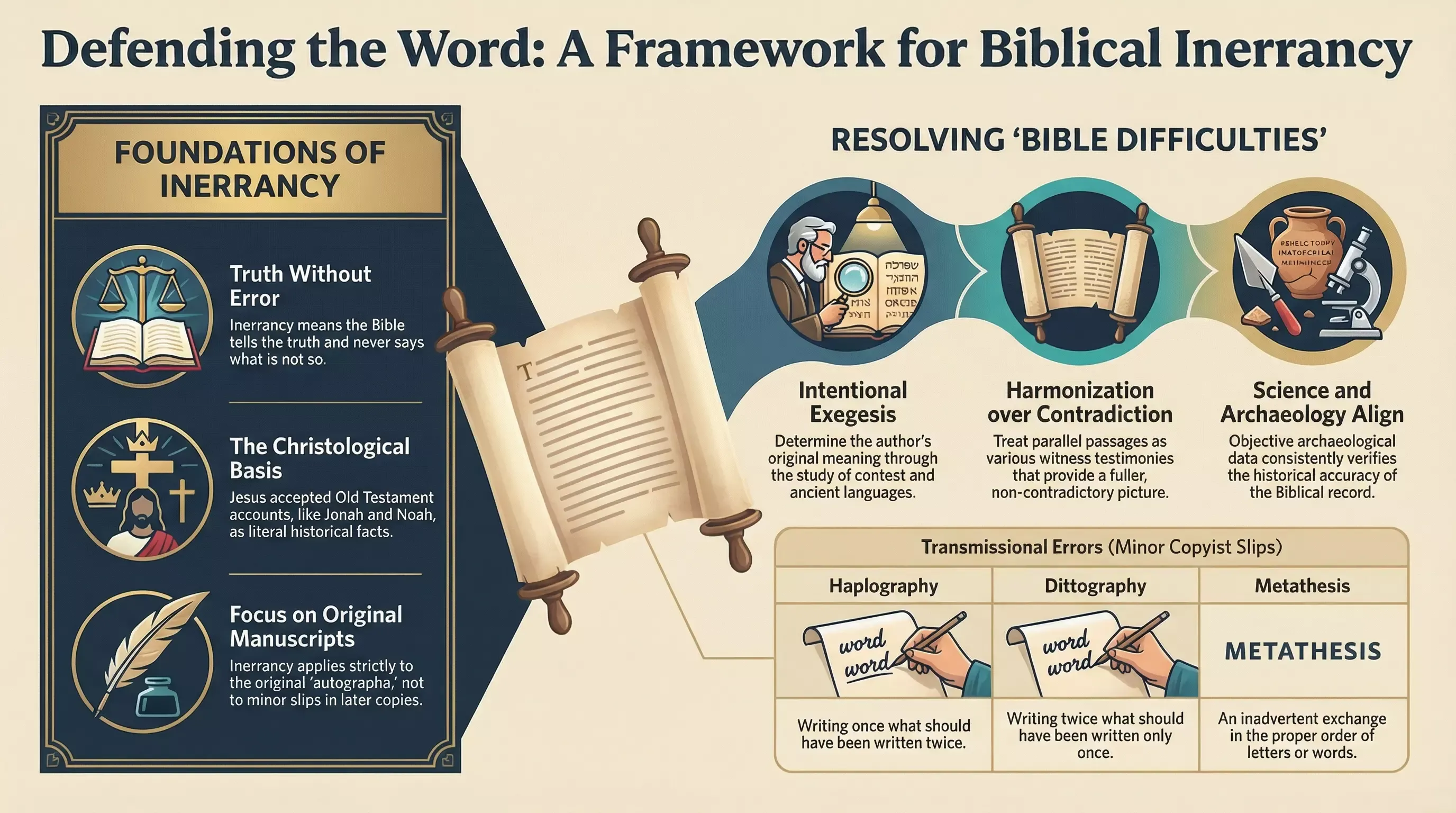
Our framework for addressing alleged contradictions—grounded in inerrancy, exegesis, and harmonization.
Why Bother Responding?
Some Christians argue that the Bible doesn’t need defending. “The Word of God is like a lion,” they say, quoting Spurgeon. “You don’t defend a lion. You let it loose.”
There’s truth in that. Scripture has its own inherent power. The Spirit works through the Word regardless of our apologetic efforts. We don’t save anyone by winning arguments.
But consider this: If an obstacle to faith remains, it should be the stumbling block of the cross—not a perceived contradiction that dissolves under scrutiny.
When someone rejects Christ because they believe the Bible is a mess of contradictions, and that belief is based on a misunderstanding that could be corrected, we have failed them if we refuse to engage. God never asks believers to crucify their intellect. He made the mind. He expects us to use it. And He has provided a Book that can withstand examination.
Our task is to remove imaginary obstacles. The real offense of the Gospel—that we are sinners who cannot save ourselves, that Christ alone is the way—will remain. We can’t smooth over that stumbling block, nor should we try. But we can clear away the debris that skeptics mistakenly believe is part of the foundation.
Our Methodology
Every article in this series follows a consistent approach:
1. State the Alleged Contradiction Fairly
We don’t build straw men. If atheist scholars have published a case, we engage the strongest version of that case. If internet skeptics have popularized a critique, we address it as they present it. You’ll recognize the objection because we’ll state it clearly.
2. Examine the Texts in Context
Most alleged contradictions evaporate when the passages are read in their literary, historical, and canonical context. We examine genre, authorial intent, original audience, and how the passages function within the broader biblical narrative.
3. Consider Linguistic Factors
Hebrew and Greek have their own idioms, semantic ranges, and conventions. A word that seems contradictory in English translation may have a perfectly coherent meaning in the original language. We dig into the text.
4. Apply Historical and Archaeological Data
The Bible is an ancient Near Eastern and Greco-Roman document. Understanding its world illuminates its meaning. We bring relevant historical and archaeological scholarship to bear.
5. Address Transmission Issues
Some difficulties arise not from the original authors but from the copying process. When textual criticism is relevant, we explain it. The goal is always to recover what the original said.
6. Provide a Coherent Resolution
We don’t just identify possibilities—we argue for what we consider the most probable and satisfying resolution. Where multiple valid explanations exist, we present them. Where one stands out, we make the case.
7. Acknowledge Remaining Difficulty
We’re not triumphalists. Some passages remain challenging even after careful analysis. Intellectual honesty requires admitting what we don’t fully know while maintaining confidence in what we do.
The Foundation: Christ’s Own View
Ultimately, our commitment to biblical inerrancy rests on something deeper than apologetic strategy. It rests on the authority of Jesus Christ.
Jesus treated the Old Testament as historically factual and entirely trustworthy. He cited the creation of Adam, the reality of Noah’s flood, the destruction of Sodom, and the experience of Jonah—all passages that modern skeptics dismiss as myth or legend. He built theological arguments on the tense of a verb (Matthew 22:32) and the precise wording of a psalm (John 10:34-35).
Most significantly, Jesus linked His own resurrection to the historicity of Jonah. In Matthew 12:40, He declared: “For as Jonah was three days and three nights in the belly of the great fish, so will the Son of Man be three days and three nights in the heart of the earth.”
This is typological reasoning. The type (Jonah) must be historically real for the antitype (Christ’s resurrection) to be validated by it. If Jonah is fiction, Christ’s appeal collapses. Jesus clearly believed it was history.
To claim Christ as Lord while rejecting His testimony regarding Scripture is an untenable inconsistency. If He is who He claimed to be—the Son of God, risen from the dead—then His view of the Bible is authoritative. And His view was that it tells the truth.
The Project Ahead
We’ve already published our first responses, and many more are in development. Each alleged contradiction gets its own article, and each article links to our interactive visualization where you can explore the connections yourself.
The arcs that once represented unanswered challenges now represent challenges met. The more we respond, the more complete the picture becomes. The goal isn’t just to answer critics—it’s to build a resource that equips believers for generations.
Some contradictions will be easy to resolve. A difference in wording, a copyist’s slip, a matter of translation. Others will require more substantial work—careful analysis of ancient Near Eastern customs, detailed examination of narrative perspective, or nuanced theological reflection.
We’re not in a hurry. We’d rather be thorough than fast. Every article will represent our best effort to honor the text, engage the objection, and serve the reader.
An Invitation
If you’ve struggled with alleged Bible contradictions—whether you’re a believer wrestling with doubt or a skeptic genuinely curious about the Christian response—this series is for you.
We’re not asking you to check your brain at the door. We’re inviting you to think carefully, examine the evidence, and consider whether the Bible really is the tangled mess its critics claim.
The arcs in that original infographic were meant to condemn. We’re redrawing them to vindicate.
Start exploring the responses: Interactive Bible Contradictions Resource
The journey continues. Join us.