“Unless you eat the flesh of the Son of Man and drink His blood, you have no life in yourselves.”
When Jesus spoke these words in the synagogue at Capernaum, His audience reacted with revulsion. “This is a difficult statement,” they muttered. “Who can listen to it?” (John 6:60). Many of His disciples turned back and no longer followed Him.
Two thousand years later, the difficulty remains.
The New Testament contains several passages that appear to condition salvation on physical rituals or elemental prerequisites. You must be “born of water and the Spirit” to enter the kingdom (John 3:5). “Baptism now saves you” (1 Peter 3:21). You must eat Christ’s flesh and drink His blood to have eternal life (John 6:53-54).
For the skeptic cataloging contradictions, these verses create obvious tension with the gospel of grace through faith. If salvation is a free gift received by believing, why does Scripture repeatedly tie eternal life to water, bread, and wine? Are physical rituals required? Does grace flow through pipes and cups?
This is the second category of apparent contradiction in our series addressing the 245 verses the Skeptic’s Annotated Bible presents as irreconcilable. In Part 1, we surveyed the scope of the challenge and outlined the seven categories we would address. In Part 2, we resolved the tension between faith and works, demonstrating that Paul and James fight different enemies while proclaiming the same gospel.
Now we turn to the sacraments: water baptism and the Eucharist. Do these rituals contribute to salvation? Are they necessary prerequisites? Or is something more nuanced happening in these texts?
The Verses in Question
The sacramental passages fall into two groups: those addressing water baptism and those addressing the consumption of Christ’s body and blood.
Water Baptism and Regeneration
Several verses link salvation, spiritual rebirth, or union with Christ to the physical element of water:
- John 3:5: “Jesus answered, ‘Truly, truly, I say to you, unless one is born of water and the Spirit he cannot enter into the kingdom of God.’”
- Mark 16:16: “He who has believed and has been baptized shall be saved; but he who has disbelieved shall be condemned.”
- Acts 2:38: “Peter said to them, ‘Repent, and each of you be baptized in the name of Jesus Christ for the forgiveness of your sins; and you will receive the gift of the Holy Spirit.’”
- 1 Peter 3:21: “Corresponding to that, baptism now saves you—not the removal of dirt from the flesh, but an appeal to God for a good conscience—through the resurrection of Jesus Christ.”
- Romans 6:4-5: “Therefore we have been buried with Him through baptism into death, so that as Christ was raised from the dead through the glory of the Father, so we too might walk in newness of life.”
The Eucharist and Physical Consumption
The Johannine discourse in chapter 6 presents equally visceral language:
- John 6:50: “This is the bread which comes down out of heaven, so that one may eat of it and not die.”
- John 6:53-54: “Truly, truly, I say to you, unless you eat the flesh of the Son of Man and drink His blood, you have no life in yourselves. He who eats My flesh and drinks My blood has eternal life, and I will raise him up on the last day.”
Reading these passages at face value, the skeptic has a point. If salvation requires physical rituals, the Reformation’s sola fide appears to collapse. If baptism regenerates and the Eucharist confers eternal life, then grace is not merely received by faith—it is dispensed through water and wine.
But face-value readings often miss the linguistic, historical, and theological context that ancient authors assumed their audiences understood. What did these words mean to their original hearers? And do they actually teach what sacramentalist interpreters claim?
Born of Water and Spirit: John 3:5 in Context
Jesus’ conversation with Nicodemus ranks among the most theologically significant dialogues in Scripture. When the Pharisee comes to Jesus by night, acknowledging Him as a teacher from God, Jesus immediately cuts to the heart: “Unless one is born again, he cannot see the kingdom of God” (John 3:3).
Nicodemus is confused. “How can a man be born when he is old? He cannot enter a second time into his mother’s womb and be born, can he?” (v. 4).
Jesus clarifies: “Unless one is born of water and the Spirit he cannot enter into the kingdom of God.”
Three major interpretive models have been proposed for this “water and Spirit” language:
The Sacramentarian View
This interpretation takes “water” as a reference to Christian baptism. To be born again, one must receive the sacrament of baptism alongside the work of the Spirit.
The problem? This reading is anachronistic. Christian baptism as a churchly rite had not yet been instituted. John’s Gospel later notes that “Jesus Himself was not baptizing, but His disciples were” (John 4:2), suggesting even the dominical practice was still developing. More critically, Nicodemus could not have understood a reference to a Christian ceremony that did not yet exist. Jesus rebukes him precisely because he should have understood: “Are you the teacher of Israel and do not understand these things?” (v. 10). Jesus expected Nicodemus to recognize something from his own scriptural heritage, not a future ecclesiastical practice.
The Physical Birth View
Some interpreters argue that “water” refers to amniotic fluid—physical birth. The logic: one must first be born physically (“of water”) and then born spiritually (“of the Spirit”).
This view also fails. First-century Jews did not use “water” as a colloquialism for childbirth or amniotic fluid. There is no textual or cultural evidence for this usage. Furthermore, the structure of the phrase suggests a unified concept—“water and Spirit” together describe one spiritual reality, not two sequential births.
The Ezekiel 36 View
The most contextually defensible reading identifies “water and Spirit” as a single, unified reference to the New Covenant cleansing prophesied in Ezekiel 36:25-27:
“Then I will sprinkle clean water on you, and you will be clean; I will cleanse you from all your filthiness and from all your idols. Moreover, I will give you a new heart and put a new spirit within you… I will put My Spirit within you and cause you to walk in My statutes.”
Here, water and Spirit function together as metaphors for divine purification and internal transformation. The prophet Ezekiel—whom Nicodemus as “the teacher of Israel” certainly would have studied—described the coming regeneration using precisely this dual imagery.
This is why Jesus rebukes Nicodemus for not understanding. The concept was not novel; it was the fulfillment of prophetic expectation. Being “born of water and the Spirit” describes the monergistic act of spiritual regeneration—God’s sovereign cleansing and renewal of the human heart. It is not a prescription for a physical ritual Nicodemus needed to perform. It is a description of what God does when He makes sinners alive.
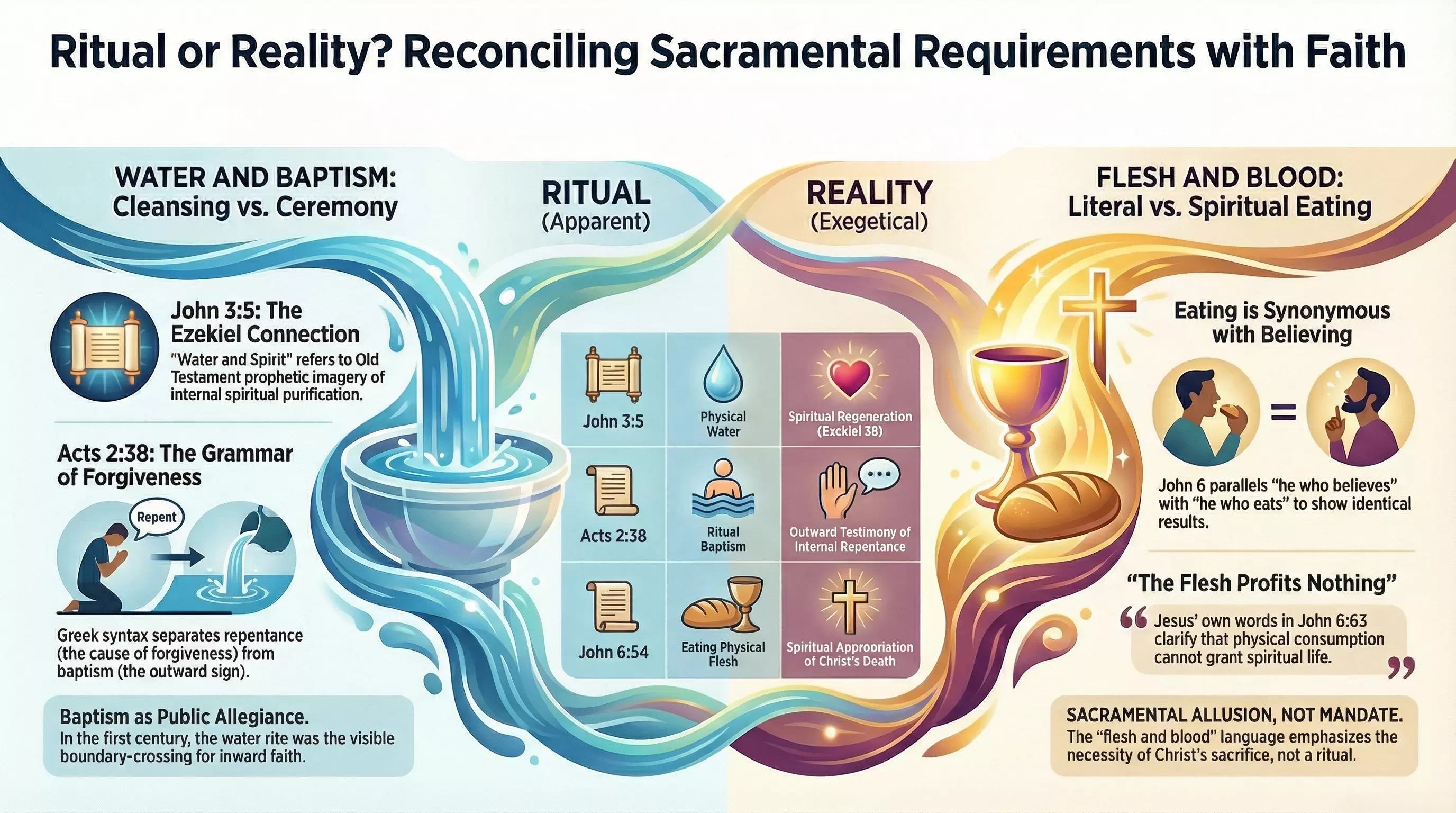
Water baptism, when later instituted, becomes the sign of this spiritual reality. But the sign is not the thing signified. The cleansing water of Ezekiel 36 was always spiritual, not sacramental.
The Grammar of Forgiveness: Acts 2:38
On the day of Pentecost, Peter’s audience was “pierced to the heart” and cried out, “What shall we do?” (Acts 2:37). Peter responded: “Repent, and each of you be baptized in the name of Jesus Christ for the forgiveness of your sins.”
The phrase “for the forgiveness of your sins” (εἰς ἄφεσιν τῶν ἁμαρτιῶν) has generated centuries of debate. Does baptism cause forgiveness? Is it necessary for forgiveness?
The resolution lies in understanding the Greek preposition eis (εἰς).
The Flexibility of Eis
English translations render eis as “for” or “unto,” which modern readers naturally interpret as purpose: “in order to obtain.” But eis is highly flexible in Koine Greek. It frequently denotes ground or causality—“because of” or “on the basis of.”
Consider Matthew 12:41: “The men of Nineveh will stand up with this generation at the judgment, and will condemn it because they repented eis (at/because of) the preaching of Jonah.” The Ninevites did not repent in order to cause Jonah’s preaching. They repented in response to it—because of it.
Similarly, being baptized eis the forgiveness of sins can mean being baptized because of or in response to forgiveness already granted through repentance.
The Morphological Structure
Greek grammar provides another clue. In Acts 2:38:
- “Repent” (metanoēsate) is a second-person plural imperative, corresponding to the plural “your” in “forgiveness of your sins.”
- “Be baptized” (baptisthētō) is a third-person singular imperative, creating a grammatical parenthesis.
This structure binds the promise of forgiveness directly to repentance (the internal reality), while baptism functions as a subsequent outward sign. Peter is not presenting two coordinate requirements—repent and be baptized in order to be forgiven. He is commanding repentance for forgiveness and then, as a separate though related imperative, commanding baptism as the appropriate public response.
The narrative context confirms this. When Cornelius and his household believed the gospel, “the Holy Spirit fell upon all those who were listening to the message” (Acts 10:44)—before they were baptized. Peter then commanded baptism precisely because they had already received the Spirit: “Surely no one can refuse the water for these to be baptized who have received the Holy Spirit just as we did, can he?” (v. 47).
Baptism did not cause their regeneration. It testified to what God had already done.
Baptism Saves—But How? (1 Peter 3:21 and Mark 16:16)
Peter’s statement that “baptism now saves you” (1 Peter 3:21) appears to settle the debate in favor of sacramental efficacy. But Peter himself immediately clarifies what he means—and what he does not mean:
“…not the removal of dirt from the flesh, but an appeal to God for a good conscience—through the resurrection of Jesus Christ.”
The saving power is explicitly not the physical element. It is not the water removing dirt. The power lies in the “appeal to God for a good conscience”—the internal faith that baptism expresses and signifies.
Peter identifies the true ground of salvation: “through the resurrection of Jesus Christ.” The sacrament points to the resurrection; it does not replace it. Baptism “saves” in the same way that a wedding ring “marries” a couple—as the sign, symbol, and public declaration of a spiritual reality that exists independent of the physical object.
Mark 16:16 follows the same pattern: “He who has believed and has been baptized shall be saved; but he who has disbelieved shall be condemned.”
Notice the asymmetry. The positive statement includes both faith and baptism: believe and be baptized, and you will be saved. But the negative statement mentions only disbelief: “he who has disbelieved shall be condemned.”
If baptism were absolutely necessary for salvation, we would expect: “He who has disbelieved or has not been baptized shall be condemned.” But Mark does not say this. Condemnation is based solely on unbelief. Faith is the indispensable instrumental cause; baptism is the expected accompaniment—the normal way believers publicly identify with Christ—but not the efficient cause of salvation itself.
The thief on the cross (Luke 23:43) provides the clearest counter-example to baptismal necessity. He died without water baptism, yet Jesus promised him: “Truly I say to you, today you shall be with Me in Paradise.” Baptism is commanded, expected, and normative for believers. It is not the ground upon which they stand before God.
Eating the Flesh of the Son of Man: John 6 in Context
John 6 presents the most visceral sacramental language in Scripture. Jesus does not soften His words for His scandalized audience. He intensifies them.
The Setting: Passover and Political Expectation
The discourse occurs against the backdrop of Passover (John 6:4), when Jewish hopes for liberation would be at their peak. The crowd that witnessed Jesus multiply loaves wanted to “take Him by force to make Him king” (v. 15). They sought a political bread-king—a second Moses who would rain manna and overthrow Rome.
Jesus shatters these expectations. The bread He offers is not physical sustenance for political rebellion. It is His own flesh, given for the life of the world.
The Vocabulary Shift: Phago to Trogo
Literalist interpreters point to Jesus’ escalating vocabulary as proof of Eucharistic intent. He shifts from phagō (φάγω)—the general Greek verb for eating—to trōgō (τρώγω), a more specific term meaning “to gnaw, munch, or chew.”
If Jesus wanted to soften His statement or clarify its metaphorical nature, why did He intensify the physical language?
The answer lies in the function of intensification in prophetic speech. The shift to trōgō—an onomatopoeic word mimicking the sound of crunching—serves not to mandate literal consumption but to emphasize the thoroughness and intimacy of the appropriation Jesus describes.
The prophetic tradition uses similar intensification. When Ezekiel is commanded to “eat this scroll” (Ezekiel 3:1), no one imagines literal paper consumption. When Jeremiah says, “Your words were found and I ate them” (Jeremiah 15:16), he describes spiritual internalization, not digestion. Jesus’ command to “gnaw” His flesh demands that hearers ruminate on His death—chewing, as it were, on the truth of the Gospel. It is a call to deep, meditative faith, not to cannibalism.
The Parallelism of Faith
The decisive evidence for a non-sacramental reading lies in John 6 itself. Jesus uses “eating” and “believing” as interchangeable metaphors for the same spiritual reality.
Compare the structure of verses 40 and 54:
| The Believing Argument (John 6:40) | The Eating Argument (John 6:54) |
|---|---|
| “…everyone who looks on the Son and believes in Him should have eternal life…" | "Whoever feeds on My flesh and drinks My blood has eternal life…" |
| "…and I will raise him up on the last day." | "…and I will raise him up on the last day.” |
The parallel is exact. Believing and eating produce identical outcomes. If eating Christ’s flesh means participating in a physical Eucharist, then believing in Christ must mean something other than faith—but no one argues this. The parallelism demonstrates that “eating” is Johannine metaphor for “believing.”
Jesus Himself provides the interpretive key in verse 63: “It is the Spirit who gives life; the flesh profits nothing; the words that I have spoken to you are spirit and are life.”
The flesh profits nothing. The life-giving power is spiritual, not material. Jesus’ words are “spirit and life”—that is, they must be understood spiritually, not carnally. The disciples who abandoned Him failed precisely because they understood Him literally when He was speaking spiritually.
The Architecture of Causality
How do we hold together what Scripture says about sacraments without either marginalizing them (as some low-church traditions do) or exalting them into meritorious causes (as sacramentalists do)?
The historic Christian tradition developed a framework distinguishing different kinds of causality:
- Efficient Cause: The Triune God and His sovereign grace. God alone regenerates dead hearts.
- Material Cause: The finished work of Christ—His active and passive obedience imputed to believers.
- Instrumental Cause: Faith alone (sola fide)—the “hand” that receives what God offers.
- Ministerial Conduits: The sacraments—baptism and the Lord’s Supper—as means God has ordained to signify and seal His promises.
Under this framework, sacraments are not “works” that purchase salvation. They are commanded signs by which God normally applies the benefits of redemption to His people. They function within the covenant community as visible words—preaching through water, bread, and wine the same gospel proclaimed from the pulpit.
The sign and the thing signified are connected but not identical. A wedding ring signifies marriage without constituting it. A passport signifies citizenship without creating it. Baptism signifies regeneration and union with Christ without causing them.
This is why Cornelius could receive the Spirit before baptism (Acts 10) and why the thief could enter Paradise without it (Luke 23). The sign normally accompanies the reality—but when providence separates them, God is not bound by His own ordinances.
What These Texts Actually Teach
So what must you do to be saved? Not perform rituals that magically confer grace. Not eat physical bread that somehow becomes eternal life.
What Scripture teaches is this:
Sacraments are signs, not causes. They point to Christ’s work; they do not replace it. Water does not regenerate. Bread does not confer life. The Spirit gives life through the word of the Gospel received by faith.
Signs are nevertheless commanded. Jesus instituted baptism and the Lord’s Supper. The apostles practiced them. Christians throughout history have obeyed them. A faith that refuses the commanded signs raises questions about whether it is genuine faith at all—not because the rituals save, but because the regenerate heart desires to obey Christ.
Ritual language often describes spiritual realities. When Scripture speaks of being “born of water,” it draws on prophetic imagery for divine cleansing. When Jesus commands eating His flesh, He commands faith-reception of His sacrificial death. We must not flatten figurative language into mechanical ritual any more than we would require literal eye-plucking (Matthew 5:29) or sword-bringing (Matthew 10:34).
The ground of salvation remains Christ alone. Every baptism points to Him. Every Eucharist proclaims His death until He comes. The rituals have no power apart from what they signify—the broken body and shed blood of the only Mediator between God and man.
Continuing Forward
We have now addressed two of the seven categories of soteriological texts: faith and works, and sacramental prerequisites. In both cases, the apparent contradictions dissolve when we attend to what the biblical authors actually said, in their historical context, using the language they inherited from the prophets and apostles.
The pattern is becoming clear. The 245 verses do not present 245 different paths to salvation. They present one gospel, refracted through different genres, contexts, and rhetorical purposes.
The journey continues. In the next installment, we will examine the most demanding category yet: the radical discipleship passages where Jesus commands self-mutilation, poverty, and the hatred of family.
This article is Part 3 of “What Must You Do to Be Saved?”—a sub-series within our larger project addressing apparent contradictions in Scripture. The full set of 245 verses is mapped on our Bible Contradictions Arc Diagram.