
Martin Luther called the Epistle of James “an epistle of straw.”
He later softened that judgment, but his frustration was understandable. After recovering the gospel of justification by faith alone from centuries of medieval corruption, Luther opened James and read: “You see that a man is justified by works and not by faith alone” (James 2:24).
It seemed like a direct contradiction of everything Paul had written. “For we maintain that a man is justified by faith apart from works of the Law” (Romans 3:28). Two apostles. Two sentences. One says “not by faith alone.” The other says “by faith apart from works.”
The Skeptic’s Annotated Bible lists dozens of verses in this category—passages declaring salvation is a free gift through faith, passages demanding obedience and works, and passages insisting everyone will be judged “according to their deeds.” To the skeptic, this represents not tension but chaos. Christianity cannot even agree with itself on how people are saved.
But what if Paul and James were fighting different enemies?
What if “faith” and “works” meant something more precise in the first century than our modern assumptions allow?
What if the judgment “according to deeds” serves a different function than the justification “by faith”?
This article will demonstrate that the Bible’s teaching on faith, grace, and works forms a unified whole—that Paul, James, Jesus, and the prophets speak with one voice when their words are understood in context. The apparent contradiction dissolves not through interpretive gymnastics but through careful attention to what these authors actually said, to whom they said it, and why.
The Verses in Question
Before we can resolve the tension, we must feel its full weight. The skeptic’s case is not frivolous—these verses genuinely appear to pull in opposite directions.
Salvation as a Free Gift Through Faith
The Pauline corpus declares with thundering clarity that salvation comes through faith, not human effort:
- Romans 3:28: “For we maintain that a man is justified by faith apart from works of the Law.”
- Ephesians 2:8-9: “For by grace you have been saved through faith; and that not of yourselves, it is the gift of God; not as a result of works, so that no one may boast.”
- Galatians 2:16: “Knowing that a man is not justified by the works of the Law but through faith in Christ Jesus… since by the works of the Law no flesh will be justified.”
- Titus 3:5: “He saved us, not on the basis of deeds which we have done in righteousness, but according to His mercy.”
- Romans 6:23: “For the wages of sin is death, but the free gift of God is eternal life in Christ Jesus our Lord.”
The Johannine literature echoes this emphasis on belief:
- John 3:16: “Whoever believes in Him shall not perish, but have eternal life.”
- John 5:24: “He who hears My word, and believes Him who sent Me, has eternal life, and does not come into judgment.”
- John 6:47: “Truly, truly, I say to you, he who believes has eternal life.”
- John 11:25-26: “He who believes in Me will live even if he dies, and everyone who lives and believes in Me will never die.”
The message seems clear: believe and you will be saved. Period.
Salvation Contingent on Works and Obedience
But then we encounter passages that condition eternal life on what we do:
- James 2:14: “What use is it, my brethren, if someone says he has faith but he has no works? Can that faith save him?”
- James 2:17: “Even so faith, if it has no works, is dead, being by itself.”
- Matthew 7:21: “Not everyone who says to Me, ‘Lord, Lord,’ will enter the kingdom of heaven, but he who does the will of My Father who is in heaven will enter.”
- Matthew 19:17: “If you wish to enter into life, keep the commandments.”
- Luke 10:28: “You have answered correctly; do this and you will live.”
- John 8:51: “If anyone keeps My word he will never see death.”
- Romans 8:13: “If by the Spirit you are putting to death the deeds of the body, you will live.”
- 1 John 2:17: “The one who does the will of God lives forever.”
- Revelation 22:14: “Blessed are those who wash their robes, so that they may have the right to the tree of life.”
Final Judgment According to Deeds
And if that weren’t enough, Scripture repeatedly insists that the final judgment will evaluate everyone according to their works:
- Matthew 16:27: “The Son of Man… will then repay every man according to his deeds.”
- Romans 2:6: “Who will render to each person according to his deeds.”
- 2 Corinthians 5:10: “For we must all appear before the judgment seat of Christ, so that each one may be recompensed for his deeds in the body, according to what he has done.”
- Revelation 20:12-13: “And the dead were judged from the things which were written in the books, according to their deeds.”
- Revelation 22:12: “Behold, I am coming quickly, and My reward is with Me, to render to every man according to what he has done.”
- 1 Peter 1:17: “If you address as Father the One who impartially judges according to each one’s work…”
So which is it? Are we saved by faith, by works, or by some combination? If salvation is a free gift, why will we be judged by what we’ve done?
The answer lies in understanding what these words actually meant to their original audiences.
What “Faith” Actually Means
Modern Western Christianity often reduces “faith” to intellectual assent—believing certain propositions are true. “Do you believe Jesus rose from the dead? Yes? Then you have faith.”
But the Greek word pistis (πίστις) carries a much richer semantic range. Derived from peithō (to be persuaded), it encompasses cognitive, volitional, and relational dimensions that our English word “faith” struggles to convey.
The Three Dimensions of Pistis
Reformed scholasticism identified three essential components of saving faith, each corresponding to an aspect of the Greek term:
Notitia (Knowledge): The cognitive dimension. Saving faith requires intellectual apprehension of certain truths—that Christ died, that He rose, that He is Lord. You cannot trust what you do not know. This is necessary but insufficient on its own; James observes that “even the demons believe—and shudder” (James 2:19). Intellectual assent alone is demonic faith.
Assensus (Assent): The conviction that these truths are actually true, not merely historical data but personal reality. The gospel is not just factually accurate—it is for you.
Fiducia (Trust): The volitional dimension. This is personal, existential reliance upon Christ’s atonement, the transfer of confidence from self-effort to the finished work of Jesus. Fiducia means throwing yourself upon Christ because you have nowhere else to go.
The Relational Dimension: Allegiance
But there is a fourth dimension often overlooked in Western treatments: pistis as allegiance or fidelity. In the ancient Mediterranean world, pistis functioned within patron-client relationships. When a client pledged pistis to a patron, he was not merely affirming facts about the patron’s existence—he was entering into a relationship of loyalty, trust, and submission.
This is why many scholars now argue that pistis Christou in Paul’s letters should be translated not just as “faith in Christ” but as “the faithfulness of Christ” or “allegiance to Christ.” The term carries connotations of covenant loyalty, embodied commitment, and relational fidelity.
When Paul says we are justified by pistis, he does not mean bare intellectual assent. He means a whole-person reorientation—cognitive, volitional, and relational—toward Christ as Savior and Lord.
This is why faith without works is dead. Not because works complete faith, but because a “faith” that produces no allegiance, no transformation, no fruit, was never pistis to begin with. It was merely notitia—the faith of demons.
What “Works” Actually Means
The skeptic’s case assumes that “works” means the same thing in every biblical passage. Paul condemns works; James demands them; therefore, contradiction.
But the Greek term erga (ἔργα) shifts meaning based on context. The specific works being discussed are not identical between authors.
Paul’s Target: Works of the Law
When Paul writes that we are not justified by “works of the Law” (erga nomou), he is addressing a very specific first-century controversy: the Judaizing movement.
After the Jerusalem Council (Acts 15), a faction within early Christianity insisted that Gentile converts must adopt Jewish identity markers to be saved. These were not moral commandments in general but ritual “boundary markers”—circumcision, dietary laws, Sabbath observance, and festival calendars. These works functioned sociologically to maintain Jewish distinctiveness and exclude Gentiles from covenant membership.
Paul’s argument in Galatians and Romans is not that moral effort is irrelevant to the Christian life. His argument is that these particular rituals cannot provide the forensic ground for justification. A Gentile does not need to become ethnically Jewish to be declared righteous before God. The “works of the Law” that Paul excludes are the ceremonial identity markers that the Judaizers were requiring.
This is why Paul can say in the same letter: “The doers of the Law will be justified” (Romans 2:13). He is not contradicting himself. He distinguishes between those who keep the Law outwardly for ethnic boundary-marking (condemned) and those whose lives reflect genuine covenant obedience flowing from transformed hearts (vindicated).
James’s Target: Moral Complacency
James addresses a completely different error. His opponents are not Judaizers adding requirements but antinomians removing them. They claim to have faith but use grace as an excuse for moral laziness.
James’s erga are not circumcision and kosher food. His examples are caring for the poor: “If a brother or sister is without clothing and in need of daily food, and one of you says to them, ‘Go in peace, be warmed and be filled,’ and yet you do not give them what is necessary for their body, what use is that?” (James 2:15-16).
The works James demands are moral works—acts of mercy, charity, and practical love. These are the fruit that genuine faith produces. A faith that claims to trust God while ignoring the suffering of the vulnerable is not pistis in the biblical sense. It is empty profession.
The Resolution
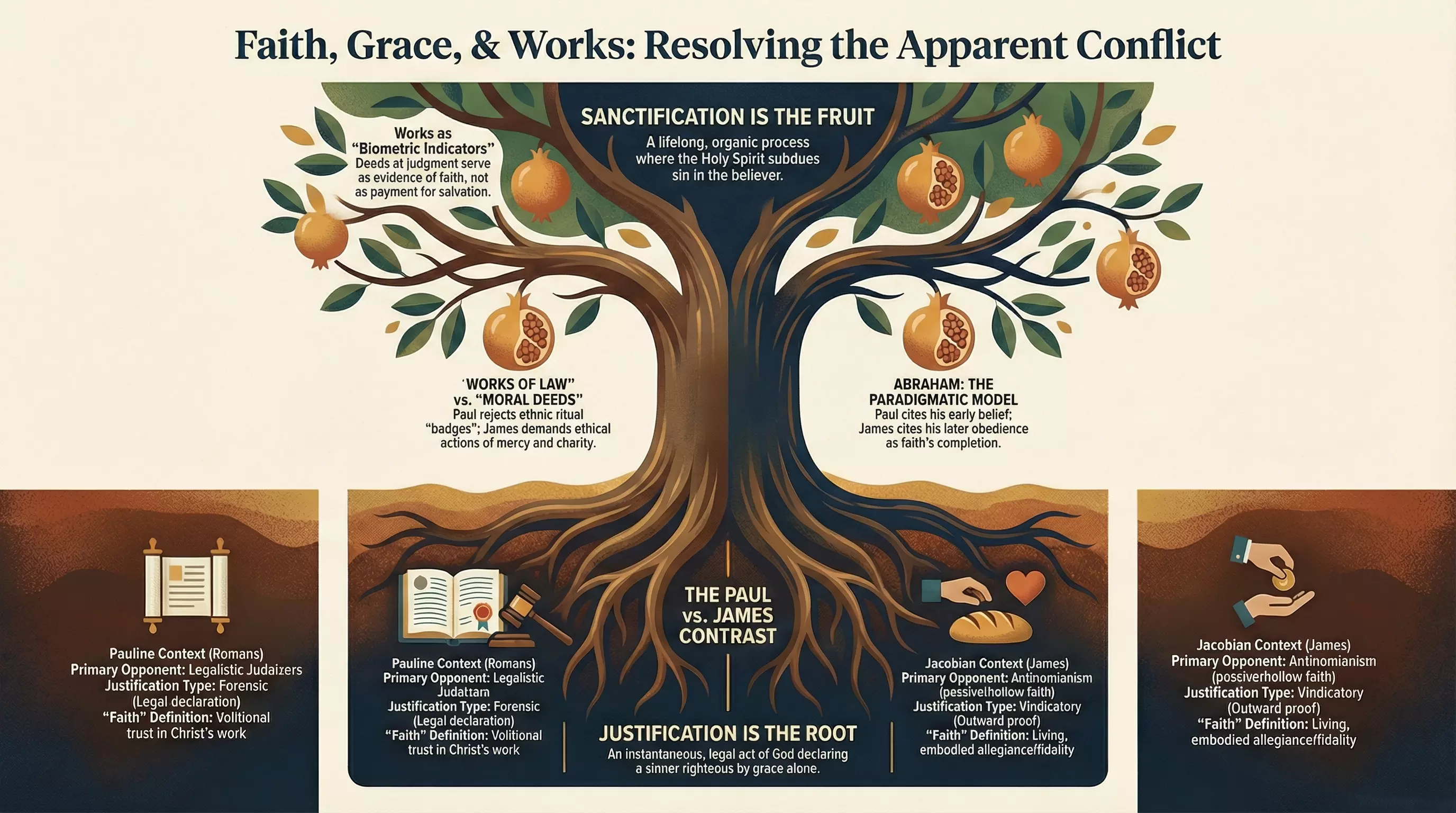
Paul and James are not contradicting each other. They are fighting on different fronts:
| Paul | James | |
|---|---|---|
| Error Addressed | Legalism (adding rituals as requirements) | Antinomianism (removing moral transformation) |
| “Works” in View | Ritual boundary markers | Moral fruit |
| ”Justification” Means | Forensic declaration of righteousness | Vindicatory demonstration of genuine faith |
| Concern | The ground of salvation | The evidence of salvation |
Paul defends the instrumental cause of justification: faith alone, not ethnic rituals. James defends the evidentiary fruit of justification: genuine faith transforms behavior. They are complementary, not contradictory.
The Synthesis of Abraham
Both Paul and James appeal to Abraham as their paradigm case. This is no accident—and examining how they use him resolves the apparent conflict.
Paul quotes Genesis 15:6: “Abraham believed God, and it was credited to him as righteousness” (Romans 4:3, Galatians 3:6). Paul emphasizes that this crediting of righteousness occurred before Abraham was circumcised (Genesis 17). Abraham was declared righteous on the basis of belief, not ritual performance. Therefore, Gentiles need not be circumcised to receive the same verdict.
James quotes the same verse (James 2:23)—but he situates it differently. He points to Genesis 22, where Abraham offered Isaac on the altar. “Was not Abraham our father justified by works when he offered up Isaac his son on the altar? You see that faith was working with his works, and as a result of the works, faith was perfected” (James 2:21-22).
James uses “justified” (dikaioō) in a demonstrative sense: Abraham’s faith was vindicated, shown to be genuine, brought to its intended completion (teleioō) through obedience. The initial crediting of righteousness (Genesis 15) was proven real by the subsequent obedience (Genesis 22).
Here is the synthesis: Abraham was justified by faith alone, but his faith was never alone. The faith that received the crediting of righteousness in Genesis 15 was the same faith that obeyed in Genesis 22. These are not two different faiths, or faith plus something else. They are one living pistis at different moments in its expression.
As the Reformers put it: Sola fide justificamur, sed fides non est sola—we are justified by faith alone, but the faith that justifies is never solitary. It is inherently pregnant with the moral transformation that James demands.
The Diagnostic Function of the Law
But what about Jesus? When the Rich Young Ruler asked “What must I do to inherit eternal life?” Jesus told him to keep the commandments (Matthew 19:17). When a lawyer asked the same question, Jesus affirmed that loving God and neighbor would lead to life: “Do this and you will live” (Luke 10:28).
Is Jesus teaching works-based salvation?
Not at all. He is using the Law diagnostically—as a mirror to expose sin and drive the sinner to grace.
The Rich Young Ruler (Matthew 19:16-26)
When Jesus told the ruler to keep the commandments, the man confidently replied, “All these things I have kept.” He genuinely believed he was righteous.
So Jesus prescribed a more invasive test: “If you wish to be complete, go and sell your possessions and give to the poor, and you will have treasure in heaven; and come, follow Me” (Matthew 19:21).
The man went away grieving, “for he was one who owned much property.”
Jesus was not teaching that selling possessions earns salvation. He was surgically exposing the man’s idolatry. The ruler had not kept the first commandment—he had another god before Yahweh. His wealth was his functional lord.
The diagnostic purpose becomes explicit in what follows. The disciples, astonished, ask, “Then who can be saved?” Jesus answers: “With people this is impossible, but with God all things are possible” (Matthew 19:26).
That is the point. With people this is impossible. The Law does not provide a ladder to climb; it reveals that we cannot climb at all. Its function is to crush self-righteousness and drive us to the only One who can save.
The Threefold Use of the Law
Reformed theology systematizes this insight through the “threefold use of the Law”:
First Use (Pedagogical): The Law functions as a schoolmaster (paidagogos) to lead sinners to Christ by exposing their inability to achieve righteousness through their own efforts (Galatians 3:24). This is what Jesus does with the Rich Young Ruler.
Second Use (Civil): The Law restrains outward sin in society, maintaining order even among the unregenerate. This is relevant to civil governance but not directly to soteriology.
Third Use (Didactic): For the regenerate believer, the Law provides guidance for grateful obedience. The Christian obeys not to be saved but because they are saved. The Law describes the shape of the transformed life.
When Jesus issues commands—keep the commandments, sell your possessions, love your neighbor—He is not contradicting grace. He is either diagnosing the sickness that grace must cure (first use) or describing the health that grace produces (third use).
The Final Judgment: Vindication, Not Justification
The most persistent tension remains: if we are justified by faith apart from works, why does Scripture repeatedly insist that judgment will be “according to deeds”?
The answer lies in distinguishing between justification and vindication.
Justification: The Present Reality
Justification is a forensic declaration. It occurs the moment a sinner trusts in Christ. At that instant, God declares the sinner righteous—not because they are righteous in themselves, but because the righteousness of Christ is imputed to their account.
This is a once-for-all legal verdict. “There is now no condemnation for those who are in Christ Jesus” (Romans 8:1). The believer has already “passed out of death into life” (John 5:24). Justification is not progressive; it is complete.
The basis of justification is the imputed righteousness of Christ, received through the empty hands of faith. Works are excluded as a ground. We contribute nothing.
Vindication: The Future Demonstration
The final judgment serves a different function. It is not the moment when God decides who is saved—that has already been determined. It is the moment when God demonstrates who was genuinely His all along.
Works at the judgment serve as evidence, not ground. They vindicate the profession of faith, proving it was genuine.
This is why the sheep in Matthew 25 are surprised by the commendation they receive: “Lord, when did we see You hungry, and feed You?” (Matthew 25:37). Their works were not calculated religious performances designed to earn merit. They were the unconscious, natural outflow of transformed hearts. They did not feed the hungry to be saved. They fed the hungry because they were saved—because the life of Christ within them inevitably expressed itself in compassion.
The judgment “according to deeds” does not threaten justification by faith. It confirms it. Works are the public evidence that faith was real.
Present Justification, Future Vindication
| Aspect | Justification | Vindication |
|---|---|---|
| Timing | Present (moment of faith) | Future (final judgment) |
| Nature | Forensic declaration | Public demonstration |
| Basis | Imputed righteousness of Christ | Evidence of genuine faith |
| Works’ Role | Excluded as ground | Included as proof |
| Function | Establishes legal standing | Confirms the standing was real |
Paul himself holds both together: “For we maintain that a man is justified by faith apart from works of the Law” (Romans 3:28)—justification, present, by faith. “Who will render to each person according to his deeds” (Romans 2:6)—vindication, future, by evidence. No contradiction. One gospel.
The Overcomer’s Identity
One final piece completes the picture. Revelation repeatedly promises blessing to those who “overcome” (nikōn): “He who overcomes will inherit these things” (Revelation 21:7).
Does this imply that only a special tier of super-Christians who achieve moral victory will be saved?
No. The identity of the overcomer is defined elsewhere: “For whatever is born of God overcomes the world; and this is the victory that has overcome the world—our faith. Who is the one who overcomes the world, but he who believes that Jesus is the Son of God?” (1 John 5:4-5).
The overcomer is not a second-class Christian who has achieved extraordinary works. The overcomer is anyone who believes. Overcoming is not an autonomous human achievement—it is the intrinsic nature of saving faith. Faith born of God overcomes because God preserves His own.
This is the doctrine of perseverance: not that believers save themselves by enduring, but that God keeps His own through every trial until the end. “Those whom He predestined, He also called; and those whom He called, He also justified; and those whom He justified, He also glorified” (Romans 8:30). The chain is unbroken. Every one of the predestined will be glorified.
The “endurance” passages (Matthew 24:13, Hebrews 3:14) describe the path of genuine believers, not a condition that genuine believers might fail to meet. Those who fall away prove they were never truly of us (1 John 2:19). The elect cannot be lost because their faith is sustained by the same God who granted it.
What the Gospel Actually Says
We can now state with precision what the Bible teaches about salvation:
Salvation is entirely by grace. Human beings are dead in sin and incapable of contributing to their own rescue. Even the faith by which we receive salvation is a gift of God, not a work we generate.
Salvation is received through faith alone. The instrumental cause of justification is pistis—not ritual, not moral achievement, not religious performance. Faith is the empty hand that receives what it cannot earn.
The faith that saves is never alone. Genuine pistis—biblical faith—is not bare intellectual assent but whole-person trust and allegiance. This kind of faith inevitably transforms. It produces moral fruit because new life in Christ cannot remain barren.
Works are the evidence of faith, not the ground of salvation. James and Paul agree: a faith that produces no transformation was never saving faith. Works demonstrate the reality of the inner change.
The final judgment vindicates what grace has done. We will be judged “according to deeds”—not to establish our standing, but to confirm it publicly. The works of the redeemed reveal the faith within.
There is no contradiction. There is a unified gospel proclaimed by prophets, by Jesus, by Paul, by James, and by John. Salvation is of the Lord from beginning to end. And those whom He saves, He transforms.
An Invitation to Examine the Evidence
If you have been told that the Bible contradicts itself on salvation—that Christianity cannot make up its mind whether faith or works is required—we invite you to look more closely.
The tension is real, but it is the tension of a symphony, not a cacophony. Faith and works are not competitors but partners: faith as the root, works as the fruit. Justification and judgment are not contradictions but two acts of one drama: the declaration of righteousness and its public vindication.
The gospel holds together. The 245 verses speak with one voice.
And that voice still asks the question that echoes through millennia: “What must I do to be saved?”
The answer remains what it has always been: “Believe in the Lord Jesus, and you will be saved.”
The faith that believes will be the faith that transforms. The grace that saves will be the grace that sanctifies. And the judgment that awaits will vindicate what mercy has already accomplished.
This is good news.
Explore the Full Contradictions Map
This article addressed Category 1 of the Skeptic’s Annotated Bible’s salvation verses. To explore the complete set of 245 passages and see how each category is resolved, visit the interactive contradictions map.
What questions do you have about faith, works, or the relationship between justification and judgment? Where does this framework help—or where do you see remaining tensions? We welcome thoughtful engagement.