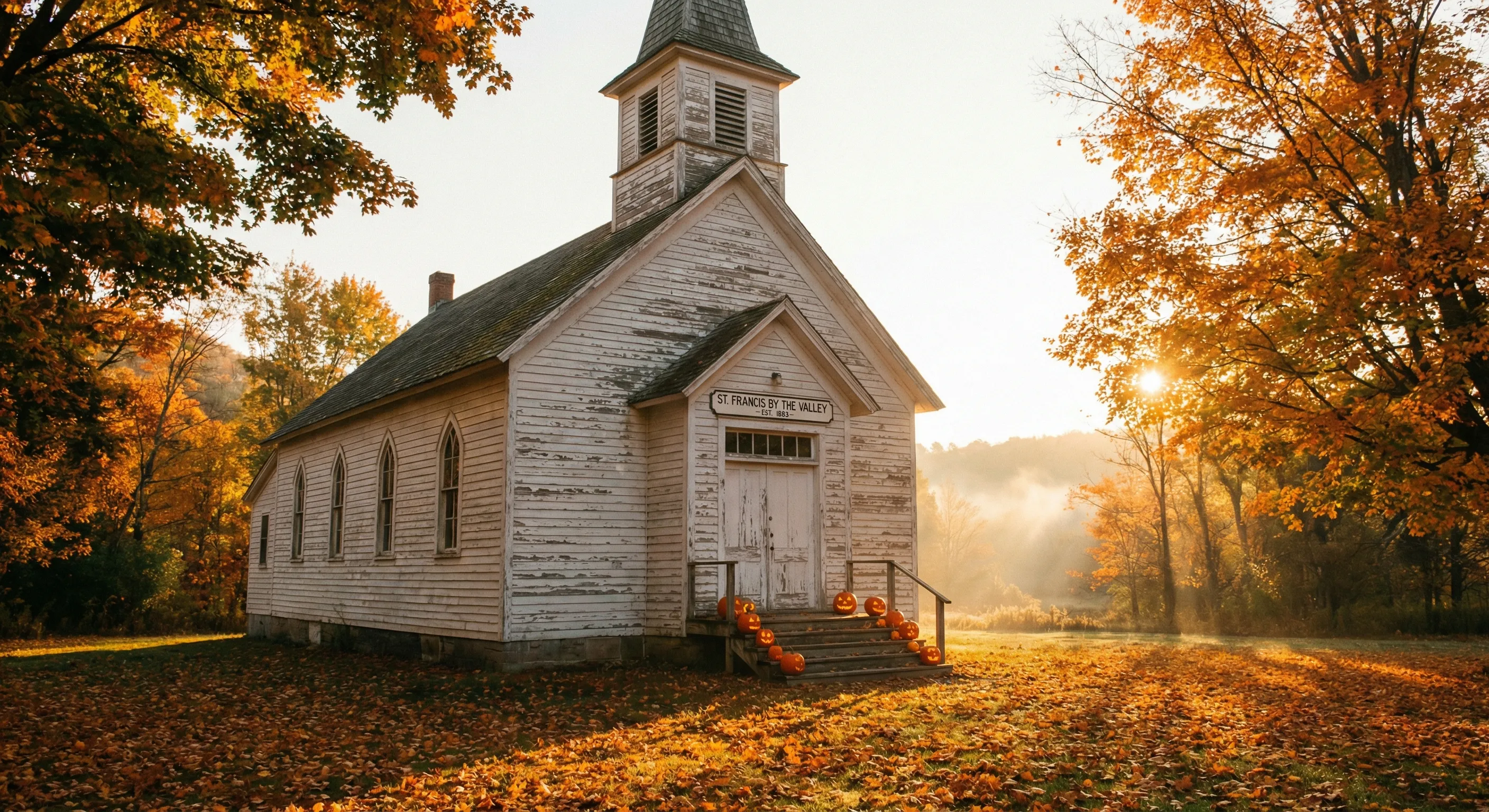
Halloween is a very interesting time of the year for me. Several years ago, I used to be very active at this time of the year, and Halloween was probably my favorite holiday. I looked forward to it pretty much from November 1 to October 31. I threw parties, decorated my house (both inside and out), created props and structures, and even played horror movies on a custom screen on my front window.
People that shared this passion could easily relate to this obsession. Of course, many people thought I was crazy and far too overboard into the holiday. Those same people I celebrated most with were a little surprised and confused when I essentially stopped celebrating Halloween completely.
I stopped decorating my house, stopped designing props, gave away all my props and decorations, and effectively paid little to no attention to the holiday at all. This change did not happen lightly or easily. I struggled with it and spent a great amount of time researching—and even more time in prayer.
Like any good immature sinner, I did what many have done when faced with a potential lifestyle change that may conflict with our beliefs: I tried to rationalize it. Initially, I tried (and tried hard) to balance my love for Halloween and my love for God so that I could still enjoy the holiday. But I hit some snags that proved to be massive stumbling blocks in my quest for a god of my own design.
1. The Holiday Origins
The history of Halloween is more complex than many realize, and I want to be careful to represent it accurately.
Halloween traces back to Samhain (pronounced “SAH-win”), a Gaelic word meaning “Summer’s End.” This was primarily a pastoral harvest festival marking the end of the lighter half of the year and the beginning of the darker half. It was a practical time—livestock were culled for winter survival, and communities prepared for the cold months ahead.
Bonfires played a large part in the festivities. Villagers were said to cast the bones of slaughtered cattle upon the flames. With the bonfire ablaze, all other fires were extinguished. Each family would then solemnly light its hearth from the common flame, bonding the village together. Often, two bonfires would be built side by side, and people would walk between them as a purification ritual.
There was also a spiritual dimension. It was believed that during this time the boundary between the living and the dead was thinnest. Some wore masks and costumes, and divination was practiced—consulting the dead for advice, an idea completely contrary to Scripture:
“Or one who casts a spell, or a medium, or a spiritist, or one who calls up the dead. For whoever does these things is detestable to the LORD…”
— Deuteronomy 18:11–12
The Christian Layer
The holiday of All Saints’ Day falls on November 1, followed by All Souls’ Day on November 2. These are observed in the Roman Catholic Church, Lutheran churches, and the Anglican Communion.
Interestingly, early churches in Ireland and Northumbria were already celebrating All Saints on November 1 before Rome officially mandated it in the 8th and 9th centuries. This suggests the date may have been an intentional attempt to sanctify the season rather than simply a pagan takeover.
What about trick-or-treating? Contrary to popular belief, the specific practice of going door-to-door has distinctly Christian medieval origins. During Allhallowtide (November 1–2), the poor would visit homes offering prayers for the dead in exchange for “soul cakes”—a practice called “Souling.” The modern phrase “trick or treat” itself was largely coined in the 1920s and 30s as a way to curb vandalism, not as a continuation of pagan worship.
Does Origin Determine Meaning?
Here I want to be fair to those who disagree with my conclusions. Some theologians argue that the origin of a practice does not permanently define its meaning—what they call avoiding the “genetic fallacy.” We use the names of days (Thursday = Thor’s Day) without worshipping Norse gods. A child dressed as Spider-Man has no intent to worship ancient Celtic spirits.
I understand this argument. But for me personally, the weight of the associations—and the broader cultural direction of the holiday—still posed a problem I couldn’t ignore. Your conscience may lead you differently, and that’s between you and God.
Ask yourself honestly: knowing what you now know, how does your participation in Halloween honor Christ?
2. Fear
A huge part of Halloween for me was fear. I loved it. I loved watching scary movies, creating terrifying effects, traumatizing children, creeping out teenagers, and especially parents. If you wanted candy, you had to earn it. My success was measured in screams and tears.
Reconciling that with the gospel presents a serious problem.
“There is no fear in love; but perfect love casts out fear…”
— 1 John 4:18
As Christians, we are called to exemplify Christ and His love. If our calling is to help people overcome fear through the perfect love of Christ, then we should be pointing them toward God—not amplifying fear.
“Fear not, for I am with you…”
— Isaiah 41:10
I had to ask myself: How are people coming to know my Savior by me doing this? The honest answer was—they weren’t.
A Different Perspective: Mockery
Some Reformed theologians offer a different take. They point to Colossians 2:15, where Christ “disarmed the rulers and authorities” and “put them to open shame.” In this Christus Victor view, because Satan is a defeated foe, Christians can mock the darkness rather than fear it. Dressing up as a “spook” isn’t honoring the devil—it’s jeering at an enemy who has been defanged by the Cross.
I can appreciate this perspective theologically. But for me, my Halloween participation wasn’t mockery—it was celebration. And the line between the two can be perilously thin.
3. Glorifying God
“Whether, then, you eat or drink or whatever you do, do all to the glory of God.”
— 1 Corinthians 10:31
“Everyone who is called by My name, whom I have created for My glory…”
— Isaiah 43:7
This was the final nail in the coffin (pun intended). We were created for God’s glory. I couldn’t answer the question:
How am I glorifying God by putting demons, ghosts, and zombies on my front lawn?
There was no good answer.
This is a question we should ask in everything we do. Many things can seem harmless or even good, but if they are not for His glory, we’ve missed the point. Halloween, as I practiced it, was neither good nor glorifying.
4. In This World, But Not of It
“Do not love the world nor the things in the world.”
— 1 John 2:15
“They are not of the world, even as I am not of the world.”
— John 17:14
This doesn’t mean Christians can’t participate in Halloween at all—but it does mean we should soberly examine our participation.
“Do not be conformed to this world, but be transformed by the renewing of your mind.”
— Romans 12:2
As our understanding of God grows, we begin to see former habits differently. Sanctification should touch every part of life—including how we approach holidays like Halloween.
Conclusion
So what do we do with Halloween? Christians differ on this, and I want to acknowledge the range of thoughtful, biblically-grounded positions:
“Everything is permissible—but not everything is beneficial.”
— 1 Corinthians 10:23
We are not bound to legalism. God judges the heart. We can approach Halloween differently—but we should seek to glorify God and exemplify Christ in all we do.
What Halloween Looks Like for Me Now
- I buy lots of candy and pre-bag it for easy distribution
- Each bag includes two gospel tracts (one for children, one for adults)
- I don’t decorate or dress up
- I want children to enjoy candy without fear
Tim Keller once noted that Halloween is the only time of year when the American social contract of privacy is suspended—neighbors voluntarily knock on your door. That makes it a powerful opportunity for hospitality and sharing the gospel. Being the most generous house on the block can itself be a parable of God’s grace.
An Alternative: Reformation Day
It’s worth remembering that October 31 is also Reformation Day—the anniversary of Martin Luther nailing the Ninety-Five Theses to the church door in Wittenberg in 1517. Many Reformed families now celebrate this instead, hosting Reformation parties where children dress as Reformers and learn church history. It’s one way to redeem the date with explicitly Christian content.
I don’t believe Christians need to hide from the world, but I do believe we should act with discernment and grace—and avoid judging fellow believers over how they handle this holiday.
“And this I pray, that your love may abound still more and more…”
— Philippians 1:9–11