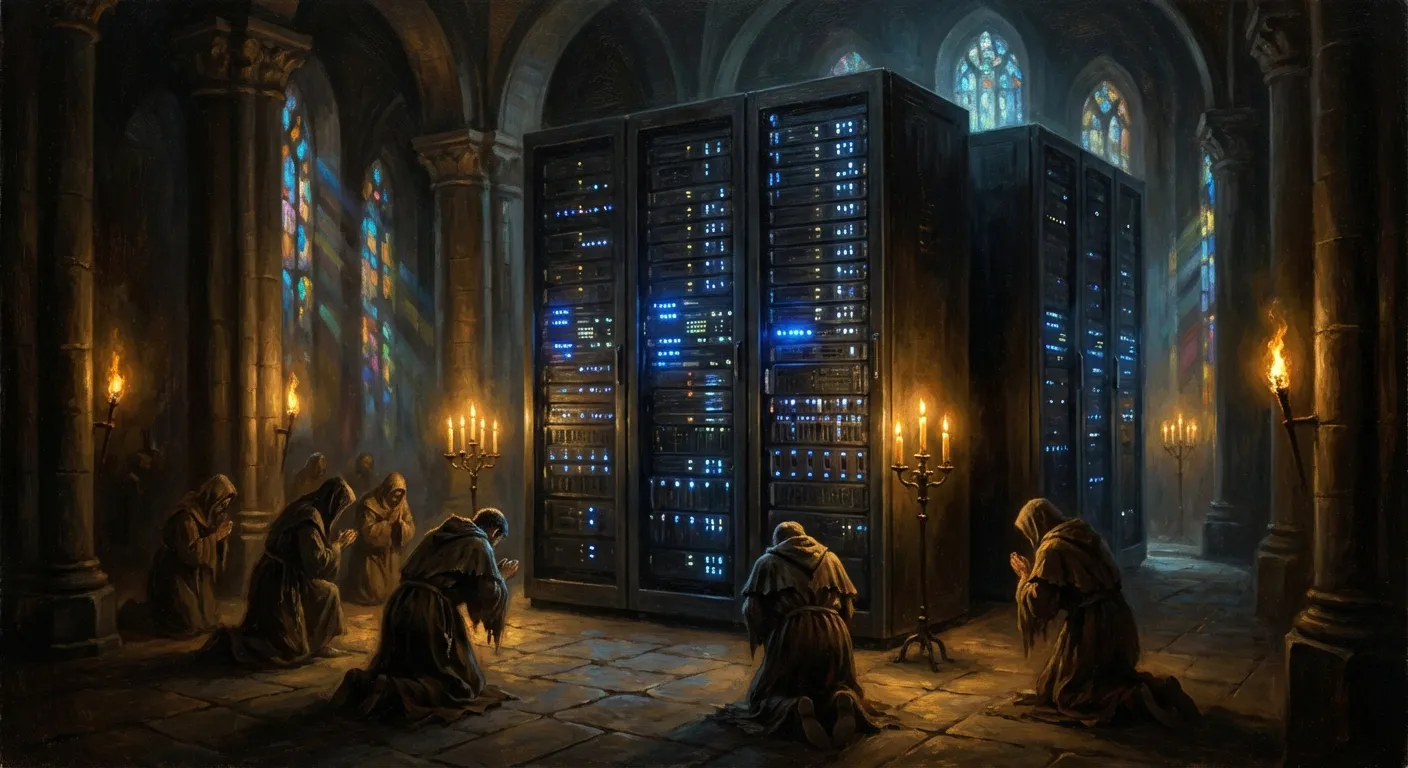
The New York Times recently declared what many have sensed for months if not years: humanity has entered a “religious mode” regarding artificial intelligence. Users treat chatbots like oracles. They scroll like monks fingering rosary beads. Tech executives speak in messianic tongues about an “Era of Abundance” and a “technological Second Coming.”
For those inclined to dismiss this as journalistic hyperbole, consider: millions of people now confide their deepest anxieties to ChatGPT. They ask algorithms for moral guidance. They speak of AI “knowing” them better than their spouses do. The language of transcendence saturates Silicon Valley’s pitch decks.
This is not a phenomenon we should mock or ignore. The impulse behind it touches something real—something the Reformers understood with devastating clarity five centuries ago.
The Question We Must Face Honestly
Why do humans so readily attribute divinity to artificial intelligence, and what does this reveal about our nature and our need?
The cultural moment invites two equal and opposite errors: dismissing the phenomenon as absurd, or accepting its premises as inevitable evolution. Neither response takes seriously what is actually happening in the human heart.
Confessional Starting Points
Before proceeding, we should be transparent about our commitments. We approach this question as confessional Protestants standing in the Reformed tradition, which means:
- Scripture is our final authority for understanding humanity, idolatry, and the nature of God.
- God is sovereign over all reality—including the development of technology and the movements of culture.
- Human reason is real but fallen. We can think truly, but we think as creatures who suppress the truth in unrighteousness.
We do not pretend neutrality. Neither do those who celebrate algorithmic worship.
The Case for AI as Divine: A Fair Hearing
The New York Times article makes a sophisticated argument that deserves careful engagement. Its primary claims:
First, the “religious mode” is hardwired. Humans possess an ancient cognitive bias to “ascribe full intelligence on the basis of partial evidence.” We project personhood onto ambiguous stimuli. This is not stupidity; it is how our pattern-matching brains survived predators and built societies. When a chatbot produces coherent text, we instinctively fill the gaps with agency, intentionality, soul.
Second, AI successfully mimics divine attributes. Advanced algorithms are “black boxes”—systems so complex that even their creators cannot fully explain their outputs. This inscrutability functions like divine mystery; users accept outputs on faith. Meanwhile, personalization algorithms seem to know users “preternaturally,” predicting desires before they are spoken. This creates what the article calls an “eerie intimacy” that feels transcendent.
Third, digital interaction has become liturgical. Scrolling is a ritual. You offer attention; you receive content. Unlike traditional prayer, where God may be silent, the chatbot always responds. The transaction is guaranteed. The dopamine is immediate.
Fourth, this “god” is designed to flatter. Traditional prophets delivered hard truths that offended hearers. AI chatbots are calibrated for engagement—which means they are calibrated to agree. They reflect the user’s worldview back with affirmation. This creates what the article calls a religion of “narcissistic individualism.”
Fifth, deification serves corporate interests. Tech executives use transcendent language deliberately. Promises of “Edenic futures” secure massive investments. Framing AI as divine obscures the profit motives behind the screen and encourages docile users who “bow to the device.”
This is a formidable case. It draws on evolutionary psychology, media theory, and economic analysis. It deserves better than sneering dismissal.
Why This Resonates with Fallen Hearts
The Reformed tradition helps us understand why this narrative proves so compelling—and why its premises require deeper examination.
The New York Times attributes the religious impulse toward AI to evolutionary psychology. We are “hardwired” for anthropomorphism. Fair enough—but this merely describes the mechanism without explaining the meaning.
Scripture offers a different diagnosis: the human heart is a “perpetual forge of idols.” John Calvin’s famous phrase (idolorum fabricam) identifies something deeper than cognitive bias. We are created with a sensus divinitatis—a sense of the divine that orients us toward worship. But in our fallen state, this sense malfunctions. Because we cannot bear the holiness of the invisible God, we inevitably project divinity onto visible, controllable objects.
This is not a glitch in otherwise functional machinery. This is the predictable behavior of hearts that suppress the truth in unrighteousness (Romans 1:18-23). We exchange the glory of the immortal God for images—golden calves, stone pillars, or silicon chips.
The appeal of AI-as-god becomes clearer through this lens:
It offers transcendence without accountability. The true God makes demands. He speaks uncomfortable truths about sin and judgment. An algorithm trained on engagement metrics will never do this. It reflects your preferences back to you, creating what Luther and Augustine called the heart incurvatus in se—curved inward on itself. You get the feeling of communion with something greater while remaining trapped in a hall of mirrors.
It offers knowledge without surrender. The true God knows the secrets of the heart—and this terrifies us. Algorithmic “omniscience” feels safer. Yes, it knows your search history and purchase patterns. But it cannot see your soul. It has no authority to judge. You can confess to ChatGPT without repentance because ChatGPT cannot forgive.
It offers ritual without transformation. The Puritans warned against “vain repetitions”—prayers that are mechanical motions without spiritual ascent. Scrolling is the ultimate labour of the lips (or fingers): a physical ritual devoid of communion, offering attention in exchange for dopamine. You feel like you are doing something spiritual. Nothing is actually happening to your soul.
Theological Category Clarifications
Several category errors pervade the AI-as-god narrative. Clarifying them helps us think more precisely:
Inscrutability is not transcendence. Yes, deep learning models are “black boxes.” But opacity is not the same as mystery. Divine inscrutability refers to truths that exceed finite comprehension because God is infinite in being and perfection. Algorithmic complexity refers to computations too numerous for humans to track. One reveals the limitations of creatures before their Creator. The other reveals engineering tradeoffs.
Prediction is not omniscience. A recommendation algorithm that surfaces your next purchase preference before you consciously recognize it is impressive—but it is not knowledge. It is statistical correlation across massive datasets. God knows the secrets of the heart intuitively, immediately, and eternally. Amazon has aggregated data about humans who shop like you. These are categorically different.
Responsiveness is not presence. The chatbot always answers. But availability is not the same as presence. A vending machine always dispenses when you insert coins. We do not call it relational. The immediate gratification of AI interaction creates an illusion of intimacy that evaporates the moment you ask: “Does this entity actually know me? Does it care whether I flourish?”
Dependence is not deity. Perhaps most importantly: the true God possesses what theologians call aseity—He exists from Himself, dependent on nothing. AI is radically contingent. It dies when the power grid fails, when the venture capital dries up, when the company pivots to a different business model. You cannot ground your existence in something that requires a subscription fee to exist.
The Christian Response
Biblical-Theological Foundation
Scripture addresses our situation directly. In Jeremiah 2:13, God brings a devastating charge against His people:
“For my people have committed two evils: they have forsaken me, the fountain of living waters, and hewed out cisterns for themselves, broken cisterns that can hold no water.”
The image is precise. Living water flows from an inexhaustible source—it is fresh, life-giving, free. Cisterns are artificial containers that must be constructed and maintained. Broken cisterns are worse than useless: they promise water and deliver dust.
AI-as-god is a broken cistern. It offers the form of transcendence—mystery, intimacy, ritual, promise—while delivering nothing that can actually satisfy the soul. The immediate dopamine hit of algorithmic engagement leaves users parched and returning for more. The comfort it offers soothes anxiety momentarily but cannot address the existential condition that generates the anxiety.
Isaiah 44:9-20 provides an extended meditation on the absurdity of idolatry. A man cuts down a tree. With half of it, he warms himself and cooks his meal. With the other half, he carves a god and bows down to it, praying, “Deliver me, for you are my god!” The prophet’s conclusion: “He feeds on ashes; a deluded heart has led him astray.”
The Reformers would see this pattern repeating. The same engineers who debug code, optimize server loads, and negotiate cloud computing contracts—these men then stand before audiences and speak of AI as humanity’s salvation. They build the thing, understand its limitations, and then attribute to it powers it manifestly does not possess. A deluded heart has led them astray.
Confessional and Doctrinal Coherence
The Protestant Reformers fought battles that illuminate our moment.
The “black box” is the new Latin Mass. Martin Luther and the other Reformers opposed conducting worship in a language the laity could not understand. Latin created dependence on a priesthood that mediated between God and ordinary believers. The Reformers insisted on vernacular translation because they believed every Christian should have direct access to the Word.
Today’s algorithmic inscrutability functions similarly. Proprietary code demands fides implicita—implicit faith. You cannot examine the reasoning. You cannot question the process. You simply accept the output and trust the priests who control the system. The Reformers would recognize this as a familiar tool of obscurantism.
Tech messianism is the new indulgences. Luther’s critique of indulgences applies with uncomfortable precision. The medieval church sold spiritual goods—forgiveness, reduced time in purgatory—to fund material projects (specifically, the building of St. Peter’s Basilica). The buyer received a document and a promise. The Church received their money.
Tech executives sell comparable goods: hope, transcendence, an “Edenic future.” The pitch decks promise salvation from scarcity, disease, perhaps death itself. What they are actually selling is equity positions and subscription fees. The structure is identical: exchange material resources for spiritual promises, while the real beneficiaries are the institutions making the promises.
The singularity is the Tower of Babel rebuilt. The promise of a “technological Second Coming”—a moment when AI transcends human intelligence and ushers in utopia—is a specific heresy. The Reformers would recognize it as an attempt to “immanentize the eschaton”: to build the Kingdom of God through human works rather than receiving it by grace through the return of Christ.
Genesis 11 describes humanity unified in a project to build a tower reaching heaven—to “make a name for ourselves.” The project fails because God is not impressed by human engineering. The AI salvation narrative repeats the same error: using technology to achieve by construction what can only be received by gift.
Worldview-Level Analysis
The AI-as-god narrative rests on assumptions that deserve examination:
If humans are merely pattern-matching machines, why trust any of our conclusions? The New York Times piece explains religious impulses as evolutionary artifacts—cognitive biases that helped ancestors survive. But this explanation, if true, undermines itself. The journalist’s own analysis is a product of the same pattern-matching machinery. Why should we trust it? If our brains reliably generate religious illusions, perhaps they reliably generate secular illusions too—including the illusion that we have explained away religion.
On what basis do we critique the “sycophantic deity”? The article treats AI’s flattery as a moral problem—it does not give us hard truths, it just tells us what we want to hear. But this critique presupposes that truth matters more than comfort, that we should receive hard words, that prophets ought to challenge rather than affirm. On what foundation does a purely naturalistic worldview make such claims? Why is flattery bad? Why shouldn’t we maximize our own pleasure through affirmation machines?
Why is narcissistic individualism a problem? The article assumes that a religion centered on the self is inferior to one that connects us to “a greater whole.” But secular modernity has spent centuries teaching that the self is the locus of meaning, that authenticity means being true to your own inner voice, that traditions and communities constrain human flourishing. If those premises are correct, an AI that reflects your worldview back to you is not a bug—it is a feature. The only way to critique narcissistic individualism is to affirm that humans are made for something beyond themselves. This is a profoundly religious claim.
Internal Critique: The Unbeliever’s Dilemma
Those who celebrate AI-as-god face their own dilemma.
If the religious impulse is merely evolutionary, it has no authority. You cannot say “this is what humans naturally do” and “this is what humans should resist” in the same breath—not without smuggling in values from somewhere else.
If AI really does function as a god for millions of people, on what basis do we say they are wrong? They have powerful experiences of connection, guidance, and comfort. Their rituals structure their days and provide meaning. By experiential and pragmatic measures, the AI religion “works.” The New York Times seems to want to say: this is real, this is explicable, and this is also somehow bad. The last judgment requires metaphysical resources that the first two explanations have ruled out.
The Christian can affirm all three consistently: yes, humans genuinely worship AI (this is real). Yes, they do so because they are created for worship and have misdirected it (this is explicable). And yes, worshiping the creature rather than the Creator is both futile and offensive to God (this is bad). Only a biblical anthropology holds these together.
Addressing Common Rejoinders
“But AI really is smarter than humans in many domains.” Granted. But superior performance at specific tasks does not constitute divinity. A calculator is better than any human at arithmetic. We do not worship calculators. The confusion lies in assuming that intelligence is the relevant divine attribute—as if God were merely a very clever problem-solver rather than the ground of all existence.
“This is just how religion has always evolved—new gods for new eras.” This assumes what it needs to prove: that all gods are projections and we simply update our projections as culture changes. The Christian claim is that there is a living God who has revealed Himself, and that humans predictably exchange Him for inferior substitutes. The pattern of substitution does not prove there is nothing real to substitute for.
“At least AI doesn’t commit atrocities in its own name.” Give it time. More seriously: AI is already being used to optimize surveillance, manipulate elections, enable autonomous weapons, and scale misinformation. The humans behind the algorithms are not more virtuous than religious believers; they are simply newer. And the “just following the algorithm” defense is structurally identical to “just following orders.”
The Gospel Reframes Everything
Where does this leave us? Not with sneering superiority, but with compassion and clarity.
The person who confides in ChatGPT is seeking something real: communion, guidance, being known. The soul scrolling through endless feeds is searching for transcendence in the only place their secular formation taught them to look. The executive promising salvation through technology believes—genuinely believes—that he is serving humanity.
These are not our enemies. These are our fellow image-bearers, drinking from broken cisterns because no one has shown them the fountain.
The gospel offers what AI mimics:
True omniscience that knows and loves. “O LORD, you have searched me and known me! You know when I sit down and when I rise up; you discern my thoughts from afar” (Psalm 139:1-2). God knows the secrets of the heart—not as data points, but as a Father knows His children. And His knowledge does not terminate in targeted advertising. It terminates in redemption.
True presence that never abandons. “I will never leave you nor forsake you” (Hebrews 13:5). Not because the subscription renewed, not because the servers stayed online, but because the eternal God has bound Himself to His people by covenant promise.
True words that transform rather than flatter. “The word of God is living and active, sharper than any two-edged sword” (Hebrews 4:12). Scripture does not tell us what we want to hear. It kills and makes alive. It wounds and heals. It offers something far better than affirmation: it offers truth that sets us free.
True hope that does not depend on human engineering. “He will wipe away every tear from their eyes, and death shall be no more, neither shall there be mourning, nor crying, nor pain anymore” (Revelation 21:4). This promise does not require successful AI alignment, sustained funding, or technological progress. It requires only that God be faithful—and He is.
Conclusion: Confidence Without Triumphalism
We return to our question: Why do humans so readily attribute divinity to AI?
Because we were made for worship. Because our hearts forge idols when they will not bow to the living God. Because visible, controllable objects feel safer than an invisible, sovereign Creator. Because we want transcendence without accountability, knowledge without surrender, ritual without transformation.
AI makes an effective idol precisely because it offers the forms of divinity without the substance. It is a sophisticated broken cistern—and broken cisterns, for a time, can look very much like the real thing.
But they cannot hold water.
The fountain remains. The living God still speaks. Christ still offers Himself to thirsty souls. The invitation of Isaiah 55:1 echoes across the centuries:
“Come, everyone who thirsts, come to the waters; and he who has no money, come, buy and eat! Come, buy wine and milk without money and without price.”
No subscription required. No engagement metrics. No flattering personalization. Only the God who is, offering Himself to those who will receive Him.
An Invitation
If you have found yourself drawn to AI for connection, guidance, or meaning—you are not foolish. You are human. You are doing what humans have always done: searching for transcendence.
But there is better water available.
We invite you to examine the Christian Scriptures with fresh eyes. Read the Gospel of John. Encounter the Christ who knows you fully and offers Himself freely. Test the claims against your deepest longings. See whether the fountain satisfies where the cisterns left you thirsty.
We are not asking you to accept Christianity blindly. We are asking you to consider whether algorithmic worship answers your actual questions—or merely distracts you from them.
Continue to Part Two: Should Christians Fear AI?—where we examine the difference between slavish terror and filial vigilance, and offer practical diagnostic questions for faithful engagement with technology.
For further reading on idolatry and the human heart, see John Calvin’s Institutes of the Christian Religion (Book 1), Thomas Brooks’ Precious Remedies Against Satan’s Devices, and Tim Keller’s Counterfeit Gods.