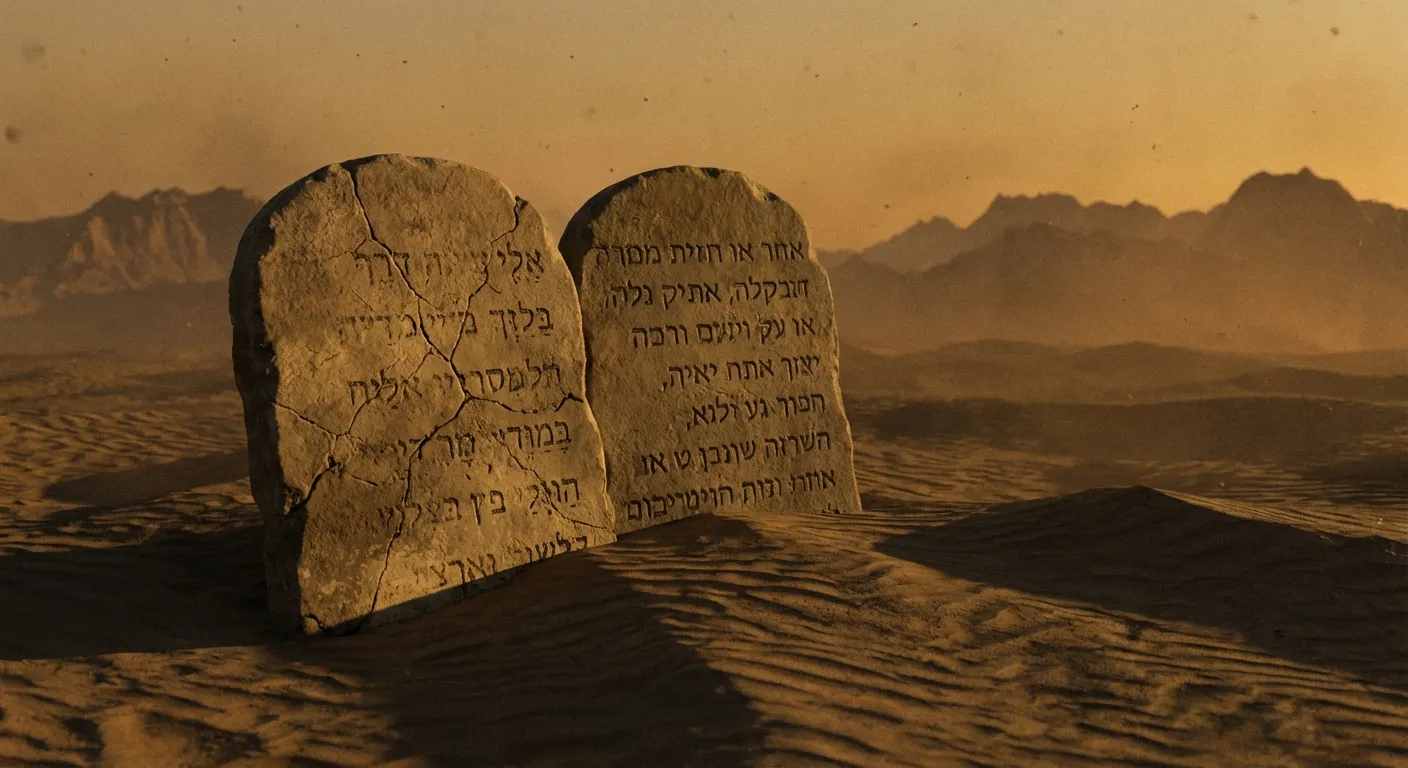
Of all the claims made by Islamic apologists regarding Muhammad in the Bible, none is more central than the appeal to Deuteronomy 18:18. Here God promises Moses: “I will raise them up a Prophet from among their brethren, like unto thee, and will put my words in his mouth; and he shall speak unto them all that I shall command him.”
Ahmed Deedat builds much of his case on this single verse, arguing that the prophecy cannot refer to Jesus but must refer to Muhammad. In this installment of our series examining Deedat’s claims, we will subject this argument to careful scrutiny—examining his interpretation of “brethren,” his criteria for “likeness,” and his theory of the prophetic “mouthpiece.”
The Central Question
Does Deuteronomy 18:18 prophesy Muhammad, as Deedat claims, or does it point to Jesus Christ?
This is not a peripheral question. The interpretation of this prophecy touches on fundamental issues of biblical hermeneutics, the nature of prophetic fulfillment, and the identity of the Messiah. Deedat understands the stakes: if he can establish Muhammad as the fulfillment of this foundational Old Testament prophecy, he significantly advances his broader claim that the Bible, properly understood, predicts and validates Islam.
Our Interpretive Framework
We approach this text with the conviction that Scripture interprets Scripture. The meaning of any passage must be determined by its immediate context, its broader canonical context, and the grammatical-historical method that seeks to understand what the original author intended and what the original audience understood. We believe God is sovereign over His Word and has preserved it for our instruction. These commitments are not obstacles to honest inquiry but the conditions for coherent interpretation.
Deedat’s Argument in Full Strength
Deedat’s case rests on three pillars, each of which deserves careful statement before we evaluate it.
Pillar One: “Brethren” Means Ishmaelites
Deedat argues that the phrase “from among their brethren” refers not to fellow Israelites but to the Ishmaelites—the descendants of Ishmael, Abraham’s firstborn son through Hagar. Since Ishmael was the half-brother of Isaac, Deedat contends that Ishmael’s descendants (the Arabs) are the “brethren” of Israel. He further argues that if God had intended an Israelite prophet, the text would say “from among yourselves” rather than “from among their brethren.”
Pillar Two: Muhammad Is “Like” Moses
Deedat presents an extensive list of parallels between Moses and Muhammad, arguing that these similarities identify Muhammad as the prophetic fulfillment:
- Both had natural births (unlike Jesus’s virgin birth)
- Both married and had children
- Both wielded political and military authority
- Both brought comprehensive legal codes
- Both died natural deaths and were buried
By contrast, Deedat argues that Jesus’s miraculous conception, celibacy, lack of political rule, crucifixion, and resurrection make Him fundamentally unlike Moses and therefore disqualified from being the promised prophet.
Pillar Three: The “Mouthpiece” Mechanism
Deedat focuses on the phrase “I will put my words in his mouth” and interprets this as predicting mechanical verbal dictation. He describes Muhammad as a “mouthpiece” or even a “head computer” who received direct verbal commands from God through Gabriel and simply transmitted them. As evidence, he points to the Qur’anic imperative Qul (“Say”), which appears hundreds of times in the Qur’an as a command to Muhammad to recite specific words.
Deedat contrasts this with the Christian understanding of biblical inspiration, where human authors utilized their intellects, personalities, and writing styles. He argues that the prophets of the Bible, including Jesus, spoke their own thoughts, while Muhammad alone fulfilled the “words in his mouth” requirement through passive verbal reception.
Why This Argument Appeals
Before we examine the evidence, we should acknowledge why Deedat’s argument carries persuasive force for many hearers.
The genealogical argument appeals to a surface reading of the text. Ishmael was Abraham’s son, and his descendants were called “brethren” of Isaac’s descendants in some Old Testament contexts. The argument feels plausible if one does not examine the legal and covenantal use of “brethren” within Deuteronomy itself.
The “likeness” argument appeals to concrete, measurable categories. We can count marriages, battles, and burial sites. Deedat’s list of parallels is impressively long and appears systematic. It satisfies our desire for empirical verification.
The “mouthpiece” argument appeals to Muslim assumptions about revelation. If you already believe that the Qur’an was verbally dictated and that prophetic inspiration should work through passive reception, then Deedat’s reading of Deuteronomy 18:18 will seem obvious. The argument is most convincing to those who already share its premises.
Examining the “Brethren” Claim
Deedat’s genealogical argument fails when examined against the immediate context of Deuteronomy itself.
The Legal Definition of “Brethren”
Just one chapter earlier, in Deuteronomy 17:15, God gives Israel instructions for selecting a king: “One from among thy brethren shalt thou set king over thee: thou mayest not set a stranger over thee, which is not thy brother.”
This verse establishes a legal binary that is fatal to Deedat’s interpretation. The text contrasts “brethren” with “stranger” (Hebrew: nokri, meaning foreigner). If Deedat’s reading were correct—if Ishmaelites counted as “brethren”—then Israel would have been permitted to appoint an Ishmaelite or Arab king. But no serious reader of Israelite history can maintain this position. The law explicitly restricted kingship to Israelites, and the term “brethren” in this legal context meant fellow members of the covenant community.
The same usage appears in the immediate context of the prophecy itself. Deuteronomy 18:2 states that the Levites “shall have no inheritance among their brethren.” Here “brethren” unambiguously refers to the other eleven tribes of Israel who received territorial allotments—not to Ishmaelites, Edomites, or other descendants of Abraham through other lines.
The Geographical Qualifier
Deedat frequently omits a crucial parallel phrase. Deuteronomy 18:15 states: “The Lord thy God will raise up unto thee a Prophet from the midst of thee, of thy brethren, like unto me.”
The Hebrew phrase miqqirbeka (“from your midst” or “from within you”) provides a geographical constraint that decisively excludes a prophet arising from distant Arabia. The prophet would come from within Israel’s own community, not from Mecca or Medina.
When we read “from among their brethren” in verse 18, the phrase “from the midst of thee” in verse 15 provides the interpretive key. The prophet will be an Israelite, arising from within Israel, belonging to the covenant community.
Examining the “Likeness” Claim
Deedat’s list of biographical parallels between Moses and Muhammad is perhaps his most rhetorically effective argument. But it suffers from a fundamental methodological flaw: it defines “likeness” by biological and sociological categories rather than by the biblical criteria for prophetic uniqueness.
What Made Moses Unique?
Scripture itself defines what set Moses apart from all other prophets. Deuteronomy 34:10-12 provides the authoritative standard:
“And there arose not a prophet since in Israel like unto Moses, whom the Lord knew face to face, in all the signs and the wonders, which the Lord sent him to do in the land of Egypt to Pharaoh, and to all his servants, and to all his land, and in all that mighty hand, and in all the great terror which Moses shewed in the sight of all Israel.”
Two criteria emerge as definitive of Moses’s prophetic uniqueness:
First: “Face to face” communion with God. Moses enjoyed direct, unmediated communication with the Lord. Numbers 12:6-8 elaborates: “If there be a prophet among you, I the Lord will make myself known unto him in a vision, and will speak unto him in a dream. My servant Moses is not so, who is faithful in all mine house. With him will I speak mouth to mouth, even apparently, and not in dark speeches.”
How does Muhammad measure against this criterion? By Islamic testimony, Muhammad received his revelations through the angel Gabriel (Jibril), not through direct communion with God. The mediation of Gabriel is central to Islamic accounts of Qur’anic revelation. Muhammad did not speak with God “face to face” or “mouth to mouth.”
How does Jesus measure? Jesus claimed unique, direct knowledge of the Father: “No one knows the Son except the Father, and no one knows the Father except the Son and anyone to whom the Son chooses to reveal him” (Matthew 11:27). Jesus explicitly claimed what Muhammad did not: unmediated intimacy with God.
Second: Public signs and wonders. Moses performed dramatic, visible miracles that authenticated his prophetic office—the plagues of Egypt, the parting of the Red Sea, water from the rock, manna from heaven.
How does Muhammad measure? Remarkably, the Qur’an itself records Muhammad’s denial of miraculous signs. When challenged to perform miracles like previous prophets, Muhammad responded that his only miracle was the Qur’an itself (Surah 17:90-93, 29:50). Whatever one makes of later hadiths, the Qur’an does not present Muhammad as a worker of Mosaic-style signs and wonders.
How does Jesus measure? The Gospels record a ministry saturated with miraculous signs: healings, exorcisms, control over nature, and ultimately resurrection from the dead. The parallel with Moses is unmistakable.
The Problem with Biological Parallelism
Deedat’s criteria—natural birth, marriage, political rule, natural death—describe the common human condition, not prophetic uniqueness. By these standards, countless figures throughout history would qualify as “like Moses.” David married and wielded political power. Elijah brought divine commands. Joshua led military campaigns. The criteria prove too much.
The biblical text does not define Moses’s uniqueness by marriage, children, or burial practices. It defines his uniqueness by his relationship with God and his miraculous authentication. When we apply the biblical criteria, Jesus emerges as the fulfillment and Muhammad does not.
Examining the “Mouthpiece” Claim
Deedat’s argument about “I will put my words in his mouth” requires us to understand this phrase as describing mechanical verbal dictation—words literally inserted into the prophet’s mouth for passive transmission. He then argues that the Qur’anic formula Qul (“Say”) demonstrates this mechanism in action.
A Standard Hebrew Idiom
The phrase “put words in his mouth” is a Hebrew idiom for prophetic authorization, not a description of dictation mechanics. The same language appears elsewhere:
- Jeremiah 1:9: “Then the Lord put forth his hand, and touched my mouth. And the Lord said unto me, Behold, I have put my words in thy mouth.”
- Exodus 4:15: God says to Moses regarding Aaron, “And thou shalt speak unto him, and put words in his mouth.”
If Deedat’s interpretation were correct—if this phrase uniquely identified the “Prophet like Moses” through mechanical dictation—then Jeremiah and Aaron would also be candidates for that role. But they are not, which demonstrates that the phrase describes authorization and accuracy, not the mechanics of word-for-word audio transmission.
Jesus’s Own Testimony
Deedat claims that Jesus spoke His own thoughts rather than words “put in His mouth” by God. But Jesus explicitly claims exactly what Deuteronomy 18:18 requires:
“For I have not spoken of myself; but the Father which sent me, he gave me a commandment, what I should say, and what I should speak” (John 12:49).
“The words that I speak unto you I speak not of myself: but the Father that dwelleth in me, he doeth the works” (John 14:10).
Jesus affirms that He speaks only what the Father commands—precisely the relationship described in Deuteronomy 18:18. The prophecy does not require the prophet to preface every utterance with the word “Say.” It requires fidelity to God’s message, which Jesus claims absolutely.
The Circularity of the Qul Argument
Deedat’s argument is ultimately circular. He interprets Deuteronomy 18:18 through Qur’anic categories, then presents the Qur’an as fulfilling his interpretation. But the Deuteronomy text says nothing about a specific syntactic formula. The requirement is that the prophet “shall speak unto them all that I shall command him”—a requirement of content fidelity, not stylistic format.
The Mediatorial Role
Beyond the specific criteria discussed, Moses served a profound theological function: he mediated the Old Covenant between God and Israel. At Sinai, Moses received the Law, sprinkled the blood of the covenant on the people, and stood between a holy God and a sinful nation.
The “Prophet like Moses” would not merely share biographical details with Moses. He would fulfill Moses’s mediatorial role in an ultimate way. He would establish a new covenant between God and humanity.
Muhammad claimed to restore the original faith of Abraham and to correct Jewish and Christian corruptions. He did not claim to mediate a blood covenant. Jesus, at the Last Supper, declared: “This cup is the new covenant in my blood” (Luke 22:20). Jesus fulfills the functional, theological role of Moses as covenant mediator and deliverer—not merely from political oppression (Egypt) but from the bondage of sin itself.
The Apostolic Interpretation
We are not left to speculate about how the earliest Christians—Jews who knew their Scriptures intimately—understood Deuteronomy 18:18. The Book of Acts records their interpretation explicitly.
Peter, preaching in the temple, declares: “For Moses truly said unto the fathers, A prophet shall the Lord your God raise up unto you of your brethren, like unto me; him shall ye hear in all things whatsoever he shall say unto you” (Acts 3:22). Peter applies this prophecy directly to Jesus, whom he has just proclaimed as risen from the dead.
Stephen, in his defense before the Sanhedrin, cites the same prophecy and clearly understands it as pointing to Christ (Acts 7:37).
These Jewish Christians, steeped in the Hebrew Scriptures and the oral traditions of interpretation, saw in Jesus the fulfillment of Moses’s words. Their testimony carries weight precisely because they had no motive to misread their own Scriptures—indeed, their interpretation cost them their lives.
Addressing Anticipated Objections
“But the prophecy says the prophet would be ‘like’ Moses—and Jesus is God, which makes Him unlike any human prophet.”
This objection misunderstands the nature of prophetic typology. Types are not identical to their fulfillments; they anticipate and point toward something greater. Moses was a great prophet; Jesus is the Prophet. Moses mediated a covenant; Jesus mediates a better covenant. Moses delivered Israel from Egypt; Jesus delivers humanity from sin. The fulfillment transcends the type while completing its meaning.
“Weren’t there many prophets after Moses in Israel? How can Jesus be uniquely ‘the Prophet like Moses’?”
Deuteronomy 34:10 answers this directly: “And there arose not a prophet since in Israel like unto Moses.” The many prophets who followed Moses were genuine prophets, but none matched his unique status of “face to face” communion and covenant mediation. The prophecy of Deuteronomy 18 anticipated not merely another prophet in the sequence but the Prophet who would fulfill what Moses represented.
“Muhammad also claimed to speak God’s words. Why isn’t that sufficient?”
The claim must be evaluated against the specific biblical criteria. Muhammad did not enjoy “face to face” communion with God (receiving revelation through Gabriel instead). He did not perform Mosaic signs and wonders (the Qur’an records his refusal to do so). He did not mediate a blood covenant. The claim to speak God’s words, standing alone, does not satisfy the prophetic profile established in Deuteronomy.
The Gospel Connection
Ultimately, the question of who fulfills Deuteronomy 18:18 is not an academic dispute about ancient predictions. It is a question about salvation.
If Jesus is the Prophet like Moses, then His words carry absolute authority. When He says, “I am the way, the truth, and the life: no man cometh unto the Father, but by me” (John 14:6), we must reckon with that claim. When He offers Himself as the Lamb of God who takes away the sin of the world, we must respond.
The prophecy itself carries a solemn warning: “And it shall come to pass, that whosoever will not hearken unto my words which he shall speak in my name, I will require it of him” (Deuteronomy 18:19). To reject the Prophet like Moses is not a neutral decision. It has consequences.
Conclusion
Ahmed Deedat’s interpretation of Deuteronomy 18:18 fails at every critical point:
- His reading of “brethren” contradicts the legal usage of that term throughout Deuteronomy, where it clearly refers to fellow Israelites and explicitly excludes foreigners.
- His criteria for “likeness” are drawn from biological categories rather than from Scripture’s own definition of Moses’s prophetic uniqueness—“face to face” communion and miraculous signs.
- His “mouthpiece” theory rests on a wooden literalization of a Hebrew idiom and ignores Jesus’s explicit claim to speak only what the Father commands.
The prophecy of Deuteronomy 18:18 finds its fulfillment in Jesus Christ: an Israelite, arising from within His people, who enjoyed direct intimacy with the Father, performed public signs and wonders, and mediated the New Covenant through His own blood. The earliest Jewish Christians understood this clearly, and their interpretation has been vindicated across two millennia of Christian confession.
The question that remains is not historical but personal: Will we hear the Prophet whom God has raised up?
An Invitation
If you have found Deedat’s arguments compelling, we invite you to examine the evidence for yourself. Read Deuteronomy 17-18 in context. Compare the biblical criteria for prophetic likeness with the claims of various figures. Ask whether the earliest interpreters—those closest to the original context—might have understood something that later readers have missed.
And consider the Person to whom this prophecy points. If Jesus is indeed the Prophet like Moses, then His invitation stands: “Come unto me, all ye that labour and are heavy laden, and I will give you rest” (Matthew 11:28).