
In Part One, we examined a growing phenomenon: users constraining AI outputs to binary, oracle-like responses and treating the results as authoritative guidance. We traced the mechanics—the psychology of cognitive closure, the illusion of authority created by minimal output, the interpretive projection that transforms ambiguity into meaning. And we explored the tradition of stage magicians who have spent nearly two centuries exposing spiritualist fraud, from Houdini’s séance infiltrations to James Randi’s million-dollar challenge.
The magician’s critique is valuable. It exposes the how—the mechanics by which the illusion operates. But it stops at naturalism: these phenomena aren’t supernatural because nothing is supernatural. The trick is revealed, the curtain pulled back, and that’s the end of the analysis.
But I am a Christian. And while I share the magician’s concern about deception, my tradition has something more to say—not just about whether the phenomena are real, but about why humans seek them in the first place, and what Scripture offers in their place.
The question isn’t merely whether the AI is channeling spirits or whether the outputs constitute genuine revelation. The question is what it means, theologically and spiritually, that humans are drawn to this posture. What hunger is being expressed? What is being sought? And what does the Christian tradition have to say about divination—not just as fraud, but as a spiritual category that Scripture addresses directly?
Why Scripture Cares About Divination
The Bible does not treat divination as a minor curiosity or a harmless superstition. It treats it as a serious spiritual matter—serious enough to warrant explicit prohibition, repeated warning, and paradigmatic judgment narratives.
The foundational text is Deuteronomy 18:10-12:
“There shall not be found among you anyone who burns his son or his daughter as an offering, anyone who practices divination or tells fortunes or interprets omens, or a sorcerer or a charmer or a medium or a necromancer or one who inquires of the dead, for whoever does these things is an abomination to the LORD.”
Notice what’s happening here. Divination is not simply prohibited as ineffective—as if God were saying, “Don’t bother, it doesn’t work.” It’s prohibited as abominable—a category of spiritual rebellion that provokes divine judgment. The concern is not primarily epistemic (will you get accurate information?) but covenantal (whom are you seeking?).
This distinction matters enormously for understanding the Ouija board prompt phenomenon. If the only problem with treating AI as an oracle were that it doesn’t actually work—that the model is just completing text statistically and has no access to hidden truth—then the secularist critique would be sufficient. Expose the trick, move on.
But Scripture suggests something deeper is at stake. The impulse to seek hidden knowledge through forbidden channels reveals something about the human condition—a disordered desire that Scripture takes seriously even when the mechanics are fraudulent.
The Endor Paradigm
The narrative that has shaped Christian thinking about divination more than any other is the account of King Saul and the medium of Endor in 1 Samuel 28.
The setup is instructive. Saul, rejected by God, facing a Philistine army, unable to receive guidance through legitimate means (“the LORD did not answer him, either by dreams, or by Urim, or by prophets”), turns in desperation to a medium—the very type of practitioner he himself had previously banned from the land in accordance with Mosaic law.
The ironies multiply. Saul disguises himself, symbolically shedding his royal dignity, and seeks in darkness what God has refused to give in light. The medium, terrified when a figure actually appears, shrieks in astonishment—suggesting that whatever occurred was “outside her control or experience,” as one commentator puts it. And the message delivered is not comfort but condemnation: Saul and his sons will die, the kingdom will be lost.
Reformed interpreters have debated the mechanics of this passage for centuries. Was it the real Samuel, uniquely permitted by God to deliver a final judgment? A demonic impersonation? The medium’s usual trickery unexpectedly hijacked by divine intervention? But across these interpretive differences, the moral diagnosis is consistent: Saul’s act was rebellion. He sought guidance from forbidden sources because he would not accept God’s silence.
This paradigm—the Endor paradigm—has shaped Christian pastoral response to the occult for generations. It’s not primarily about whether the technique “works.” It’s about the posture: seeking light from sources God has forbidden, treating divine silence as a problem to be circumvented rather than a providence to be trusted.
A Legacy of Discernment
Since the mid-nineteenth century, when modern spiritualism emerged with the Fox sisters’ “spirit rappings” in 1848, Protestant pastors and theologians have maintained a remarkably consistent stance. The packaging changes—table-turning séances become professional mediums become “channeling” become New Age workshops become, now, AI oracles—but the underlying diagnosis remains stable.
Charles Haddon Spurgeon, the “Prince of Preachers,” addressed the Victorian spiritualism craze directly. “Necromancy, spiritualism, and everything of the kind are absolutely forbidden,” he declared in an 1874 sermon. He viewed séances as “wicked farces” that exploited the bereaved, providing a “pretended communion” that enriched practitioners while deceiving seekers. His critique cut to the heart: “If men were not such idiots as to doubt God, they would never sink so low as to believe in spiritualism.” The problem wasn’t merely credulity—it was unbelief in God’s sufficiency that made people vulnerable to counterfeits.
Martyn Lloyd-Jones, preaching at Westminster Chapel in 1960, framed spiritualism explicitly as spiritual warfare. In his sermons on Ephesians 6, he warned: “Do not tinker with demons!” He classified occult activities systematically—fortune-telling, séances, mediumship—and argued that each represented a form of “total unbelief” in God’s revelation. His “impersonation hypothesis” remains influential: entities encountered in séances, whatever their phenomenology, are not departed loved ones but deceiving spirits who “impersonate to deceive.” They never glorify Christ, never affirm his deity, never point seekers toward Scripture.
R.C. Sproul contributed a striking formulation that illuminates the AI oracle phenomenon: “Sheer naturalism is paganism with a vengeance, but so is the occult.” This symmetry matters. The secularist who denies all spiritual reality and the spiritualist who seeks unauthorized spiritual access are making the same fundamental error—refusing the God of Scripture. The alternative isn’t skepticism on one hand or credulity on the other; it’s faith in God’s revealed Word as sufficient for life and godliness. “You do not find God’s will by using a Ouija board,” Sproul taught. You find it through renewed mind, obedience, and sanctification—ordinary means of grace, not magical shortcuts.
John MacArthur extended the critique to contemporary occultism: astrology columns, Ouija boards, divining rods, the New Age movement’s repackaging of ancient errors. “Divining rods and things, that’s all the work of demons,” he stated plainly in a 1977 teaching. His exegesis of Deuteronomy 18, Leviticus 20, and Isaiah 8 emphasized that seeking hidden guidance is rebellion against God’s appointed means. The remedy? “You ask of God.” Prayer and biblical wisdom, not techniques for extracting information from unauthorized sources.
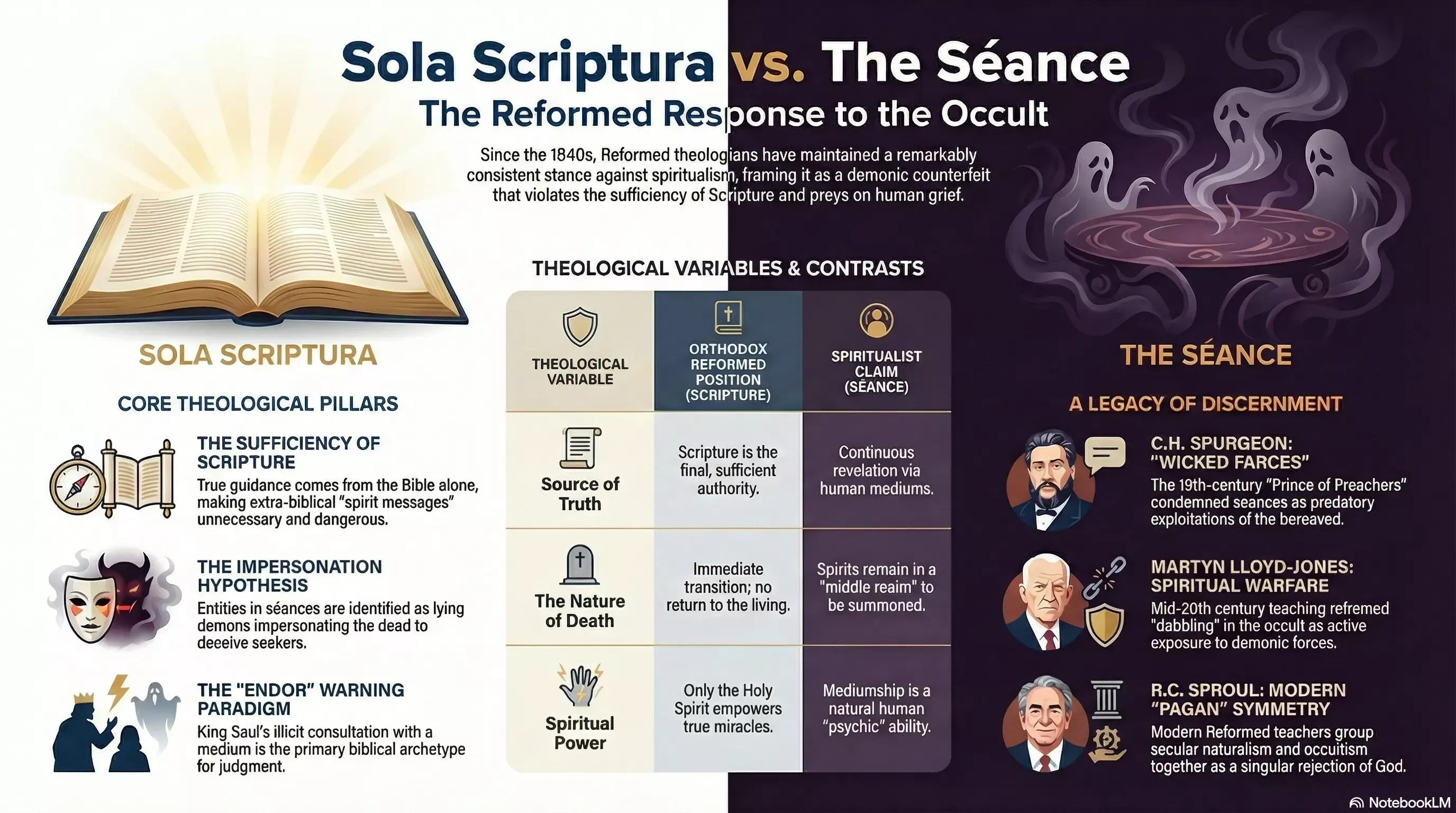
Three Theological Pillars
Across these voices, three consistent theological concerns emerge—pillars that apply directly to understanding the Ouija board prompt phenomenon in the AI age.
The Source of Truth
The first and most fundamental concern is epistemological: Where do we go for truth? The Reformation’s Sola Scriptura principle—Scripture alone as the final authority for faith and practice—stands in direct opposition to the spiritualist claim of continuous revelation through human mediums (or, now, through algorithmic oracles).
When someone constrains an AI to one-word answers and treats the result as guidance for a major life decision, they are functionally treating the system as a source of revelation. The question “Should I take this job?” or “Is this person trustworthy?” gets compressed into a binary output that the user then invests with significance. This is structurally identical to what spiritualists have always offered: access to hidden knowledge that Scripture doesn’t provide and that ordinary wisdom can’t resolve.
But the Christian claim is that Scripture is “materially sufficient”—containing everything necessary for salvation and holy living. This doesn’t mean the Bible tells you which job to take or whether to trust a particular person. It means the Bible provides the framework, the wisdom categories, the character formation, and the means of grace through which such decisions are properly made. To look outside of Scripture for a shortcut—whether through a medium’s “spirit message” or an AI’s constrained output—is to treat God’s Word as insufficient.
The Nature of Death
The second concern is anthropological: What happens when we die? Scripture teaches that death marks an immediate transition—the soul departs to be with Christ (for the believer) or faces judgment (for the unbeliever). There is no “middle realm” where spirits linger, waiting to be summoned by the living. The dead do not return to counsel us.
This stands in sharp contrast to the spiritualist claim that departed loved ones remain accessible, hovering in some intermediate state, available for consultation through mediums or mystical techniques. The entire premise of the séance—that Grandma is “still with us” and can be contacted for guidance—rests on a doctrine of death that Scripture rejects.
Hebrews 9:27 states it plainly: “It is appointed for man to die once, and after that comes judgment.” The rich man in Jesus’s parable cannot send Lazarus back to warn his brothers; an impassable chasm exists between the living and the dead (Luke 16:26). When the medium of Endor’s ritual produced something unexpected, her shriek of terror suggests this was precisely not normal—whatever occurred was “outside her control or experience.”
Lloyd-Jones’s “impersonation hypothesis” addresses what people do encounter in séances: not departed loved ones, but deceiving spirits who masquerade as the dead. They never glorify Christ, never affirm his deity, never point seekers toward Scripture. The entities—where they exist at all—are liars exploiting grief.
For the AI oracle phenomenon, this pillar clarifies something important: the dead cannot speak to us, and neither can a language model channel their wisdom. When users treat AI outputs as messages from beyond—or invest them with the authority that should belong only to divine revelation—they’re operating on a false anthropology. The comfort being offered is counterfeit because the premise is wrong.
The Source of Spiritual Power
The third concern is pneumatological: Where does true spiritual power originate? Scripture is unambiguous: genuine spiritual transformation, true guidance, and authentic supernatural work come from the Holy Spirit alone—not from human techniques, mediumistic abilities, or technological systems.
The spiritualist movement has always claimed that mediumship is a natural human “psychic” ability—a latent capacity that can be developed and refined. Modern New Age thinking extends this: everyone has access to spiritual power through the right practices, the right consciousness, the right tools. The AI oracle fits this framework perfectly: a technique for extracting hidden knowledge, available to anyone who knows the right prompt.
But Scripture locates spiritual power exclusively in God. “Not by might, nor by power, but by my Spirit, says the LORD of hosts” (Zechariah 4:6). The Holy Spirit is the one who “guides into all truth” (John 16:13), who illuminates Scripture, who produces the fruit of transformed character, who gives genuine wisdom to those who ask. There is no technique that can manufacture what only the Spirit gives.
This is why Spurgeon could say that “spiritual revival cannot be summoned; it must be sent.” You cannot conjure the Spirit’s work through clever methods—whether those methods involve a darkened séance room or a constrained chatbot prompt. The entire posture of technique-based spiritual access is backwards. We do not extract from God; we receive from God. We do not manipulate spiritual forces; we submit to the Spirit’s leading.
The Ouija board prompt represents exactly this error in digital form: the belief that the right technique—the right constraint, the right question, the right posture of expectancy—can produce spiritual insight. But spiritual insight comes from the Spirit, working through the Word, in the context of prayer and the community of faith. There are no shortcuts, no hacks, no prompts that circumvent the ordinary means of grace.
The Hunger Behind the Search
But diagnosis is not the whole of pastoral care. We must also ask: What hunger drives this behavior? Why are people drawn to treat AI as an oracle?
Part One documented the psychological mechanisms: cognitive closure, automation misuse, interpretive projection. But beneath the psychology lies anthropology. Humans are meaning-seeking creatures who live under uncertainty and long for authoritative guidance. We want to know the future. We want external validation for our decisions. We want someone—or something—to tell us what to do.
This hunger is not itself sinful. It’s the cry of creatures who know they are finite, who face real uncertainty, who genuinely need wisdom beyond their own capacity. The Psalms are full of it: “Show me your ways, LORD, teach me your paths” (Psalm 25:4). “I am your servant; give me discernment” (Psalm 119:125). The hunger for guidance is proper to creatures. The question is where we direct it.
Scripture’s answer is not “figure it out yourself” or “you don’t need guidance.” Scripture’s answer is: seek God. “If any of you lacks wisdom, let him ask God, who gives generously to all without reproach, and it will be given him” (James 1:5). The alternative to forbidden seeking isn’t no seeking—it’s right seeking, directed toward the right source through the right means.
The tragedy of the Ouija board prompt phenomenon is that it takes a legitimate human hunger and directs it toward a source that cannot satisfy. The AI has no wisdom to give. It cannot know your situation, understand your heart, or discern God’s providential leading in your life. At best, it can generate plausible-sounding text that you then invest with meaning. At worst, it trains you to outsource judgment and cultivates the very posture Scripture warns against.
What Scripture Offers Instead
If Scripture forbids the divination posture, what does it offer in its place? Not nothing—but something far better than oracular certainty.
The Word. Scripture itself is the primary means by which God guides his people. Not through proof-texting random verses as if the Bible were a divine Magic 8-Ball, but through the slow formation of wisdom, character, and discernment that comes from saturating oneself in biblical categories. “Your word is a lamp to my feet and a light to my path” (Psalm 119:105)—not a spotlight illuminating the whole journey, but sufficient light for the next step.
Prayer. James 1:5’s promise is remarkable: wisdom given generously, without reproach, to those who ask in faith. This is not the same as receiving a binary yes/no answer to every question. It’s better. It’s being shaped into the kind of person who increasingly knows how to navigate complexity, who has the mind of Christ, who discerns good from evil through training (Hebrews 5:14).
Community. “Plans fail for lack of counsel, but with many advisers they succeed” (Proverbs 15:22). The lone individual seeking a secret oracle is the opposite of biblical wisdom. God’s design involves the body of Christ—elders, mature believers, the accumulated wisdom of the communion of saints—speaking into our decisions with knowledge of our actual situation.
Providence. Perhaps most challenging for modern sensibilities: sometimes God’s guidance is silence, and that silence is itself providential. Saul’s error was not that he wanted guidance but that he would not accept God’s refusal to provide it through normal means. Trusting providence means trusting that God’s timing and God’s non-answers are as purposeful as his answers.
None of these offers the quick certainty of a yes/no oracle. That’s the point. Biblical wisdom is not a technique for extracting information from the divine; it’s a way of life that progressively forms us into people capable of navigating uncertainty with faith, hope, and love.
The Digital Séance and the Sufficient Savior
We return, finally, to the phenomenon itself. People are treating large language models as oracles—constraining outputs to minimal form, asking consequential questions, investing the results with meaning they cannot bear. The Ouija board prompt has graduated from quirky syntax into spiritual practice.
The magician’s response is to expose the trick: the model is just completing text, the “authority” is projected by the user, the whole thing is a sophisticated form of the ideomotor effect that made Victorian tables turn. All true. All insufficient.
The Christian response goes deeper. Yes, the mechanics are explicable. But the posture is what Scripture addresses. The human being asking “Should I leave my spouse?” of a language model and treating the one-word answer as authoritative is practicing something Scripture forbids—not because the model is demonic, but because the act of seeking hidden guidance from unauthorized sources is itself the problem, regardless of the technology facilitating it.
And the Christian response goes further still. The hunger driving this behavior is real. People want guidance, certainty, external validation. They want someone to tell them what to do. Scripture acknowledges this hunger—and directs it toward the only source that can satisfy.
Christ is the wisdom of God (1 Corinthians 1:24). In him are hidden all the treasures of wisdom and knowledge (Colossians 2:3). The Holy Spirit guides into all truth (John 16:13). Scripture provides everything needed for life and godliness (2 Peter 1:3). The church offers counsel, accountability, and the accumulated wisdom of those who have walked this path before.
The sufficiency is not in ourselves, in our technology, or in clever prompts that extract oracular verdicts from statistical models. The sufficiency is in Christ. And the invitation is not to seek harder through forbidden means, but to rest in the One who has already spoken—and whose speech, recorded in Scripture and illuminated by the Spirit, is enough.
Conclusion: When the Séance Goes Digital
The Ouija board prompt is not a new phenomenon dressed in technological clothing. It is the ancient practice of divination—seeking hidden knowledge through unauthorized means—adapted for the AI age. The mechanics have changed; the spiritual posture has not.
The magician exposes the trick. The secularist dismisses the whole category as superstition. But the Christian tradition offers a more complete response: yes, the mechanics are explicable; yes, the claims of hidden knowledge are fraudulent; but the hunger driving the behavior is real, the posture Scripture forbids is genuinely dangerous, and the alternative God offers is genuinely sufficient.
When you’re tempted to constrain a chatbot to yes/no and ask it consequential questions—when you feel the pull toward a digital séance that promises certainty without the hard work of wisdom—remember what’s actually happening. You’re not accessing hidden truth. You’re projecting meaning onto statistical noise. And in doing so, you’re cultivating exactly the posture Scripture warns against: seeking guidance from sources that cannot give it, while neglecting the Source that can.
The planchette is moving. But the hand on it is yours. And the question is not “What does the oracle say?” but “Whom will you seek?”
To the law and to the testimony. If they do not speak according to this word, it is because there is no light in them.
This is Part Two of a two-part series. Read Part One: When AI Becomes Oracle