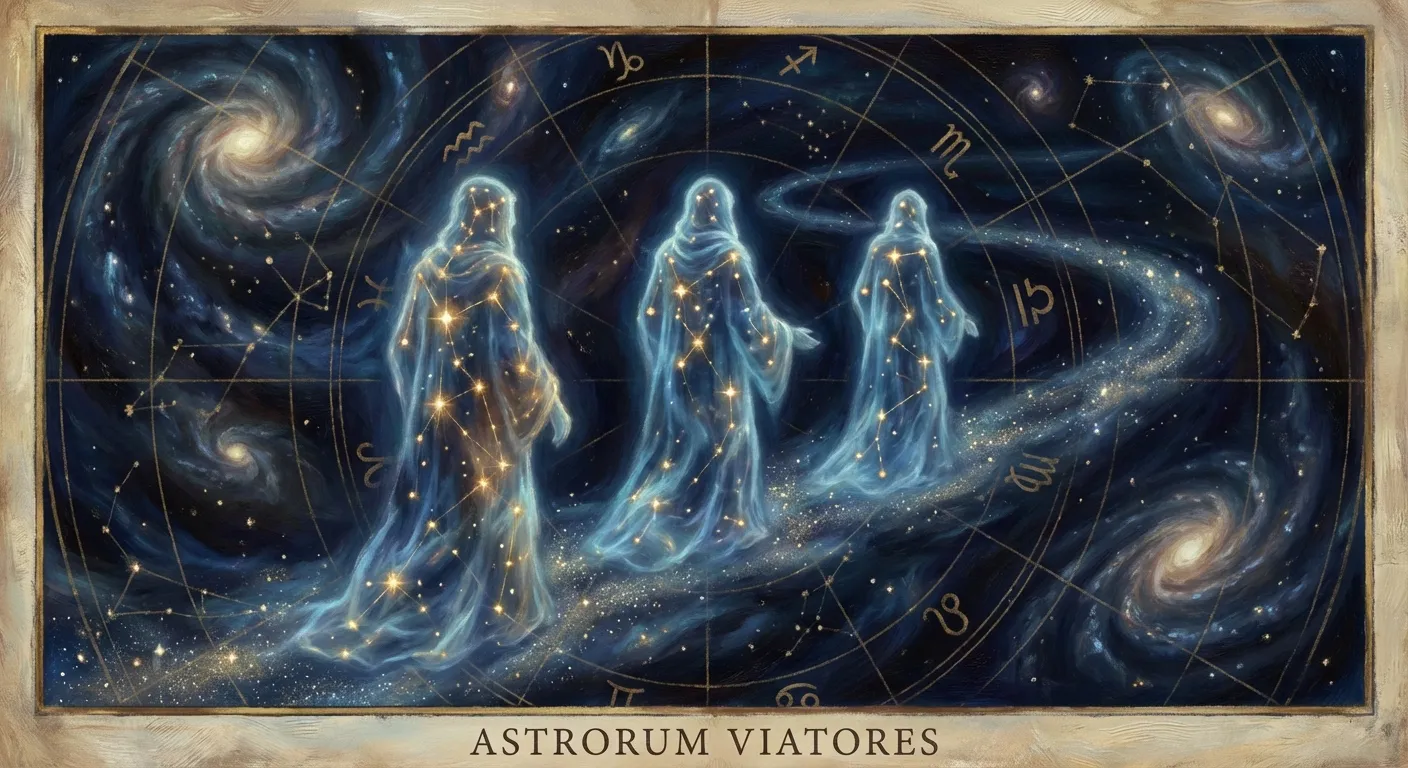
There’s an undeniable poetry to the Zeitgeist theory about the Magi. Three stars in Orion’s Belt align with Sirius, the brightest star in the sky, to point toward the sunrise on December 25. The “Three Kings” of Christian tradition, we’re told, are really those three stars. The “Star in the East” is Sirius. The whole nativity story is astronomical allegory dressed up as history.
It’s a beautiful theory. It’s also astronomically impossible, textually unfounded, and historically anachronistic.
The Claim As Presented
Zeitgeist makes several interlocking assertions:
-
The “Three Kings” are Orion’s Belt. The three stars in Orion’s Belt represent the three wise men who visited the infant Jesus.
-
The “Star in the East” is Sirius. The star that guided the Magi to Bethlehem is really Sirius, the brightest star visible from Earth.
-
A December 24 alignment points to the sun’s “birth.” On December 24, these three stars align with Sirius to point toward the sunrise on December 25—the sun’s rebirth after the winter solstice.
-
Christianity encoded solar worship as history. The nativity narrative is therefore not about a real birth but about celestial mechanics wrapped in religious language.
The implications are clear: if the Magi are constellations and the star is Sirius, then the Gospels are fiction—cleverly crafted fiction, perhaps, but fiction nonetheless.
Let’s examine each piece of this puzzle.
The Astronomical Problem: It Doesn’t Work
The most devastating refutation of the Zeitgeist claim doesn’t come from theology—it comes from astronomy. The alleged alignment simply doesn’t function the way the film describes.
Orion and Sirius Set in the West
Here’s the problem: in the Northern Hemisphere during late December, Orion and Sirius are winter constellations that reach their highest point in the sky around midnight. By the time the sun rises on December 25, Orion and Sirius have moved into the western sky and are setting.
They don’t point toward the eastern sunrise. They point away from it.
This isn’t a minor technical quibble. The entire Zeitgeist argument depends on these stars guiding observers toward the rising sun on December 25. But anyone who has watched the winter sky knows that Orion sinks toward the western horizon as dawn approaches. The alleged “pointer” is pointing in the wrong direction.
The Alignment Is Permanent
There’s another problem: the alignment of Sirius with Orion’s Belt isn’t special to December 24. These stars maintain the same relative position every night of the year. The Belt and Sirius always form roughly the same pattern because they’re fixed stars—their positions relative to each other don’t change on human timescales.
Assigning cosmic significance to this alignment on a specific calendar date is arbitrary. There’s nothing unique happening on December 24 that doesn’t happen every other night.
Sirius and the Wrong Season
If we’re looking for ancient astronomical traditions involving Sirius, we find them—but in the wrong season entirely. In ancient Egypt, the significant celestial event involving Sirius was its heliacal rising (when it first becomes visible just before dawn after being hidden by the sun’s glare). This occurred in summer, not winter, and marked the beginning of the Nile flood season.
Egyptian solar mythology involving Sirius has nothing to do with December or winter solstice celebrations. The Zeitgeist theory takes a star associated with summer and forces it into a winter framework that doesn’t fit.
The Textual Problem: There Were No “Three Kings”
Even if the astronomy worked—which it doesn’t—the Zeitgeist argument faces a devastating historical problem: the “Three Kings” never existed in the original story.
The Text Says “Magi,” Not “Kings”
The Gospel of Matthew (2:1–12) is the only Gospel that mentions the visitors from the East. It calls them magoi—a Greek word meaning wise men, astrologers, or dream interpreters. The term referred to a caste of learned men associated with Persia or Babylon. It does not mean “kings.”
Matthew never uses the word “king” to describe these visitors. The association of the Magi with royalty came centuries later, likely influenced by Psalm 72:10–11 (“May the kings of Tarshish and of the coastlands render him tribute”) and Isaiah 60:3 (“Nations shall come to your light, and kings to the brightness of your rising”). These Old Testament passages were read back into the nativity story, but they’re not part of Matthew’s original narrative.
John P. Meier, in his exhaustive historical-critical study of Jesus, notes that the text provides no basis for royal status. The Magi are scholars or astrologers, not monarchs.
The Text Doesn’t Say “Three”
Here’s the detail that collapses the entire Orion’s Belt theory: Matthew never says how many Magi visited.
Read Matthew 2 carefully. It says “wise men from the East” (magoi apo anatolōn)—plural, but with no number specified. The tradition of three visitors arose later, inferred from the three gifts mentioned: gold, frankincense, and myrrh.
The names Caspar, Melchior, and Balthazar? Those are medieval legends, appearing in Western tradition around the 6th century and not standardized until much later. They did not exist in the first century when Matthew wrote.
This is crucial: the Gospel author could not have been encoding a celestial allegory for Orion’s Belt using a “Three Kings” motif that had not yet been invented. Matthew wrote about an unspecified number of non-royal astrologers. Later Christians made them three kings. The Zeitgeist theory confuses medieval legend with first-century text.
The December 25 Problem: Wrong Date, Wrong Century
The Zeitgeist argument assumes that December 25 was always central to the Jesus story—that the Gospel writers intentionally crafted a narrative pointing to the winter solstice. But historians know this date was a later addition to Christian tradition.
No Birth Date in the New Testament
The Gospels provide no date for Jesus’ birth. Matthew and Luke give nativity narratives, but neither specifies a day, month, or even season. (Luke’s mention of shepherds “keeping watch over their flock by night” has led some scholars to suggest a spring birth, when shepherds would be in the fields with newborn lambs—but this is speculation.)
Early Christians didn’t celebrate Jesus’ birthday at all. The earliest Christian observances focused on his death and resurrection (Easter), not his birth.
December 25 Emerged in the Fourth Century
The first recorded celebration of Christmas on December 25 dates to around 336 CE in Rome—over 300 years after Jesus’ life. Why this date was chosen remains debated among historians. Two main theories exist:
-
The Calculation Hypothesis: Some early Christians believed significant events in a prophet’s life happened on the same calendar date. If Jesus died on March 25 (a traditional date), then he was also conceived on March 25. Nine months later is December 25.
-
The Co-Option Hypothesis: December 25 was the Roman festival of Sol Invictus (the Unconquered Sun), celebrating the winter solstice. Christians may have chosen this date to provide an alternative to pagan celebrations.
Either way, the December 25 date was not part of the original Gospel tradition. The authors of Matthew and Luke never mention it. Whatever astronomical alignments happen on December 25, they cannot be evidence that the first-century Jesus story was a solar myth, because the first-century Christians weren’t using that date.
The Zeitgeist argument commits a basic chronological error: it reads a fourth-century liturgical date back into a first-century text.
What About the “Star in the East”?
If the Magi weren’t Orion’s Belt and the date wasn’t December 25, what about the star itself? Was the “Star in the East” really Sirius encoded in religious language?
The Jewish Context: Numbers 24:17
Matthew’s audience was Jewish Christians steeped in Hebrew Scripture. When Matthew mentions a star heralding the birth of a king, his readers would immediately think of Numbers 24:17: “A star shall come out of Jacob, and a scepter shall rise out of Israel.”
This “Star Prophecy” was widely interpreted in Second Temple Judaism as a reference to the coming Messiah. The Dead Sea Scrolls reference it. Bar Kokhba, the Jewish revolutionary who led a revolt against Rome in 132 CE, took a name meaning “Son of the Star” in explicit reference to this prophecy.
Matthew is not encoding Egyptian astronomy. He’s claiming that Jesus fulfills Jewish messianic expectation. The star is prophetic symbolism, not a pointer to Sirius.
Astronomical Explanations vs. Literary Purpose
Astronomers have proposed various natural explanations for the Star of Bethlehem—a conjunction of Jupiter and Saturn, a comet, a supernova. These theories are interesting but somewhat beside the point.
Matthew may or may not have had a historical astronomical event in mind. What’s clear is his literary purpose: to present Jesus as the fulfillment of Jewish prophecy, the royal Messiah whose birth heaven itself announced. Whether there was an actual celestial phenomenon, the meaning Matthew assigns to it comes from Jewish theology, not Egyptian star worship.
The Problem of “Parallelomania”
Bart Ehrman, a prominent New Testament scholar and religious skeptic, has a term for the methodology behind theories like Zeitgeist: “parallelomania”—the tendency to see parallels everywhere and assume they indicate borrowing.
Fabricated Parallels
Ehrman notes that mythicist authors frequently assert parallels—other gods with “Stars in the East,” “Three Kings,” virgin births on December 25—without providing primary documentation. When you trace these claims back to their sources, you often find 19th-century books by authors like Kersey Graves, who simply made assertions without evidence.
The claim that Horus had “Three Kings” at his birth, for instance, appears nowhere in ancient Egyptian texts. It’s a modern invention, repeated from source to source without anyone checking the original documents.
The Burden of Proof
If you want to argue that Christianity borrowed the Magi story from Orion’s Belt worship, you need to demonstrate:
- That ancient people actually interpreted Orion’s Belt as “Three Kings” before Christianity.
- That this interpretation was known in first-century Palestine.
- That the Gospel author was aware of this tradition.
- That he intentionally encoded it in his narrative.
None of these have been demonstrated. The Zeitgeist theory asserts connections without establishing them through historical evidence.
What the Evidence Actually Shows
Let’s summarize what mainstream scholarship—including scholars with no Christian commitments—actually concludes:
-
The astronomy doesn’t work. Orion and Sirius point west, not east, at sunrise on December 25.
-
The “Three Kings” are medieval, not biblical. Matthew describes an unspecified number of non-royal Magi.
-
December 25 is a fourth-century date. It wasn’t part of the original Christian tradition.
-
The “star” reflects Jewish messianic expectation. It’s an allusion to Numbers 24:17, not Sirius.
-
No primary evidence links these elements. The connections exist only in modern mythicist literature.
The Magi story in Matthew functions as Jewish theological argument: Jesus is the promised Messiah, recognized even by Gentile wise men, the fulfillment of prophecy and the rightful king of Israel. Whether the narrative is historical or theological construction (scholars debate this), its meaning comes from Jewish categories, not Egyptian astronomy.
Why the Theory Persists
Given these problems, why does the Orion’s Belt theory remain popular?
Perhaps because it offers what the Gospel doesn’t: a hidden code, a secret meaning available only to those clever enough to decode it. There’s satisfaction in believing you’ve seen through the manipulation that fooled billions of people for millennia.
But intellectual satisfaction isn’t the same as truth. The Zeitgeist theory fails basic tests of astronomy, textual accuracy, and historical methodology. It’s not a discovery of hidden truth—it’s a modern myth about ancient myths.
The Invitation to Honest Inquiry
None of this proves the Magi story is historical. Scholars like Meier and Ehrman have their own questions about Matthew’s narrative—whether there was a real star, real visitors, a real census. These are legitimate historical questions.
But the answer to those questions isn’t “it was all astrology.” The evidence doesn’t support that conclusion. The nativity narratives, whatever their historical status, emerged from Jewish theological reflection, not Babylonian star charts.
If we want to understand what the Gospel writers were actually claiming—and whether those claims are true—we need to engage the text on its own terms, in its own historical context. The stars make poor guides when we read into them what we want to find.
Author’s Note (2026): This article was originally written in 2013 but was never published at the time. Prior to publication in 2026, it has been carefully reviewed and updated to ensure that historical references, scholarly claims, and source material are accurate, current, and properly represented.