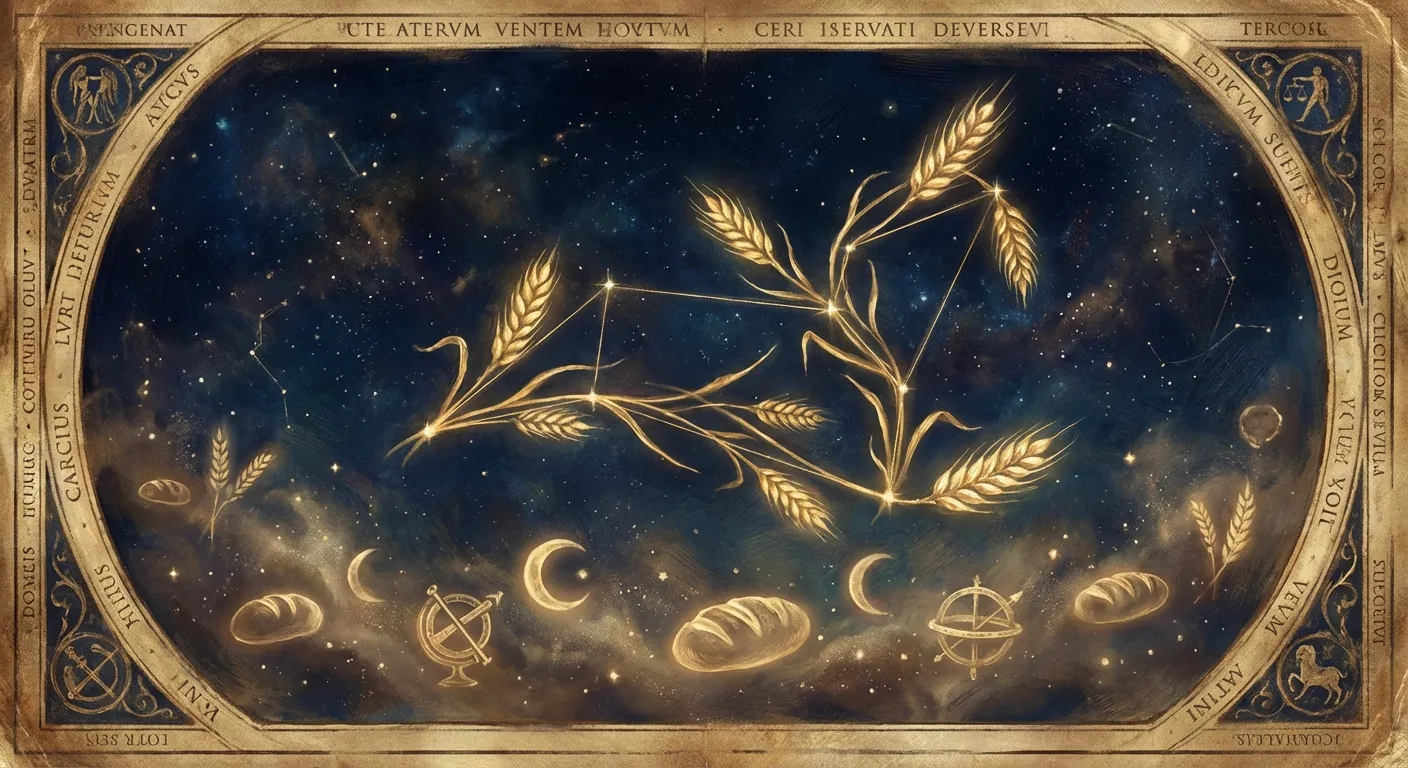
Few claims in popular skepticism sound as clever as the Virgo-Bethlehem hypothesis. The 2007 documentary Zeitgeist presents a tidy narrative: the Virgin Mary is nothing more than a personification of the constellation Virgo, the celestial virgin. Bethlehem, we’re told, isn’t a dusty town in Judea—it’s a reference to the “House of Bread,” which supposedly corresponds to Virgo’s association with the harvest. The implication is clear: Christianity borrowed its most sacred narratives from the stars, and the faith collapses once we recognize the astrological shell game.
It’s a theory that sounds devastating on first hearing. It also happens to be almost entirely unsupported by mainstream scholarship.
The Claim in Its Own Words
Before critiquing the theory, we should state it fairly. Zeitgeist argues:
-
The Virgin Mary represents Virgo. The title “Virgin” was applied to Mary because she symbolizes the constellation Virgo, the celestial virgin depicted in ancient star charts.
-
Bethlehem is not a real place—it’s a location in the sky. The name “Bethlehem” means “House of Bread” in Hebrew (Beit Lechem), and Virgo is traditionally associated with grain and harvest. Therefore, when the Gospels say Jesus was born in Bethlehem, they mean he was “born” in the constellation Virgo.
-
Christianity is astrology dressed up as history. The virgin birth narrative is not historical but a solar-zodiac allegory adapted from pagan star worship.
If true, this would fundamentally undermine the historical claims of the New Testament. The virgin birth would be fiction, Bethlehem a metaphor, and the incarnation of God in human flesh a cosmic fairy tale.
Why This Theory Appeals to Modern Minds
We should acknowledge why the Virgo-Bethlehem hypothesis resonates. It offers:
- A sense of discovery. The viewer feels they’ve uncovered a hidden code that institutional Christianity has suppressed.
- Intellectual autonomy. Rather than accepting religious authority, the skeptic decodes the myth for themselves.
- Simplicity. If Christianity is just recycled astrology, there’s no need to wrestle with its moral demands or historical evidence.
These are understandable impulses. We all want to see through manipulation. We all prefer explanations that don’t require us to change our lives.
But intellectual honesty demands that we evaluate claims by evidence, not by how satisfying they feel to believe.
Where Did the “Virgin” Actually Come From?
The Zeitgeist theory assumes the “virgin” designation came from gazing at the stars. But historians have traced the origin of the virgin birth narrative with considerable precision—and it has nothing to do with astronomy.
The Isaiah 7:14 Connection
The Gospel of Matthew explicitly tells us why he believed Mary was a virgin: he was reading the prophet Isaiah. Matthew 1:22–23 quotes Isaiah 7:14: “Behold, the virgin shall conceive and bear a son, and they shall call his name Immanuel.”
Here’s where things get interesting—and where the Zeitgeist theory falls apart.
In the original Hebrew of Isaiah 7:14, the word used is almah, which means “young woman.” It doesn’t necessarily imply virginity. However, when Jewish scholars translated the Hebrew Scriptures into Greek (the Septuagint, completed around the 3rd–2nd century BC), they rendered almah as parthenos—which specifically means “virgin.”
Matthew, writing in Greek and using the Septuagint as his Bible, saw Isaiah’s prophecy through this translation. When he learned (or believed) that Jesus was born to a woman who had not had relations with a man, he saw a direct fulfillment of Isaiah’s words as he knew them.
This is a translation phenomenon, not an astrological one. Scholars like Bart Ehrman, John P. Meier, and Paula Fredriksen—none of whom are conservative Christian apologists—agree that the virgin birth tradition arose from Jewish scriptural interpretation, a method called midrash. The motivation was to prove Jesus was the Messiah by linking him to Hebrew prophecy.
There is no textual evidence in the Gospels, in Second Temple Jewish literature, or in early Christian writings connecting Mary to the constellation Virgo.
Was Bethlehem Just a “Place in the Sky”?
The claim that Bethlehem was never a real town—just a zodiacal reference—runs headlong into several inconvenient facts.
Bethlehem Was a Real, Documented Settlement
Archaeological evidence confirms Bethlehem as an Iron Age settlement dating to at least the 8th–7th century BC. It appears in the Hebrew Bible as the hometown of David (1 Samuel 16:1) and in the book of Ruth. It was a functioning administrative center in the Kingdom of Judah long before anyone imposed Greek zodiacal categories on Jewish culture.
You can visit it today. It has buildings. And people. It’s decidedly not in the sky.
The Micah 5:2 Motivation
Why did Matthew and Luke both place Jesus’ birth in Bethlehem? The answer is sitting openly in Matthew 2:5–6, where the author quotes the prophet Micah: “But you, O Bethlehem Ephrathah… from you shall come forth for me one who is to be ruler in Israel.”
The Gospel writers placed Jesus in Bethlehem because Micah 5:2 said the Messiah must come from David’s city. This is classic Jewish prophetic interpretation—reading the Hebrew Scriptures and identifying Jesus as their fulfillment.
Notably, Matthew and Luke give different and incompatible explanations for how Jesus’ family ended up in Bethlehem (Matthew has them living there originally; Luke invents a census to move them from Nazareth). This suggests they inherited a tradition that Jesus was born in Bethlehem and constructed different backstories to explain it. They weren’t copying from a shared astrological template; they were independently trying to make sense of a theological claim.
The “House of Bread” Non-Sequitur
Yes, Beit Lechem means “House of Bread” (or possibly “House of Meat” in some Semitic cognates). And yes, Virgo is sometimes depicted holding wheat.
But this is what scholars call a semantic coincidence. Bethlehem was named for the agricultural fertility of its region—the town was known for grain production in the ancient Near East. This naming convention predates the Hellenistic zodiac by centuries.
To conclude that Bethlehem was “really” about Virgo because both relate to grain is like concluding that Portland, Oregon is named after the Portland cement used in the zodiacal “foundation” of… nothing. It’s pattern-matching without evidence.
Maurice Casey, a secular scholar who was notably unsympathetic to Christian apologetics, dismissed this zodiacal etymology as a non-sequitur with no textual or historical support.
What About Pagan “Virgin Birth” Parallels?
Zeitgeist implies that virgin birth stories were common in the ancient world and that Christianity simply borrowed the trope. This claim deserves scrutiny.
Divine Sex vs. Asexual Conception
When scholars examine alleged “virgin birth” parallels—the births of Hercules, Perseus, Alexander the Great, various Egyptian figures—they find something quite different from the Gospel accounts. In virtually every pagan narrative, a male deity has sexual intercourse (or a physical substitute like a thunderbolt, golden rain, or serpent) with a human woman.
The New Testament presents something conceptually distinct: an asexual conception by the Holy Spirit. Mary does not have intercourse with anyone, divine or human. Gabriel announces that “the Holy Spirit will come upon you, and the power of the Most High will overshadow you” (Luke 1:35). This is not the language of divine-human sexual union.
Bart Ehrman, who is not a Christian and has devoted his career to critiquing traditional Christian claims, acknowledges this distinction clearly. The Christian conception story doesn’t fit neatly into the pagan mold.
The Silence of Mark and Paul
If Jesus were a solar myth, we would expect the “virgin-as-Virgo” element to be central to the earliest Christian proclamation. But it isn’t.
The Gospel of Mark—the earliest Gospel, written around 70 AD—never mentions the virgin birth at all. Neither does the Apostle Paul, whose letters predate all the Gospels. Paul shows no awareness of a miraculous birth; he simply says Jesus was “born of a woman” (Galatians 4:4).
The virgin birth tradition appears only in Matthew and Luke, written around 80–90 AD. Meier and other historians interpret this as a later theological development designed to address questions about Jesus’ origins and his status as Messiah—not as evidence that the zodiac was foundational to the Jesus story.
The Nazareth Problem
If the Zeitgeist theory were correct—if Jesus were a solar allegory constructed from zodiacal patterns—we would expect the story to be consistent with that framework. But there’s a glaring problem: Nazareth.
An Embarrassing Hometown
Nazareth was a tiny, insignificant hamlet never mentioned in the Hebrew Bible. It had no prophetic significance, no messianic associations, no zodiacal correlate. And yet all four Gospels identify Jesus as being from Nazareth. “Jesus of Nazareth” became his standard designation.
The early Christians were embarrassed by this. John 1:46 preserves the skeptical response: “Can anything good come from Nazareth?” Nathanael’s dismissive question reflects the widespread ancient view that Nazareth was a backwater.
If Christians were inventing a solar myth, why would they invent this complication? Why give their cosmic sun god a connection to an obscure village that worked against their theological claims?
Bart Ehrman applies the “criterion of embarrassment” here: details that created problems for early Christians are likely historical, because they would have been edited out of pure fiction. The Nazareth connection is one of the most secure historical facts about Jesus—and it’s precisely the kind of detail that a zodiacal myth would never introduce.
What This Tells Us About Evidence and Interpretation
The Virgo-Bethlehem theory fails not because it’s offensive to Christians, but because it doesn’t survive contact with the evidence:
- The “virgin” title traces to a Greek translation of Isaiah, not to star-gazing.
- Bethlehem is archaeologically attested as a real town, and the Gospel writers explicitly tell us they placed Jesus there because of Micah’s prophecy.
- The “House of Bread” etymology is a semantic coincidence, not evidence of zodiacal borrowing.
- Pagan “virgin birth” stories typically involve divine intercourse, unlike the New Testament account.
- The earliest Christian sources don’t mention the virgin birth, contradicting the claim that Virgo was central to the Jesus myth.
- Nazareth’s presence in the tradition makes no sense if Jesus were a constructed solar allegory.
Mainstream scholars—including those with no Christian commitments—reject the Zeitgeist hypothesis in favor of a “history of traditions” approach. The Gospel narratives arose from Jewish theological creativity, specifically the effort to demonstrate that Jesus fulfilled Hebrew Scripture. This is a well-documented phenomenon called midrash.
Was the process historical? Were the events literally true? Scholars disagree on those questions. But virtually none of them think the answer lies in Mesopotamian astrology or Greek zodiac charts.
The Deeper Question
If the Zeitgeist theory is so poorly supported, why does it persist?
Perhaps because it offers something easier than the alternative. If Christianity is just recycled paganism, we don’t have to take its claims seriously. We don’t have to ask whether God became man, whether sin is real, whether resurrection is possible. We can admire the mythology from a safe distance, secure in our autonomy.
But what if the historical question is more complex? What if early Christians really did believe something unprecedented had happened—that the God who spoke through Isaiah had entered history in an obscure corner of the Roman Empire? What if Bethlehem was exactly what they claimed: the prophesied birthplace of Israel’s king?
These questions don’t require blind faith. They require honest investigation—the same willingness to follow evidence that led scholars to reject the Zeitgeist hypothesis.
Christianity has always invited scrutiny. “Come now, let us reason together,” God says through Isaiah (1:18). The invitation still stands.
Author’s Note (2026): This article was originally written in 2013 but was never published at the time. Prior to publication in 2026, it has been carefully reviewed and updated to ensure that historical references, scholarly claims, and source material are accurate, current, and properly represented.