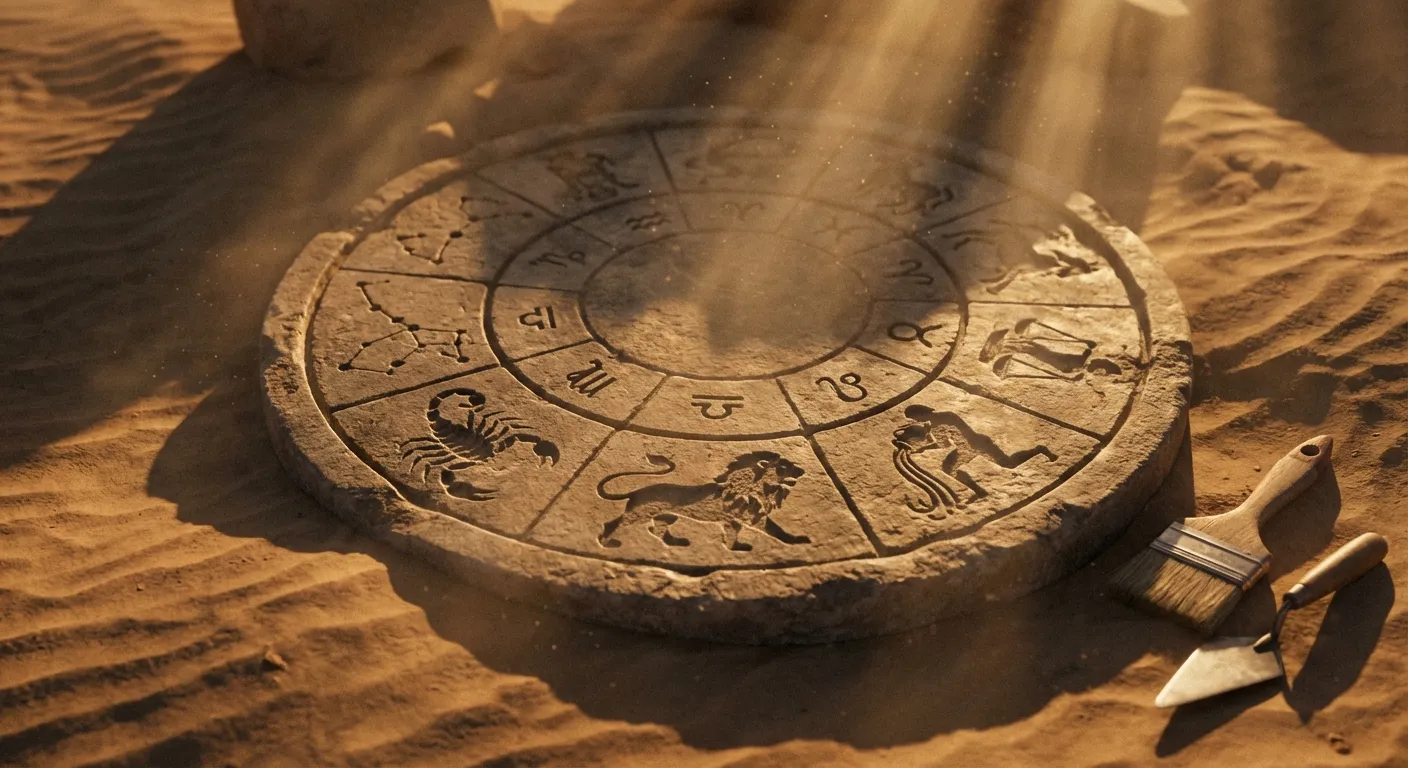
We have now examined two of Zeitgeist’s major claims about Christianity. The first—that Jesus is a “solar deity” whose story encodes the sun’s annual journey through the zodiac—collapsed under scrutiny. The second—that Christianity plagiarized dying-and-rising gods and Old Testament narratives were lifted from pagan sources—proved equally groundless.
Now we turn to the film’s third major argument: that the entire Bible is an allegorical narrative encoding the astronomical phenomenon known as the “Precession of the Equinoxes.”
This claim is arguably the most ambitious of the three. While the solar deity argument focused on Jesus’ biography and the plagiarism argument addressed specific narratives, the astrological ages thesis purports to unlock the hidden meaning of scripture as a whole. From Moses to Jesus to the apocalypse, the Bible allegedly tracks humanity’s passage through successive astrological ages—with religious figures serving as cosmic markers for astronomical transitions.
If this claim is true, the implications are staggering. The Bible would not be divine revelation but astronomical code. Moses and Jesus would not be historical figures but zodiacal symbols. The Second Coming would not be Christ’s return but the dawning of the Age of Aquarius.
It’s a seductive narrative—one that promises to decode millennia of religious confusion with a single interpretive key.
But is it true?
The Precession of the Equinoxes
Before examining the specific claims, we need to understand the astronomical phenomenon Zeitgeist invokes.
The Earth’s axis wobbles slowly over time, like a spinning top that isn’t perfectly upright. This wobble—called “axial precession”—causes the position of the vernal equinox (the point where the sun crosses the celestial equator in spring) to drift gradually backward through the zodiac constellations.
One complete cycle takes approximately 25,772 years. Divided among the twelve zodiac constellations, each “astrological age” lasts roughly 2,150 years.
The phenomenon is real and has been known since antiquity. The Greek astronomer Hipparchus (c. 190–120 BCE) is generally credited with its discovery, though some argue earlier civilizations may have recognized it.
Zeitgeist claims that ancient religious traditions—including the Bible—encoded this astronomical cycle into their myths and narratives, with different religious figures representing transitions between astrological ages.
The Three Core Claims
Zeitgeist presents three specific arguments for biblical astrology:
1. Moses and the Age of Aries
The Claim: Moses shattering the Golden Calf (the bull of Taurus) represents the transition from the Age of Taurus to the Age of Aries (the ram). This is why, the film claims, Jews blow the ram’s horn (shofar) and why the ram becomes significant in Hebrew religion.
The narrative goes like this: When Moses descended Mount Sinai and found the Israelites worshipping a golden calf, he wasn’t upset about idolatry per se. Rather, the calf represented the old age of Taurus, which had passed. The Israelites were clinging to outdated astrology. Moses’ anger symbolizes the necessity of embracing the new age—Aries, the ram—which explains the prominence of rams and lambs in subsequent Hebrew worship.
2. Jesus and the Age of Pisces
The Claim: Jesus represents the Age of Pisces (the two fish). His feeding of the multitudes with two fish, his calling of fishermen as disciples, and the ubiquitous “Jesus fish” symbol all allegedly encode the transition into the Piscean age.
The film presents this as self-evident: Jesus arrives at the dawn of the Age of Pisces (around the first century CE), surrounds himself with fish imagery, and establishes a religion whose symbol is—suspiciously—a fish. The ichthys (fish symbol) isn’t a clever Greek acronym for “Jesus Christ, Son of God, Savior” but rather a pagan astrological symbol marking the sun’s kingdom during this 2,150-year period.
3. The End of the World as End of the Age
The Claim: The “end of the world” in biblical eschatology is a mistranslation. The Greek word “aeon” (αἰών) means “age,” not “world.” Thus, when Jesus speaks of being with his disciples “until the end of the age” (Matthew 28:20), he’s referring to the end of the Age of Pisces and the coming Age of Aquarius—symbolized by Luke 22:10, where Jesus tells his disciples to follow a man bearing a pitcher of water (the water-bearer of Aquarius).
Under this reading, Christian eschatology isn’t about cosmic judgment but astronomical transition. The “Second Coming” is simply the next astrological age. And Zeitgeist implies that institutional Christianity has deliberately mistranslated and misrepresented these passages to maintain apocalyptic fear and religious control.
Why This Theory Appeals
The astrological ages thesis has genuine appeal for several reasons.
It offers a grand unified theory. Rather than addressing individual biblical stories, it claims to decode the entire narrative arc of scripture. This kind of comprehensive “key” feels intellectually satisfying—one principle explains everything.
It flatters the interpreter. Those who accept the theory join an elite group who see what billions of religious adherents have missed. This gnostic appeal—secret knowledge for the initiated—is psychologically powerful.
It neutralizes without hostile rejection. Unlike aggressive atheism that dismisses religion as stupid, the astrological reading reframes religion as encoded wisdom. It allows people to retain some respect for tradition while rejecting its truth claims. The Bible isn’t false; it’s just been misunderstood.
It fits New Age sensibilities. The “Age of Aquarius” carries positive cultural associations—peace, enlightenment, spiritual evolution. Reframing eschatology as astrological transition replaces judgment with progress.
The Questions We Must Ask
Despite its appeal, the theory faces serious challenges that deserve careful examination:
Historical: Did ancient Hebrews and first-century Jews actually understand or care about the Precession of the Equinoxes? What evidence exists that they encoded astronomical cycles into their religious texts?
Textual: Do the specific biblical passages cited actually support astrological interpretation? What do the original languages and literary contexts reveal?
Logical: Is the theory internally consistent? Does it actually explain what it claims to explain, or does it cherry-pick convenient details while ignoring inconvenient ones?
Scholarly: What do historians of ancient religion, biblical scholars, and archaeoastronomers actually say about these claims?
Our Approach
In the following three articles, we will examine each major claim in detail:
Article 18: Moses and the Golden Calf—Was the bull/ram imagery about astrological ages, or does the text have a different, more mundane explanation?
Article 19: Jesus and the Fish—Does Piscean symbolism explain Christian fish imagery, or are there better historical and theological explanations?
Article 20: The End of the Age—Is Matthew 28:20 about Aquarius, or is Zeitgeist misrepresenting Greek vocabulary and Jewish eschatology?
We will consult primary sources, examine scholarly consensus, and test whether the astrological thesis survives contact with evidence.
The promise of hidden knowledge is alluring. But truth doesn’t hide from investigation.
Author’s Note (2026): This article was originally written in 2013 but was never published at the time. Prior to publication in 2026, it has been carefully reviewed and updated to ensure that historical references, scholarly claims, and source material are accurate, current, and properly represented.