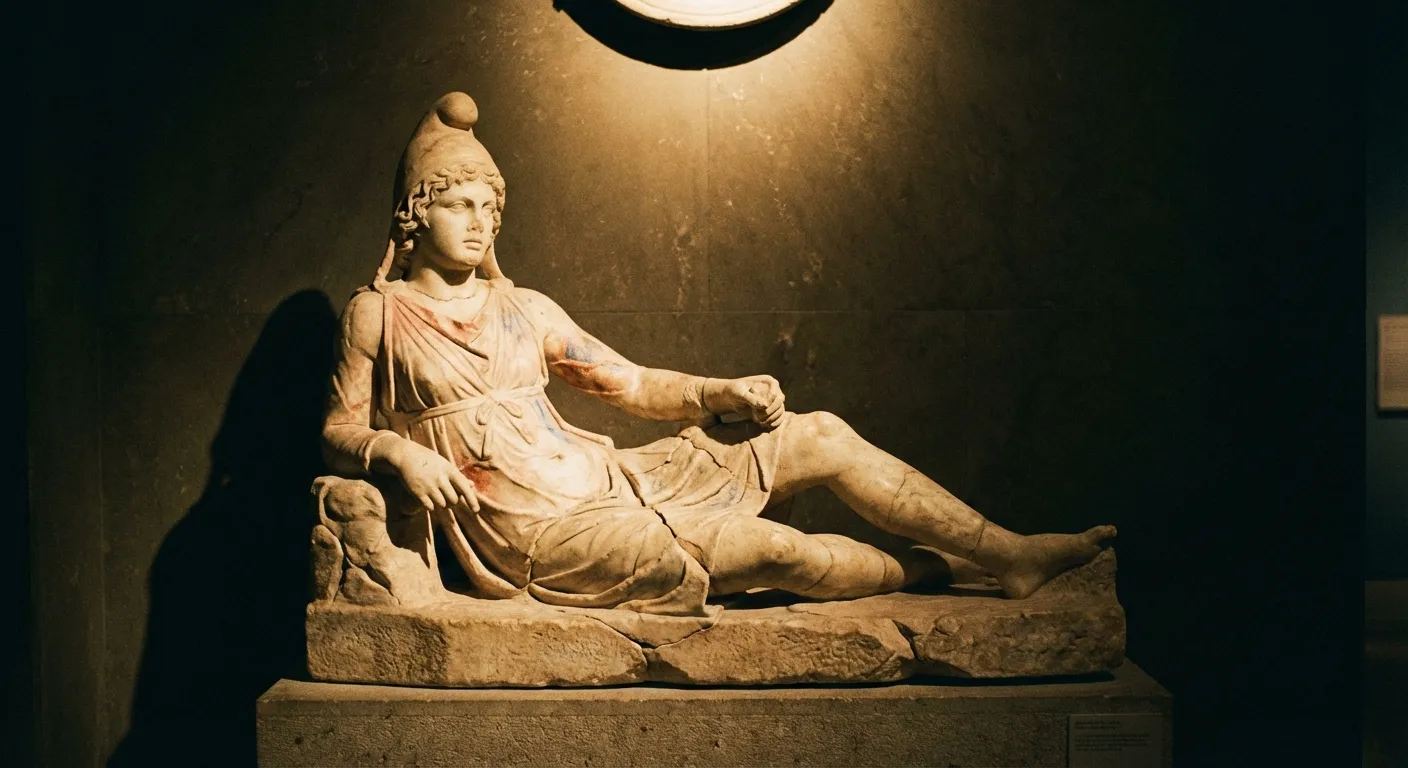
Attis, the Phrygian god associated with the cult of Cybele, is another deity invoked by Zeitgeist as a template for Jesus. The claims follow the familiar pattern:
- Born of a virgin
- Crucified
- Rose from the dead after three days
If true, these parallels would suggest that Christianity borrowed its central narrative from an older Phrygian myth. Jesus would be just another “dying and rising god” in a long tradition of vegetative deities.
But when we examine the actual mythology of Attis—what the ancient sources describe—the parallels collapse. Attis did not die by crucifixion. He did not rise from the dead. And the very category of “dying and rising gods” has been largely dismantled by modern scholarship.
The Collapse of the “Dying and Rising God” Category
The foundational premise of the Attis-Jesus connection is that Attis belongs to a universal pre-Christian category of “dying and rising gods.” This framework was popularized by James Frazer in The Golden Bough (1890), who argued that deities like Attis, Osiris, and Adonis represented vegetative cycles—crops dying in winter, returning in spring.
For generations, this framework shaped popular understanding of comparative religion. It seemed to explain everything: ancient peoples personified the agricultural cycle, Christianity borrowed the pattern, and Jesus was just another vegetation god.
But contemporary scholarship has largely dismantled this category.
Bart Ehrman cites the pivotal work of historian of religion J.Z. Smith, who demonstrated that the “dying and rising god” category is a “misnomer based on imaginative reconstructions.” When you actually examine the myths, the deities placed in this category don’t share the pattern attributed to them:
- Some gods die but do not return (like Attis in the earliest versions)
- Some gods disappear and return but do not die (like Persephone, who descends to the underworld but isn’t killed)
- None unambiguously die and rise to life in the soteriological sense attributed to Jesus before Christianity emerges
The Christian claim is specific: a person died, was buried, and rose bodily to life on the third day, appearing to witnesses before ascending to heaven. This is not the same as a vegetation deity symbolizing seasonal cycles. The categories are different.
How Attis Actually Died
The Claim: Attis was crucified like Jesus.
What the Myth Actually Says: Attis died by self-castration under a pine tree.
The mythological narratives vary in details, but the core story involves Attis, a beautiful young shepherd, driving himself mad and castrating himself. He bleeds to death beneath a pine tree. In some versions, he is castrated by others; in some, he does it to himself in a frenzy. But in no version is he crucified.
Crucifixion was a specific Roman judicial penalty—a method of public execution reserved for slaves, criminals, and insurrectionists. It involved suspension on a wooden frame, not self-mutilation beneath a tree. The two deaths have nothing in common beyond both resulting in death.
The sources are clear about how Jesus died: Roman crucifixion under Pontius Pilate, a historical fact corroborated by non-Christian sources including Tacitus and Josephus. As Paula Fredriksen and E.P. Sanders note, the crucifixion is among the most secure historical facts about Jesus—it was a political punishment for sedition, not a mythological reenactment of vegetative cycles.
Attis castrated himself. Jesus was executed by Rome. These are not parallel deaths.
Preservation vs. Resurrection
The Claim: Attis rose from the dead after three days.
What the Myth Actually Says: Attis does not rise from the dead. His body is preserved.
After Attis dies, the goddess Agdistis (or Cybele, depending on the version) is grief-stricken. She petitions Zeus, who grants that Attis’s body will not decay. His hair continues to grow. His little finger continues to move. But he does not return to life. He does not walk among the living. He does not appear to followers. He does not ascend to heaven as a living savior.
This is preservation of a corpse, not resurrection.
The distinction matters enormously. The Christian claim is that Jesus rose bodily—that he left the tomb empty, appeared to disciples, ate with them, spoke with them, and then ascended. The Gospels go out of their way to emphasize the physical reality of the resurrection: Jesus invites Thomas to touch his wounds, he eats fish with the disciples, he is not a ghost.
Attis’s body being preserved from decay is a completely different concept. He remains dead. His corpse simply doesn’t rot. This is closer to mummification than resurrection.
The Virgin Birth Claim
The Claim: Attis was born of a virgin, like Jesus.
What the Myth Actually Says: The conception of Attis is bizarre, but it is not a virgin birth in the Christian sense.
In the most common version of the myth, Attis is conceived when Nana (a river nymph) places an almond or pomegranate in her bosom. The almond/pomegranate itself derives from the severed genitals of Agdistis (a hermaphroditic deity who was castrated by the other gods).
This is a form of magical or biological impregnation—strange, certainly—but it is not the asexual conception described in the Gospels of Matthew and Luke. The Christian narrative describes the Holy Spirit “overshadowing” Mary without any physical or quasi-physical mechanism. The Attis myth involves a fruit derived from severed genitals.
Mythicists often use the term “virgin” loosely to describe any miraculous birth. But the specific Christian claim—conception without any male contribution, divine or physical—is distinct from the Attis narrative.
No Vicarious Atonement
One of the most significant differences between Attis and Jesus is the meaning of their deaths.
The death of Attis was associated with grief, with the preservation of nature, with the cyclical rhythms of vegetation. It was not interpreted as a sacrifice for human sin.
The death of Jesus, by contrast, was interpreted by his earliest Jewish followers through the lens of Isaiah 53 and Jewish sacrificial theology. Jesus died “for our sins” (1 Corinthians 15:3). His death was a vicarious atonement—he bore the penalty that others deserved.
Bart Ehrman addresses this directly: the pagan myths of Attis do not contain the concept of vicarious atonement. Mythicists who claim Attis “died for the sins of the world” are, in Ehrman’s words, simply “imagining things.”
This is a crucial theological distinction. Even if the surface narratives were similar (which they aren’t), the meaning assigned to the deaths is completely different. Christianity isn’t just claiming that someone died and came back—it’s claiming that his death accomplished something specific: the forgiveness of sins. Attis mythology contains no such claim.
The Chronology Problem
Even setting aside the narrative differences, there is a chronological problem with claiming Christianity borrowed from the Attis cult.
Many of the sources that describe anything resembling a “resurrection” for Attis date from after the rise of Christianity. The earlier sources describe his death and the preservation of his corpse. The later sources—written in a world where Christianity was spreading—add elements that look more familiar.
Bart Ehrman and J.Z. Smith both note this pattern. If there are similarities in later pagan texts, the historically probable explanation is that the pagan cults were influenced by Christianity, not the reverse. Christianity was the new, aggressive, rapidly spreading movement. Older cults adapted to compete.
This doesn’t mean Christianity definitely influenced later Attis traditions. But it does mean the simplistic claim that “Christianity copied Attis” ignores the chronological evidence. The direction of influence, if any, is unclear—and may have gone the opposite way.
The Eucharist Question
Some mythicists claim that Christian rituals—particularly the Eucharist—were borrowed from the Attis mysteries or other pagan cult meals.
Earlier scholars did attempt to derive the Christian Eucharist from mystery religion meals. But this view has been substantially re-evaluated. Gerd Theissen notes that H.J. Klauck’s research showed there are no real parallels to the notion of the “real presence” of a deity in a sacrament outside of primitive Christianity.
The Christian meal is best explained by its Jewish context: the Passover meal, the table fellowship that characterized Jesus’ ministry, and the specific words Jesus spoke at the Last Supper. The Jewish roots are clear and well-documented. The pagan parallels are vague and questionable.
Jesus Makes Sense in Jewish Context
The fundamental problem with the “Christianity plagiarized Attis” hypothesis is that it’s unnecessary. Jesus is fully explicable within the context of first-century Judaism.
E.P. Sanders and John P. Meier demonstrate that Jesus’ ministry—his selection of twelve disciples (representing the twelve tribes of Israel), his apocalyptic message, his ethical teaching, his debates over Torah—is deeply rooted in Jewish restoration theology. The categories are Jewish. The expectations are Jewish. The language is Jewish.
The earliest Christians were Jews. They interpreted Jesus through Jewish Scripture—Isaiah 53, the Psalms, Daniel. They understood his death through Jewish sacrificial categories. They proclaimed his resurrection using Jewish apocalyptic frameworks.
Inventing a Jewish Messiah based on a castrated Phrygian nature god would have been culturally unintelligible to the earliest Aramaic-speaking Christians. Why would Palestinian Jews in the 30s CE look to a Phrygian vegetation cult for their theology? They had their own rich tradition to draw from—and that tradition explains everything we find in early Christianity.
The Attis hypothesis solves a problem that doesn’t exist. The Jewish context already explains the data.
Summary
The claim that Jesus was copied from Attis fails on multiple levels:
| Claim | Reality |
|---|---|
| Virgin birth | No—magical conception via almond/pomegranate from severed genitals |
| Crucified | No—died by self-castration under a pine tree |
| Rose after three days | No—body preserved from decay, but did not return to life |
| Died for sins | No—no concept of vicarious atonement in Attis mythology |
The “dying and rising god” category that supposedly links Attis to Jesus has been dismantled by scholars like J.Z. Smith. The chronology suggests that if any borrowing occurred, it may have gone from Christianity to later Attis traditions. And the Jewish context of early Christianity explains Jesus far better than Phrygian vegetation myths.
Attis castrated himself and his corpse was preserved. Jesus was executed by Rome and rose bodily from death. These are not the same story.
Author’s Note (2026): This article was originally written in 2013 but was never published at the time. Prior to publication in 2026, it has been carefully reviewed and updated to ensure that historical references, scholarly claims, and source material are accurate, current, and properly represented.