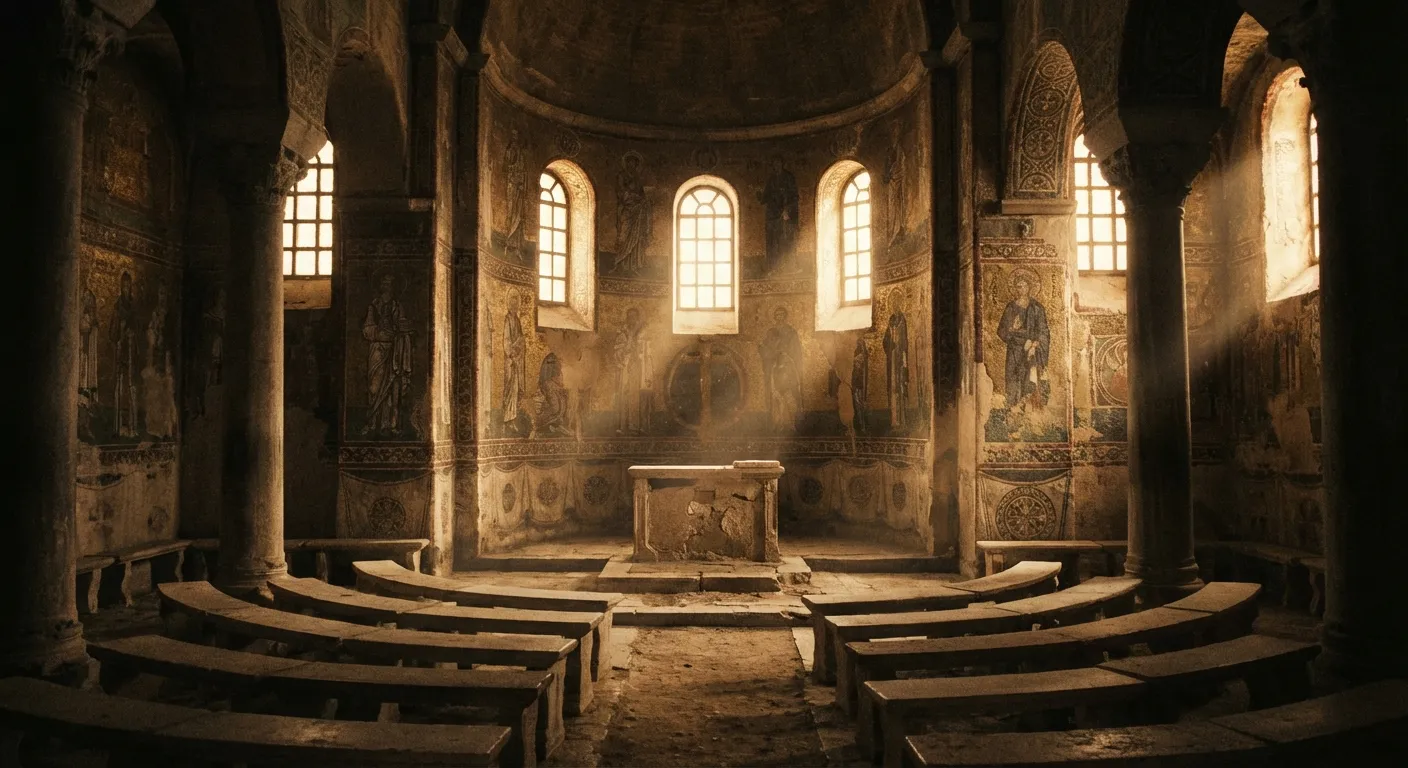
In 325 CE, Emperor Constantine convened a gathering of Christian bishops in the city of Nicea (modern Iznik, Turkey). According to Zeitgeist, this council marks the moment when Christianity as we know it was manufactured—when “politically motivated Christian doctrines” were established, beginning a dark legacy of “religious bloodshed and spiritual fraud.”
The narrative is dramatic: a pagan emperor, seeking to consolidate power, gathered religious leaders and dictated what they would believe. The divinity of Jesus, the contents of the Bible, the structure of Christian doctrine—all invented on the spot to serve imperial interests.
It’s a compelling conspiracy theory. It’s also almost entirely false.
The Council of Nicea is one of the most documented events in late antiquity. We have records of its proceedings, letters from participants, and extensive commentary from contemporaries. What actually happened bears little resemblance to the Zeitgeist narrative.
What Zeitgeist Claims
The film suggests that:
- Constantine created Christianity’s core doctrines at Nicea
- The council decided which books belonged in the Bible
- The council established Christianity as the enforced state religion
- This began an era of religious tyranny and manipulation
Each of these claims is historically false. Let’s examine them in turn.
Claim 1: Constantine Invented Christian Doctrine
The most fundamental error in the Zeitgeist narrative is the claim that Christian doctrine was established in the fourth century. This ignores nearly 300 years of documented Christian belief.
The Evidence from Paul (c. 50 CE)
Paul’s letters, written approximately 270 years before Nicea, already contain what scholars call “high Christology”—the belief that Jesus was divine, not merely a human teacher.
In Philippians 2:6–11, Paul writes (or quotes an even earlier hymn) that Christ Jesus, “though he was in the form of God, did not count equality with God a thing to be grasped, but emptied himself, by taking the form of a servant, being born in the likeness of men.”
In 1 Corinthians 8:6, Paul declares: “Yet for us there is one God, the Father, from whom are all things and for whom we exist, and one Lord, Jesus Christ, through whom are all things and through whom we exist.”
This is not the language of a later political invention. It’s the earliest Christian writing we possess, and it already treats Jesus as a pre-existent divine being through whom God created the universe.
Bart Ehrman, who is no friend to Christian apologetics, emphasizes this point: the belief in Jesus’ divinity was not invented at Nicea. It was the foundational conviction of the Christian movement from its inception.
The Gospels (c. 70–100 CE)
By the time the Gospels were written, Christian belief in Jesus’ divine nature was well established.
The Gospel of John, composed around 90–95 CE, opens with an explicit declaration: “In the beginning was the Word, and the Word was with God, and the Word was God… And the Word became flesh and dwelt among us” (John 1:1, 14).
This is full-blown incarnational theology—God becoming human in Jesus Christ—written more than 200 years before Constantine was born.
The Synoptic Gospels (Matthew, Mark, Luke) present Jesus performing miracles, forgiving sins (a divine prerogative), and accepting worship. The resurrection narratives depict disciples worshipping the risen Jesus. These texts circulated throughout the Christian world long before any Roman emperor took interest in the church.
The Pre-Nicene Rule of Faith
By the late second century, Christian teachers had articulated what they called the “Rule of Faith” (regula fidei)—a summary of essential Christian beliefs.
Irenaeus of Lyon, writing around 180 CE, describes this rule:
“…this faith: in one God, the Father Almighty, who made the heaven and the earth and the seas and all the things that are in them; and in one Christ Jesus, the Son of God, who was made flesh for our salvation; and in the Holy Spirit…”
Tertullian, writing around 200 CE, provides similar summaries. These pre-Nicene statements mirror the later Nicene Creed in their essential content. The creed didn’t invent new beliefs; it codified what Christians had believed for centuries.
What This Means
The Zeitgeist narrative requires us to believe that Constantine invented doctrines in 325 CE that are documented in texts from 50–200 CE. This is historically impossible. The evidence is unambiguous: Christian belief in Jesus’ divinity predates Nicea by nearly three centuries.
What Actually Happened at Nicea
If Nicea didn’t invent Christianity, what was it actually about?
The Arian Controversy
The council was convened to address a specific theological dispute that had been tearing the church apart: the Arian Controversy.
A priest named Arius, based in Alexandria, had been teaching that the Son of God was a created being—the first and greatest of God’s creations, but not co-eternal with the Father. In Arius’s famous phrase, “there was a time when the Son was not.”
His opponent, the deacon Athanasius (later bishop of Alexandria), insisted that the Son was of the same substance (homoousios) as the Father—not created, but eternally begotten.
Here’s the crucial point: both sides believed Jesus was divine. The debate wasn’t about whether Jesus was God; it was about the nature of that divinity. Was the Son a lesser divine being, created by the Father? Or was the Son fully and equally God, sharing the Father’s eternal nature?
This was an in-house Christian debate about how to interpret texts that both sides accepted as authoritative. The council didn’t invent the doctrine of Christ’s divinity; it adjudicated a dispute about what that divinity meant.
Constantine’s Role
Constantine did convene the council. He wanted a unified church to support a unified empire—religious division was politically inconvenient. But his role was that of a facilitator, not a theologian.
The historical evidence suggests Constantine was largely ignorant of the theological nuances involved. He wanted the bishops to reach consensus; he didn’t particularly care what that consensus was, as long as they stopped fighting.
The actual theological work was done by the bishops themselves, who debated, argued, and eventually formulated the Nicene Creed based on their reading of Scripture and tradition. Constantine ratified their decision; he didn’t dictate it.
The Nicene Creed
The creed that emerged from Nicea affirmed that the Son was:
”…God from God, Light from Light, true God from true God, begotten not made, of one substance (homoousios) with the Father…”
This was a victory for Athanasius’s position and a defeat for Arianism. But it wasn’t an invention—it was a clarification of what the bishops believed Scripture and tradition had always taught.
The council also addressed other matters: the date of Easter, the status of those who had lapsed during persecution, and various administrative issues. It was a working session, not a conspiracy to manufacture religion.
Claim 2: Nicea Decided the Biblical Canon
One of the most persistent myths about Nicea—popularized by The Da Vinci Code as well as Zeitgeist—is that the council decided which books belonged in the Bible.
This is simply false. The Council of Nicea did not discuss the biblical canon.
The Actual History of the Canon
The formation of the New Testament canon was a gradual process that unfolded over centuries.
By the mid-second century, the four Gospels and Paul’s major letters were widely accepted as authoritative. Other books (Hebrews, James, Revelation) were debated in some regions but accepted in others. The process was organic, driven by usage in worship and teaching, not by imperial decree.
The first list matching our current 27-book New Testament appears in a letter by Athanasius of Alexandria in 367 CE—more than 40 years after Nicea. And even after that, regional variations persisted.
The councils that formally affirmed the canon were local synods at Hippo (393 CE) and Carthage (397 CE)—not Nicea, and not under Constantine (who died in 337 CE).
The idea that Constantine determined the contents of the Bible is a modern fiction. It has no basis in any ancient source.
Why the Myth Persists
The “Constantine created the Bible” narrative is appealing because it offers a simple explanation for complex historical processes. It’s easier to imagine a single decision point than to trace the messy, centuries-long development of the canon.
But history doesn’t work that way. The biblical canon emerged through a gradual process of reception and recognition across diverse Christian communities. No single council or emperor made the decision.
Claim 3: Nicea Established Christianity as State Religion
Zeitgeist implies that Constantine imposed Christianity on the Roman Empire, beginning an era of religious coercion.
The chronology doesn’t support this.
What Constantine Actually Did
In 313 CE—twelve years before Nicea—Constantine and his co-emperor Licinius issued the Edict of Milan. This edict made Christianity a legal religion (religio licita) and ended the persecution that had plagued Christians for generations.
But legalization is not establishment. Christianity became one permitted religion among many. The traditional Roman cults continued to operate. Constantine himself retained the title Pontifex Maximus (chief priest of the Roman state religion) and wasn’t baptized until he was on his deathbed.
When Christianity Became the State Religion
Christianity was not declared the official state religion of Rome until 380 CE, under Emperor Theodosius I—more than 40 years after Constantine’s death.
The Edict of Thessalonica (380 CE) made Nicene Christianity the empire’s official religion and began the process of suppressing both paganism and Christian heresies. The closing of pagan temples and the criminalization of pagan worship came later still, primarily under Theodosius.
To blame Constantine and Nicea for the religious coercion of later centuries is historically inaccurate. Constantine legalized Christianity; Theodosius established it.
The “Dark Ages” Narrative
Zeitgeist suggests that Nicea initiated an immediate descent into religious tyranny. This is anachronistic.
The political power often attributed to the institutional church in popular imagination—the ability to suppress dissent, control information, and enforce orthodoxy through violence—developed gradually over centuries. The fourth-century church, still adjusting to its new legal status, did not possess these capabilities.
The relationship between church and state in late antiquity was complex and evolving. It wasn’t a sudden imposition of theocratic control.
What the Evidence Shows
Let’s summarize what actually happened:
Before Nicea
- Christian belief in Jesus’ divinity is documented from the 50s CE onward
- The core narrative (incarnation, crucifixion, resurrection) appears in texts from 70–100 CE
- The “Rule of Faith” summaries from 180–200 CE match the essential content of later creeds
- Christians had been dying for these beliefs for nearly 300 years before Constantine showed any interest
At Nicea
- The council addressed the Arian Controversy—a debate about the nature of Christ’s divinity, not its existence
- Bishops debated and formulated the creed based on Scripture and tradition
- Constantine facilitated but did not dictate the theological outcome
- The biblical canon was not discussed
After Nicea
- Constantine legalized Christianity but did not make it the state religion
- The biblical canon was defined decades later through a separate process
- Christianity became the official state religion under Theodosius in 380 CE
- The institutional power often attributed to “the Church” developed gradually over centuries
Why This Matters
The Zeitgeist narrative about Nicea serves a specific rhetorical purpose: it allows the film to dismiss Christianity as a political invention rather than engaging with its actual claims.
If Constantine created Christianity in 325 CE, then everything Christians believe is just imperial propaganda. The question of whether Jesus rose from the dead becomes irrelevant—it’s all made up anyway.
But the historical evidence doesn’t support this convenient dismissal. Christian beliefs are documented centuries before Constantine. The council addressed a specific dispute within an already-established tradition. The “Constantine invented Christianity” narrative is itself a modern invention.
This matters because historical truth matters. If we’re going to evaluate Christianity, we should evaluate what it actually claims based on what actually happened—not on conspiracy theories that collapse under scrutiny.
The Real Questions
Once we clear away the historical errors, we’re left with the real questions:
- Did Jesus exist? (The evidence says yes.)
- What did the earliest Christians believe about him? (They believed he was divine, died, and rose again.)
- Are those beliefs true?
The third question is the one that matters. It can’t be answered by appealing to conspiracy theories about Constantine. It requires engaging with the actual evidence: the resurrection appearances, the empty tomb, the transformation of the disciples, the explosive growth of the early church.
The Council of Nicea didn’t invent Christianity. It clarified beliefs that Christians had held—and died for—since the first century.
Whether those beliefs are true is a question Nicea cannot answer for us.
Author’s Note (2026): This article was originally written in 2013 but was never published at the time. Prior to publication in 2026, it has been carefully reviewed and updated to ensure that historical references, scholarly claims, and source material are accurate, current, and properly represented.