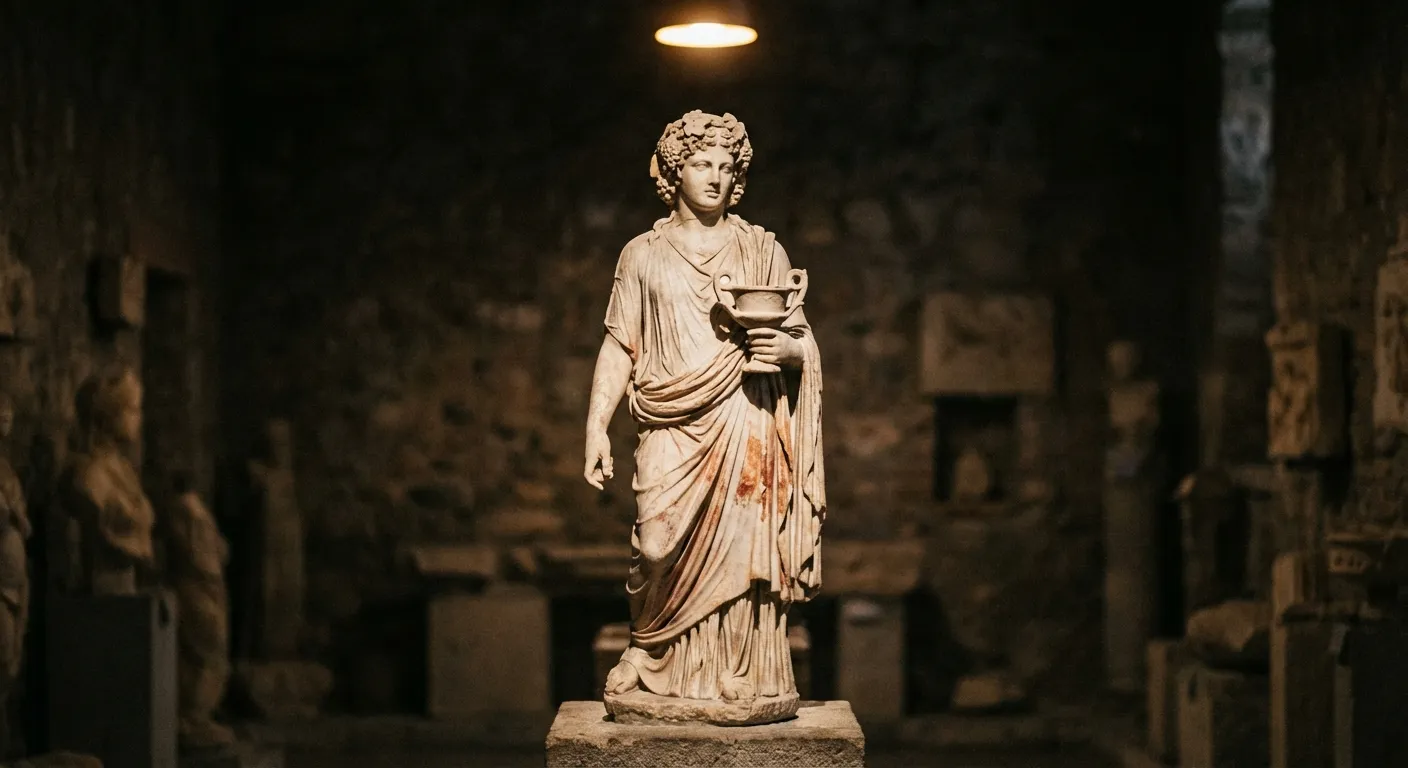
Dionysus—the Greek god of wine, ecstasy, and ritual madness—is another deity invoked by Zeitgeist as a template for Jesus. The parallels sound compelling at first:
- Born of a virgin
- Born on December 25
- Turned water into wine
- Rose from the dead
Add to this the claim that the very name “Jesus” derives from a Dionysian epithet, and Christianity appears to be little more than Greek mystery religion with a Jewish veneer.
But when we examine the actual mythology and the linguistic claims, the parallels collapse. Dionysus was not born of a virgin. The “IES” etymology is a fabrication. And while Christianity did compete with Dionysian cults in the Hellenistic world, competition is not the same as plagiarism.
The Virgin Birth Claim
The Claim: Dionysus was born of a virgin on December 25, serving as the template for Jesus’ nativity.
What Greek Mythology Says: Dionysus was born of a union between Zeus and Semele, a mortal princess. In the standard myth, Zeus appears to Semele and they have sexual relations. When Semele (tricked by the jealous Hera) asks to see Zeus in his true divine form, she is incinerated by his glory. Zeus rescues the unborn Dionysus and sews him into his own thigh, from which Dionysus is later “born.”
In variant traditions, Dionysus’s mother is Persephone rather than Semele, but again, the conception involves Zeus having intercourse with her.
Neither version is a virgin birth. Both involve sexual union between Zeus and a female figure. The mother is not a virgin; she has had relations with the king of the gods.
Bart Ehrman notes that mythicists frequently equivocate on the term “virgin.” In pagan myths where a god impregnates a mortal woman, sex is almost always involved—sometimes in disguised form (Zeus as a swan, a bull, a shower of gold), but sex nonetheless. This is conceptually distinct from the Christian claim of asexual conception by the Holy Spirit.
The Gospels of Matthew and Luke describe Mary conceiving without intercourse of any kind. No male figure, divine or human, has sexual relations with her. Gabriel announces that “the Holy Spirit will come upon you, and the power of the Most High will overshadow you” (Luke 1:35). This is not the same as Zeus sleeping with Semele.
As for December 25: the date appears nowhere in the New Testament and was not adopted for Christmas until the fourth century. Even if Dionysus had been celebrated on that date, it would be irrelevant to the origins of Christianity.
The “IES” Linguistic Fallacy
The Claim: The name “Jesus” derives from “IES,” a pagan epithet for Dionysus.
What Linguists Say: This claim is, in Maurice Casey’s words, a “ludicrous word game” lacking any philological basis.
The claim originates with D.M. Murdock (Acharya S), who revived 19th-century pseudo-scholarship to argue that “Jesus” derives from “IES,” supposedly an anagram connected to Dionysus or related Sanskrit words. Casey critiques this as the same kind of linguistic incompetence we’ve seen throughout mythicist arguments.
The actual etymology of “Jesus” is straightforward and well-documented:
- Jesus (Iēsous in Greek) is the standard Greek transliteration of the Semitic name Yeshua or Yehoshua (Joshua)
- The name means “Yahweh saves” in Hebrew
- It was a common Jewish name in the Second Temple period
- It appears frequently in Josephus and the Septuagint (the Greek translation of the Hebrew Bible)
The name has a clear Jewish etymology, attested across multiple independent sources, completely unrelated to Greek Bacchic titles. The “IES” connection is invented—a modern fabrication with no support in ancient linguistics.
Water to Wine: Competition, Not Plagiarism
The Claim: Jesus’ miracle of turning water into wine at Cana was copied from Dionysus, the god of wine.
What Scholars Say: There is a relationship here—but it’s competition, not plagiarism.
Dionysus was associated with wine miracles in Greek tradition. His cult celebrated wine as a divine gift. When the Gospel of John describes Jesus turning water into wine at a wedding in Cana (John 2:1-11), the narrative exists in a cultural context where Dionysus was the acknowledged deity of wine.
Gerd Theissen acknowledges this context. The story of Cana portrays a miracle that “exceeds a miracle by Dionysus.” But historians view this not as evidence that Jesus was a fictional copy of Dionysus. Rather, early Christians shaped their narratives to portray Jesus as superior to rival deities in the Hellenistic marketplace.
This is a crucial distinction. The early church existed in a religiously competitive environment. When Christian writers emphasized Jesus’ power over wine, they were making a polemical point: our Lord is greater than your wine god. This is religious competition—one tradition asserting superiority over another—not evidence that Jesus didn’t exist or that his story was borrowed.
Similar dynamics appear throughout the New Testament. The titles applied to Jesus (“Lord,” “Savior,” “Son of God”) were also used for Roman emperors. Christians weren’t copying imperial propaganda; they were challenging it.
The Eucharist Claim
The Claim: The Christian Eucharist was copied from Dionysian rituals involving the consumption of the god.
What Scholars Say: The parallels are superficial, and the specific claims are factually wrong.
Mythicists (particularly Acharya S) claim the Eucharist copies the Eleusinian mysteries of Dionysus/Bacchus. Maurice Casey refutes this on basic factual grounds: the Eleusinian mysteries focused on Demeter and Persephone, not Dionysus. There is no evidence of an “Eleusinian Eucharist” involving the body and blood of a god.
Dionysian cults did involve ecstatic practices, including omophagy—the ritual eating of raw flesh, often of an animal representing or embodying the god. This is quite different from the Christian Eucharist, which involves bread and wine, not raw flesh, and which Jesus instituted at a Passover meal.
H.J. Klauck (cited by Theissen) examined the evidence and concluded there are “no real parallels” to the Christian concept of the “real presence” of the deity in a sacramental meal outside of primitive Christianity. The Eucharist has clear roots in Jewish practice—Passover, table fellowship, Jesus’ specific words at the Last Supper—that explain its origins without requiring Dionysian borrowing.
The “Dying and Rising God” Problem
The Claim: Dionysus was a “dying and rising god” who provided the template for Jesus’ death and resurrection.
What Scholars Say: The “dying and rising god” category has largely collapsed under scholarly scrutiny.
Bart Ehrman and J.Z. Smith have both demonstrated that this category—popularized by Frazer’s The Golden Bough—is a scholarly construct that doesn’t hold up when you examine the actual myths:
- In many pagan myths, the god dies but does not return
- In others, the god disappears and returns but does not die
- There is no unambiguous pre-Christian instance of a deity undergoing specific death and bodily resurrection for the atonement of sins
The Christian claim about Jesus is specific: he died, was buried, and rose bodily on the third day, appearing to witnesses before ascending to heaven. His death was interpreted as a vicarious atonement for human sin. This specific pattern does not appear in pre-Christian Dionysus mythology.
Where later texts (post-Christian) do suggest resurrection motifs for figures like Dionysus or Adonis, Ehrman suggests this may actually reflect pagan traditions being influenced by Christianity, not the reverse. Christianity was the aggressively expanding movement; older cults adapted to compete.
What the Evidence Actually Shows
| Claim | Reality |
|---|---|
| Virgin birth | No—Zeus had sex with Semele (or Persephone) |
| Born December 25 | Not in Greek sources; irrelevant since Dec 25 isn’t in NT |
| ”Jesus” from “IES” | No—“Jesus” is Greek for Hebrew “Yeshua” (Joshua) |
| Water to wine copied | Competition, not plagiarism—Christians claimed superiority |
| Eucharist from Dionysus | No—different rituals; Eucharist has Jewish roots |
| Dying and rising god | Category doesn’t hold up; no pre-Christian parallel to Jesus’ specific death/resurrection |
Competition vs. Plagiarism
The relationship between early Christianity and Dionysian religion is real—but it’s the relationship of competitors, not of original and copy.
Christianity emerged into a world full of religious options. The Hellenistic marketplace offered mystery cults, imperial religion, philosophical schools, and traditional polytheism. Christians made claims about Jesus that directly challenged these alternatives: he is the true Lord (not Caesar), the true source of life and joy (not Dionysus), the true wisdom (not philosophy).
This competitive dynamic shaped how Christians told their stories and which details they emphasized. But shaping a narrative to compete with rivals is not the same as inventing a fictional character based on those rivals.
The historical Jesus—a Jewish teacher executed by Rome—is the foundation. The Christian proclamation about him developed in dialogue with, and often in opposition to, the surrounding religious culture. That’s how religions work. It doesn’t make Jesus a copy of Dionysus any more than it makes him a copy of Caesar.
The Jewish Context Remains Primary
As with the other alleged parallels, the Dionysus hypothesis fails because Jesus is fully explicable within first-century Judaism.
The Eucharist has clear roots in Passover and Jewish table fellowship. The resurrection proclamation draws on Jewish apocalyptic expectation (Daniel 12, 2 Maccabees 7). The title “Son of God” comes from Jewish royal theology. The twelve disciples represent the twelve tribes.
Early Christians were Jews interpreting a Jewish teacher through Jewish Scripture. The Greek context influenced how they communicated in the broader Hellenistic world, but it didn’t create Jesus out of whole cloth.
Dionysus was a Greek god of wine and ecstasy. Jesus was a Jewish prophet executed by Rome. The two figures have different origins, different cultural contexts, and different meanings. The parallels alleged by Zeitgeist are either fabricated or superficial.
Author’s Note (2026): This article was originally written in 2013 but was never published at the time. Prior to publication in 2026, it has been carefully reviewed and updated to ensure that historical references, scholarly claims, and source material are accurate, current, and properly represented.