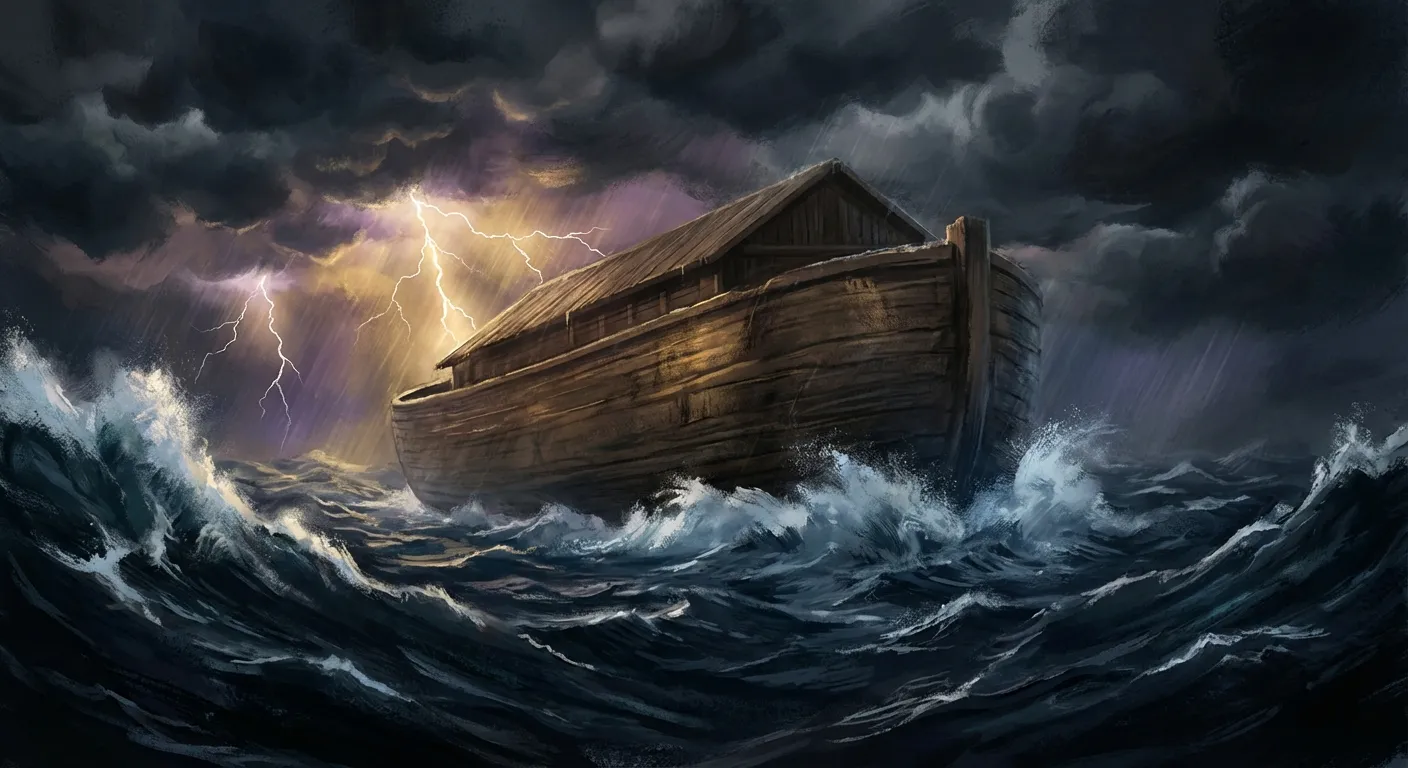
The Epic of Gilgamesh presents perhaps the most historically significant parallel to any biblical narrative. Unlike the spurious Horus comparisons or fabricated Dionysus etymologies we’ve examined in this series, the relationship between the Mesopotamian flood account and Genesis 6–9 involves real textual connections that scholars take seriously.
This makes the Zeitgeist claim both more interesting and more misleading. The film asserts that the biblical flood is a straightforward “plagiarization” of the Epic of Gilgamesh—copied wholesale by Hebrew scribes who dressed up an older Babylonian myth in monotheistic clothing. The implication is clear: if the flood story existed before Moses, then Genesis is fiction.
But this framing misrepresents how scholars actually understand the relationship between these texts. Even those who believe Genesis depends on Mesopotamian sources reject the crude “plagiarism” label. And from a Christian presuppositional standpoint, the Wiseman Hypothesis offers a compelling alternative: that Genesis preserves the original eyewitness account, while Gilgamesh represents a later mythological distortion.
The Claim We Must Examine
The Zeitgeist Claim: The Genesis flood narrative was copied directly from the Epic of Gilgamesh, proving that the Bible is derivative mythology rather than historical revelation.
The film presents this as a simple case of literary theft. An older text (Gilgamesh) exists; a newer text (Genesis) shares obvious similarities; therefore the newer text plagiarized the older one. Case closed.
But comparative literature doesn’t work this way. And the actual scholarship on this question is far more nuanced than Zeitgeist suggests.
What the Texts Actually Say
Before evaluating the relationship, we need to understand what each text claims.
The Epic of Gilgamesh (Tablet XI)
The Mesopotamian flood account appears in Tablet XI of the Epic of Gilgamesh, where the immortal Utnapishtim tells Gilgamesh how he survived a great deluge:
- The god Ea secretly warns Utnapishtim that the gods have decided to destroy humanity
- Utnapishtim builds a boat and loads it with his family, craftsmen, and animals
- A catastrophic storm destroys all other life
- The boat comes to rest on Mount Nisir
- Utnapishtim releases birds (a dove, a swallow, a raven) to find dry land
- He offers sacrifice; the gods gather around “like flies”
- Utnapishtim and his wife are granted immortality
The Genesis Flood (Chapters 6–9)
The biblical account describes:
- God warns Noah that He will destroy humanity because of their moral corruption
- Noah builds an ark according to divine specifications and loads it with his family and pairs of animals
- A catastrophic flood destroys all other life
- The ark comes to rest on the mountains of Ararat
- Noah releases birds (a raven, then doves) to find dry land
- He offers sacrifice; God smells the pleasing aroma
- God makes a covenant with Noah, placing His bow in the clouds
The parallels are unmistakable: a divine warning, a single righteous survivor, a boat, animals preserved, birds released, sacrifice offered after the waters recede. These are not coincidental similarities.
The Scholarly Landscape: Three Positions
Contemporary scholarship offers three main frameworks for understanding this relationship. Honesty requires that we represent each fairly.
Position 1: Genesis Depends on Mesopotamian Tradition
Many critical scholars argue that the Hebrew scribes knew the Mesopotamian flood tradition and adapted it for their own purposes. This view notes that:
- Gilgamesh (in its Standard Babylonian version) dates to around 1200 BCE, with the flood tradition appearing even earlier in the Atrahasis Epic (c. 1700 BCE)
- The Israelites had extensive contact with Mesopotamian culture, especially during the Babylonian exile
- The structural parallels are too specific to be coincidental
However—and this is crucial—scholars who hold this view do not call it plagiarism. They describe it as “adaptation,” “polemical subversion,” or “theological transformation.” The biblical authors, on this view, took a known cultural template and radically rewrote its meaning.
Bart Ehrman, no friend of conservative Christianity, criticizes mythicists for misusing scholarly work on ancient parallels. Finding literary relationships is not the same as finding copying. Ancient authors engaged with their cultural milieu; they didn’t simply steal from it.
Position 2: Shared Cultural Memory
A second scholarly position argues that both Genesis and Gilgamesh preserve independent memories of a historical catastrophe. On this view:
- A massive flood (perhaps regional, perhaps global) occurred in the ancient Near East
- Multiple cultures preserved memories of this event
- The Mesopotamian and Hebrew traditions developed independently from a common historical core
- Similarities reflect shared experience, not literary borrowing
This position is supported by the fact that flood traditions appear in cultures worldwide—not just in the ancient Near East but in Greek, Hindu, Chinese, and Native American traditions. While not all scholars find this evidence compelling, it suggests the possibility of a historical event remembered diversely across cultures.
Position 3: Genesis Preserves the Original Account (The Wiseman Hypothesis)
From a Christian presuppositional standpoint, the most compelling framework is P.J. Wiseman’s “Tablet Theory,” which argues that Genesis was compiled from ancient cuneiform records written by the patriarchs themselves.
Wiseman identified the recurring Hebrew phrase eleh toledoth (“These are the generations of…”) not as a chapter heading introduced by a later editor, but as a colophon—a standard scribal device used throughout ancient Mesopotamia to mark the end of a tablet. A colophon typically identifies the owner or writer of the tablet and sometimes dates the material.
Under this model:
- The phrase “These are the generations of Noah” (Genesis 6:9) signals that what precedes comes from Noah’s records
- The flood narrative was recorded by the survivors themselves—Noah and his sons
- These tablets were passed down through the patriarchal line and eventually compiled by Moses
- The Genesis account is the primary historical record, written shortly after the events occurred
If Wiseman is correct, the implications are profound. The Epic of Gilgamesh would not be the source for Genesis but rather a later mythologized distortion of the same historical event. The Babylonian version accumulated theological embellishments over centuries, while the Hebrew tradition preserved the original account through careful patriarchal record-keeping.
Evidence Supporting the Wiseman Hypothesis
Several lines of evidence support the antiquity and priority of the Genesis account:
The Rule of Literary Accretion
Egyptologist Kenneth Kitchen has documented a consistent pattern in ancient Near Eastern literature: traditions typically evolve from simple, matter-of-fact prose into elaborate, embellished legends. This pattern of “accretion” is well-established across multiple cultures and literary traditions.
Applying this principle to the flood accounts:
- Genesis is written in sober, factual prose. It focuses on logbook-style details: specific dates (“In the six hundredth year of Noah’s life, in the second month, on the seventeenth day of the month”), precise dimensions (300 x 50 x 30 cubits), and genealogical records.
- Gilgamesh is poetic, dramatic, and fantastical. The gods cower in terror, swarm like flies around the sacrifice, and bicker among themselves.
Following the standard pattern of literary evolution, the sober Genesis account more likely represents the older, “purer” tradition, while Gilgamesh represents later mythological elaboration.
Nautical Realism
The physical descriptions of the vessels reveal a striking difference between historical realism and mythological symbolism.
The Cube of Gilgamesh: Utnapishtim is instructed to build a perfect cube (120 x 120 x 120 cubits) with seven decks. Nautical engineers confirm that a cubic hull is inherently unstable—it would roll violently in rough water, making survival impossible. The dimensions reflect religious symbolism (a floating Ziggurat or temple tower) rather than physical reality.
The Rectangular Ark: The biblical Ark uses a ratio of 30:5:3 (300 x 50 x 30 cubits). These proportions mirror historical cargo barges designed for stability rather than propulsion. Modern naval architecture confirms that this ratio produces excellent stability in rough seas.
The shift from an unseaworthy mythological cube to a functional, seaworthy barge suggests that Genesis preserves realistic specifications—likely recorded by the builder himself—while the Babylonian tradition distorted the dimensions into religious symbolism.
Linguistic Evidence
Linguist A.S. Yahuda noted that while biblical books written during the Babylonian Exile are saturated with Babylonian loanwords, the Genesis flood narrative is remarkably free of them. Instead, it reflects an Egyptian linguistic milieu, consistent with Mosaic authorship using earlier patriarchal tablets, rather than a late “copy” of Babylonian mythology.
If Hebrew scribes had simply adapted the Babylonian flood story during or after the exile, we would expect to find Babylonian vocabulary permeating the text. Its absence supports the view that Genesis draws on much older sources.
The Theological Divergence
Even if we bracket questions of literary priority, the theological differences between the accounts are irreconcilable. These are not minor variations; they represent fundamentally opposed worldviews.
Divine Motivation: Caprice vs. Justice
In Gilgamesh: The gods destroy humanity for arbitrary reasons. In the earlier Atrahasis tradition, the chief god Enlil orders the flood because human “noise” (rigmu) disturbs his sleep. The destruction is an act of divine irritation—capricious and morally unjustified.
In Genesis: God judges humanity because of moral corruption and “violence” (hamas). The flood is a judicial response to ethical anarchy, grounded in the character of a morally perfect God. Genesis 6:5 states: “The LORD saw that the wickedness of man was great in the earth, and that every intention of the thoughts of his heart was only evil continually.”
This is not a surface-level difference. It reflects entirely different conceptions of deity: a petty, sleep-deprived pantheon versus a holy God who acts in accordance with moral justice.
Divine Character: Vulnerability vs. Sovereignty
In Gilgamesh: The gods are depicted as terrified by the storm they unleashed. They “cowered like dogs” and wept, regretting their decision. When Utnapishtim offers sacrifice, the gods “gathered like flies” around the offering because they were starving—having destroyed the humans who fed them through sacrifice.
In Genesis: God remains transcendent and in total control throughout. He “remembers” Noah (a Hebrew idiom for deliberate, covenantal action, not a lapse in memory). He smells the “pleasing aroma” of Noah’s sacrifice but does not need the food. The sacrifice results in a covenant of peace, not a feeding frenzy.
The Mesopotamian gods are vulnerable, dependent creatures who panic in the face of their own creation. The God of Genesis is self-sufficient, sovereign, and purposeful.
Post-Flood Symbolism: Grudge vs. Covenant
In Gilgamesh: The goddess Ishtar lifts her necklace of lapis lazuli as a memorial of the gods’ folly and her grudge against Enlil for causing the flood.
In Genesis: Yahweh sets His “bow” (qeshet—a weapon of war) in the clouds. This symbolizes the “retirement” of the divine weapon, pointing away from the earth as a sign of demilitarization and eternal covenant. God binds Himself to never again destroy the earth by flood.
One account ends with divine resentment; the other with divine promise. These are not variations on a theme but contradictory theological statements.
Why the “Plagiarism” Label Fails
The Zeitgeist framing of this relationship as “plagiarism” or “copying” fails for several reasons:
1. It ignores ancient literary conventions. Ancient authors did not operate under modern notions of copyright and originality. Working within a shared cultural tradition—engaging, adapting, and challenging known stories—was standard practice, not intellectual theft.
2. It commits the fallacy of “parallelomania.” Biblical scholar Samuel Sandmel coined this term to describe the scholarly vice of overstating literary similarities while ignoring differences. Finding parallels is not the same as proving dependence, and proving dependence is not the same as proving “copying.”
3. It ignores polemical intent. Even scholars who believe Genesis depends on Mesopotamian tradition recognize that the Hebrew authors radically transformed what they received. They weren’t copying; they were correcting—replacing a capricious pantheon with a sovereign, moral God.
4. It fails to consider alternative models. The Wiseman Hypothesis and the shared cultural memory model both offer explanations for the parallels that don’t require Genesis to be derivative. Responsible scholarship considers all viable hypotheses.
The Christian Response
From a Christian perspective, the relationship between Genesis and Gilgamesh is not a threat to faith but a confirmation of it.
If a catastrophic flood actually occurred—as Genesis claims—we would expect other cultures to preserve memories of it. The existence of flood traditions across the ancient Near East is precisely what we should find if the biblical account is historical.
The Wiseman Hypothesis provides a coherent framework for understanding how the original, accurate account was preserved through careful patriarchal record-keeping while other cultures’ memories devolved into mythology. Noah’s descendants carried the historical memory with them as they dispersed; over time, that memory was corrupted in most lineages but faithfully preserved in the line that led to Abraham, Isaac, Jacob, and eventually Moses.
This is not special pleading. It’s the application of a well-documented pattern (Kitchen’s rule of accretion) and a plausible transmission model (Wiseman’s tablets) to the available evidence.
Addressing Common Objections
“But Gilgamesh is older!”
The surviving manuscripts of Gilgamesh are older than the surviving manuscripts of Genesis. But manuscript date is not the same as composition date, and composition date is not the same as the age of the underlying tradition. If Wiseman is correct, the Genesis flood account was recorded by Noah’s family shortly after the event—far earlier than any surviving cuneiform copy.
“You’re just assuming the Bible is right.”
Every interpreter brings presuppositions. The critical scholar presupposes naturalism and late authorship; the Christian presupposes the reliability of Scripture. What matters is which framework better explains the evidence. The nautical realism of the Ark, the absence of Babylonian loanwords, the pattern of literary accretion—all of these fit more naturally with the Wiseman Hypothesis than with the “Babylonian copy” theory.
“Scholars don’t take the Wiseman Hypothesis seriously.”
The hypothesis has supporters among conservative scholars and has never been definitively refuted. But even setting Wiseman aside, mainstream scholars reject the Zeitgeist “plagiarism” claim. The choice is not between “copying” and “Christian fundamentalism.” Even critical scholars recognize that Genesis represents sophisticated theological transformation, not crude literary theft.
What This Means for Faith
The existence of Mesopotamian flood traditions should not shake Christian faith. If anything, it strengthens the case for the historical core of the Genesis account.
The question is not whether ancient cultures shared flood stories. They did. The question is which account preserves the truth about what happened and why. Genesis offers a coherent narrative: a morally perfect God judged a morally corrupt humanity, preserved a righteous remnant, and established a covenant of grace.
Gilgamesh offers a fractured pantheon of petty, terrified, hungry gods who destroy humanity on a whim and regret it immediately.
One of these accounts has the ring of historical memory carefully preserved. The other has the hallmarks of mythological elaboration. The evidence suggests that Genesis—far from being a “copy”—preserves the original.
An Invitation
The relationship between Genesis and Gilgamesh is a genuinely interesting scholarly question. It deserves careful study, not dismissive slogans about “plagiarism.”
If you’ve been troubled by this claim, I encourage you to read the primary sources for yourself. Compare the texts. Note the similarities, but pay equal attention to the profound theological differences. Ask yourself which account bears the marks of historical realism and which shows signs of mythological drift.
And consider the possibility that the existence of flood traditions across cultures, far from disproving the Bible, confirms that something catastrophic really happened—something so significant that humanity never forgot it, even as most cultures gradually distorted the memory into myth.
Next in the series: We examine the claim that Moses was copied from Sargon of Akkad.