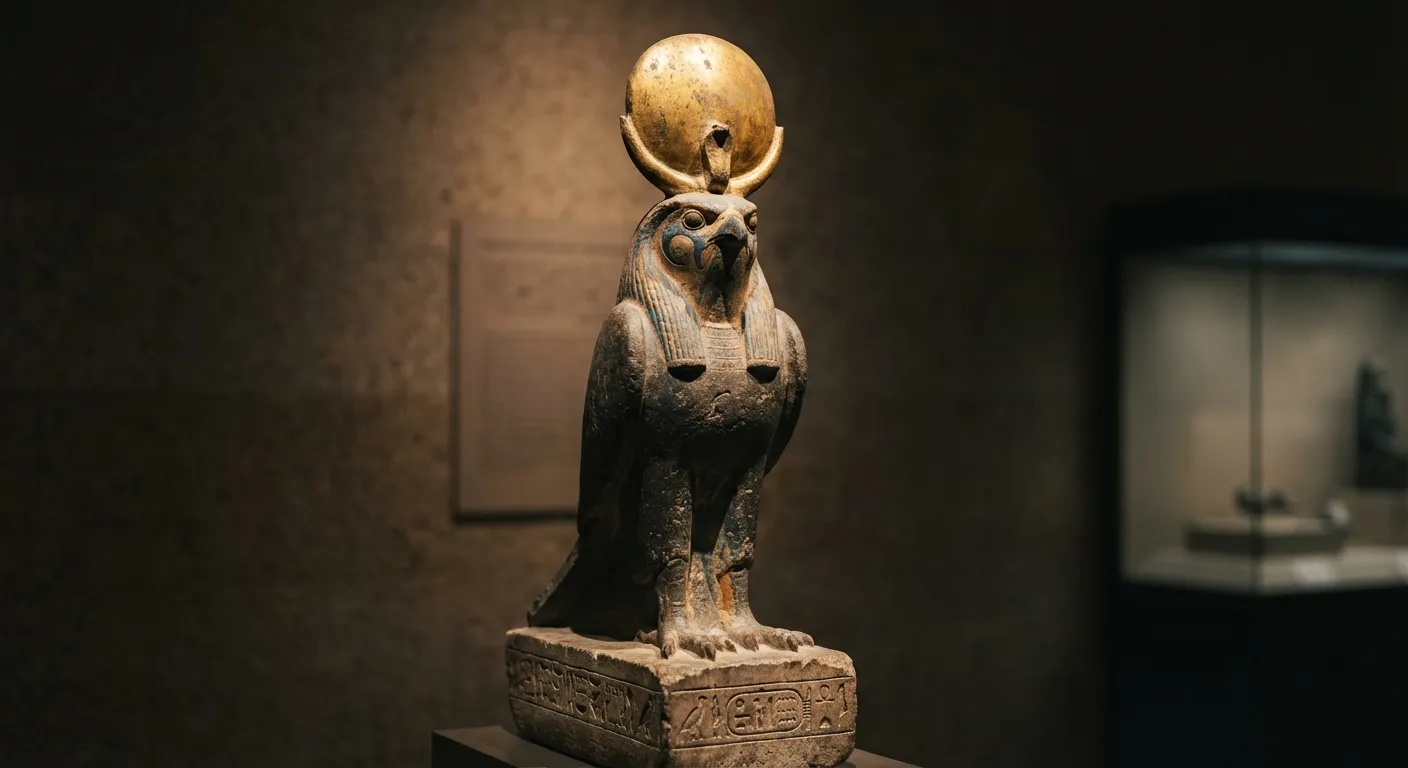
Of all the alleged pagan parallels to Jesus, Horus is the most frequently cited. The Egyptian falcon-headed god appears in countless internet memes, YouTube videos, and popular documentaries—always with the same list of shocking similarities to Christ.
Zeitgeist: The Movie presents the case most memorably:
- Horus was born on December 25
- Born of a virgin (Isis)
- Birth announced by a star in the east
- Attended by three wise men
- Baptized by “Anup the Baptizer” (who was later beheaded)
- Had twelve disciples
- Performed miracles and walked on water
- Was crucified
- Rose from the dead after three days
If this list is accurate, the implications are staggering. Christianity would be exposed as warmed-over Egyptian mythology, its core claims borrowed from a religion thousands of years older.
But is the list accurate?
According to Egyptologists—the scholars who actually work with hieroglyphics, the Pyramid Texts, and the Coffin Texts—the answer is no. The specific claims made by Zeitgeist do not appear in Egyptian sources. They derive almost entirely from 19th-century amateur mythologists whose work is rejected by contemporary scholarship.
Let us examine each claim against what the ancient texts actually say.
The Virgin Birth Claim
The Claim: Horus was born of the virgin Isis on December 25.
What Egyptian Sources Say: In Egyptian mythology, Horus is conceived through sexual union between Isis and her husband Osiris. The details vary across different periods and texts, but the core narrative is consistent:
Osiris is murdered by his brother Set, who dismembers his body and scatters the pieces across Egypt. Isis searches for and recovers the pieces, reassembling her husband’s corpse. In many versions, she fashions a golden phallus to replace the missing original. She then has intercourse with the reassembled body—sometimes transforming into a bird to hover over him—and conceives Horus.
This is emphatically not a virgin birth. It is conception through sexual union with a reanimated corpse. The mechanism is extraordinary by any standard, but it is clearly sexual in nature.
The New Testament narrative is conceptually distinct. Mary does not have intercourse with anyone, divine or human. Gabriel announces that “the Holy Spirit will come upon you, and the power of the Most High will overshadow you” (Luke 1:35). This is asexual conception—a category fundamentally different from the Isis-Osiris story.
As for December 25: there is no fixed “solstice birth” for Horus in Egyptian texts. The date does not appear in ancient sources. And as we’ve noted in previous articles, December 25 is not in the New Testament either—it was adopted by Christians in the fourth century, over 300 years after Jesus’ life.
The “KRST” Linguistic Claim
The Claim: The Egyptian word “KRST” is the origin of “Christ,” proving Egyptian roots for Christianity.
What Egyptologists Say: This claim is based on a fundamental misunderstanding of Egyptian language.
The Egyptian word KRST (or Qeresat) means “burial” or “coffin.” It appears on Egyptian coffins because it refers to the mummification process and the state of being entombed. It has no linguistic or semantic connection to the Greek Christos (meaning “Anointed One”) or the Hebrew Mashiach (Messiah).
Maurice Casey, a secular New Testament scholar, cites modern Egyptologists who confirm this point. The KRST-Christ connection is described as linguistically impossible—a false cognate based on superficial phonetic resemblance.
This claim traces back to Gerald Massey (1828–1907), a 19th-century English poet and amateur Egyptologist. Massey’s work predates the proper decipherment of Egyptian hieroglyphics and is regarded by contemporary Egyptologists as “hopelessly incompetent” and “out of date.” Yet his assertions continue to circulate in popular media because most people never check the sources.
The “Anup the Baptizer” Claim
The Claim: Horus was baptized by a figure named “Anup the Baptizer,” who was later beheaded—the prototype for John the Baptist.
What Egyptian Sources Say: This claim is, to use Maurice Casey’s term, “comically inaccurate.”
“Anup” is simply the Egyptian name for Anubis, the jackal-headed god of embalming and the dead. Anubis presides over mummification and guides souls to the underworld. He is one of the most recognizable figures in Egyptian iconography—depicted with a black jackal’s head, associated with cemeteries and the afterlife.
There is no record in any Egyptian text of Anubis acting as a “baptizer” or performing any water ritual on Horus. The concept of baptism as understood in Jewish and Christian contexts—ritual immersion for purification or initiation—does not map onto Anubis’s role in Egyptian religion.
As for the beheading: there is no Egyptian myth in which Anubis is beheaded. This detail appears to be fabricated entirely to force a parallel with the biblical account of John the Baptist’s execution by Herod.
The alleged linguistic connection between “Anup” and “John” (via Greek “Ioannes”) is equally spurious. These names derive from completely different linguistic roots in different language families. The connection exists only in the imagination of mythicists who need it to exist.
The Twelve Disciples Claim
The Claim: Horus had twelve disciples.
What Egyptian Sources Say: There is no evidence in Egyptian texts that Horus traveled with twelve disciples.
Horus is depicted in various myths with followers—the Shemsu Hor (Followers of Horus)—but their numbers vary considerably across different texts and periods. The most commonly depicted group associated with Horus is his four sons (Imsety, Duamutef, Hapi, and Qebehsenuef), who appear in funerary contexts as protectors of the deceased’s organs stored in canopic jars.
The number twelve does appear in Egyptian cosmology—there are twelve hours of the night, for instance, and the zodiac (adopted from Babylonian sources) has twelve signs. But these are not “disciples” in the sense of students, followers, or apostles who accompany a teacher.
Some mythicists claim Horus had “Twelve Fishers of Men.” This is pure invention. The phrase does not appear in Egyptian sources. (It’s worth noting that in the Bible, only four of Jesus’ disciples are fishermen—Peter, Andrew, James, and John. The others had different occupations.)
As we established in earlier articles, Jesus’ twelve disciples symbolize the restoration of the Twelve Tribes of Israel—a concept deeply rooted in Jewish history and eschatology, not Egyptian astronomy. Jesus explicitly makes this connection in Matthew 19:28, promising the disciples they will “sit on twelve thrones, judging the twelve tribes of Israel.”
The Crucifixion and Resurrection Claim
The Claim: Horus was crucified and rose from the dead after three days.
What Egyptian Sources Say: Horus does not die and rise in Egyptian mythology. The death and resurrection motifs in the Osiris-Horus cycle apply to Osiris, not Horus.
Here is the actual narrative: Osiris is murdered by Set. After Isis reassembles his body and conceives Horus, Osiris does not return to life on earth. Instead, he becomes the ruler of the Duat—the Egyptian underworld, the realm of the dead. He reigns as king of the deceased, judging souls in the afterlife.
This is fundamentally different from the Christian resurrection claim. Jesus, according to the Gospels, rose bodily from death and appeared to his followers in physical form. He ate with disciples, invited Thomas to touch his wounds, and walked the roads of Galilee and Judea for forty days before ascending to heaven. He returned to the world of the living.
Osiris, by contrast, became king of the dead. He did not return to earth. He did not appear to living followers. He ruled a different realm entirely.
Furthermore, crucifixion was a specifically Roman method of execution, developed centuries after Egyptian civilization reached its peak. The concept would have been meaningless in ancient Egyptian context. There is no Egyptian myth depicting Horus (or Osiris) being crucified on a cross.
The “Dying and Rising God” Category
Behind the Horus claims lies a broader assumption: that the ancient world was full of “dying and rising gods,” and that Jesus was simply another instance of this common pattern.
This framework was popularized by James George Frazer in The Golden Bough (1890). For generations, it shaped popular understanding of comparative religion.
But modern scholarship has largely dismantled it.
Jonathan Z. Smith, one of the most respected historians of religion in the 20th century, wrote the definitive encyclopedia article on “Dying and Rising Gods.” His conclusion: the category is “largely a scholarly construct” that doesn’t hold up when you examine the actual myths.
The deities placed in this category don’t actually share the pattern attributed to them:
- Osiris dies but becomes king of the underworld—he doesn’t return to life on earth.
- Adonis descends to the underworld seasonally but doesn’t actually die in most versions.
- Attis dies by self-castration and is preserved as a corpse—he doesn’t rise.
The Christian claim is distinct: a specific person rose bodily from death in historical time, appeared to witnesses, and ascended to heaven. This is not the same as a deity becoming king of the dead or a vegetation god symbolizing seasonal cycles.
Bart Ehrman, an agnostic New Testament scholar, makes this point forcefully in Did Jesus Exist?: the alleged parallels between Jesus and dying gods like Osiris are “either greatly exaggerated or flat-out wrong.”
The Source Problem: Massey and Murdock
Where do these Horus claims come from, if not from Egyptian sources?
The trail leads to two primary figures:
Gerald Massey (1828–1907) was an English poet and self-taught Egyptologist who argued that all religions derived from Egyptian sources. He wrote prolifically, producing books like The Natural Genesis and Ancient Egypt: The Light of the World. His work predates modern Egyptology and relies on interpretations that trained scholars reject as incompetent.
D.M. Murdock (1960–2015), who wrote under the pen name Acharya S, was the primary source for the Zeitgeist film’s religious claims. Her books, including The Christ Conspiracy and Christ in Egypt, present the Horus-Jesus parallels as established fact. Professional Egyptologists and historians have consistently rejected her work as amateur speculation dressed up in scholarly language.
Maurice Casey’s assessment is blunt: Murdock’s work demonstrates “no understanding of ancient languages” and relies on sources that are “hopelessly incompetent.” Her citations frequently trace back to Massey or to other mythicist authors who themselves relied on Massey. It’s a closed loop of citation that never touches the primary Egyptian texts.
What the Evidence Actually Shows
Let us summarize what Egyptology actually reveals about Horus:
| Claim | Egyptian Sources |
|---|---|
| Virgin birth | No—sexual conception with reanimated Osiris |
| Born December 25 | No fixed date in Egyptian texts |
| Baptized by “Anup” | No—Anubis is god of the dead, not a baptizer |
| Twelve disciples | No—followers vary in number; four sons most common |
| Crucified | No—crucifixion is Roman, not Egyptian |
| Rose after three days | No—Osiris becomes king of underworld; Horus doesn’t die |
Every specific parallel claimed by Zeitgeist fails when checked against the primary sources.
This doesn’t mean there are no connections between Egyptian religion and later traditions. Cultural exchange happened throughout the ancient Mediterranean. Hellenistic Egypt saw significant religious syncretism. Scholars debate various points of contact and influence.
But “cultural contact existed” is very different from “Christianity copied Horus.” The specific claims—virgin birth, twelve disciples, crucifixion, resurrection—are fabrications that appear nowhere in Egyptian texts.
Why the Myth Persists
Given the evidence, why does the Horus-Jesus parallel remain so popular?
It sounds authoritative. Most people have never read the Pyramid Texts or the Book of the Dead. When someone presents a list of parallels with confidence, it feels like insider knowledge.
It confirms existing beliefs. If you already suspect Christianity is fabricated, the Horus theory provides “evidence.” Confirmation bias does the rest.
Checking requires expertise. Evaluating claims about Egyptian mythology requires access to primary sources and knowledge of ancient languages. Most people can’t verify the claims themselves, so they trust the confident presentation.
The internet amplifies errors. A well-produced documentary reaches millions; scholarly refutations reach thousands. The myth spreads faster than the correction.
Conclusion
The claim that Jesus was copied from Horus is not supported by Egyptian sources. It derives from 19th-century amateur speculation that modern Egyptologists reject. The specific parallels—virgin birth, twelve disciples, crucifixion, resurrection after three days—are fabrications that do not appear in the Pyramid Texts, the Coffin Texts, or any other ancient Egyptian literature.
This doesn’t prove Christianity is true. That’s a separate question requiring separate investigation. What it does show is that the Horus argument is not a serious challenge to Christian claims. It’s a modern myth about ancient myths—a fabrication built on fabrications.
If you want to evaluate Christianity, engage its actual claims in their actual historical context. The Horus parallel is a distraction, not an argument.
Author’s Note (2026): This article was originally written in 2013 but was never published at the time. Prior to publication in 2026, it has been carefully reviewed and updated to ensure that historical references, scholarly claims, and source material are accurate, current, and properly represented.