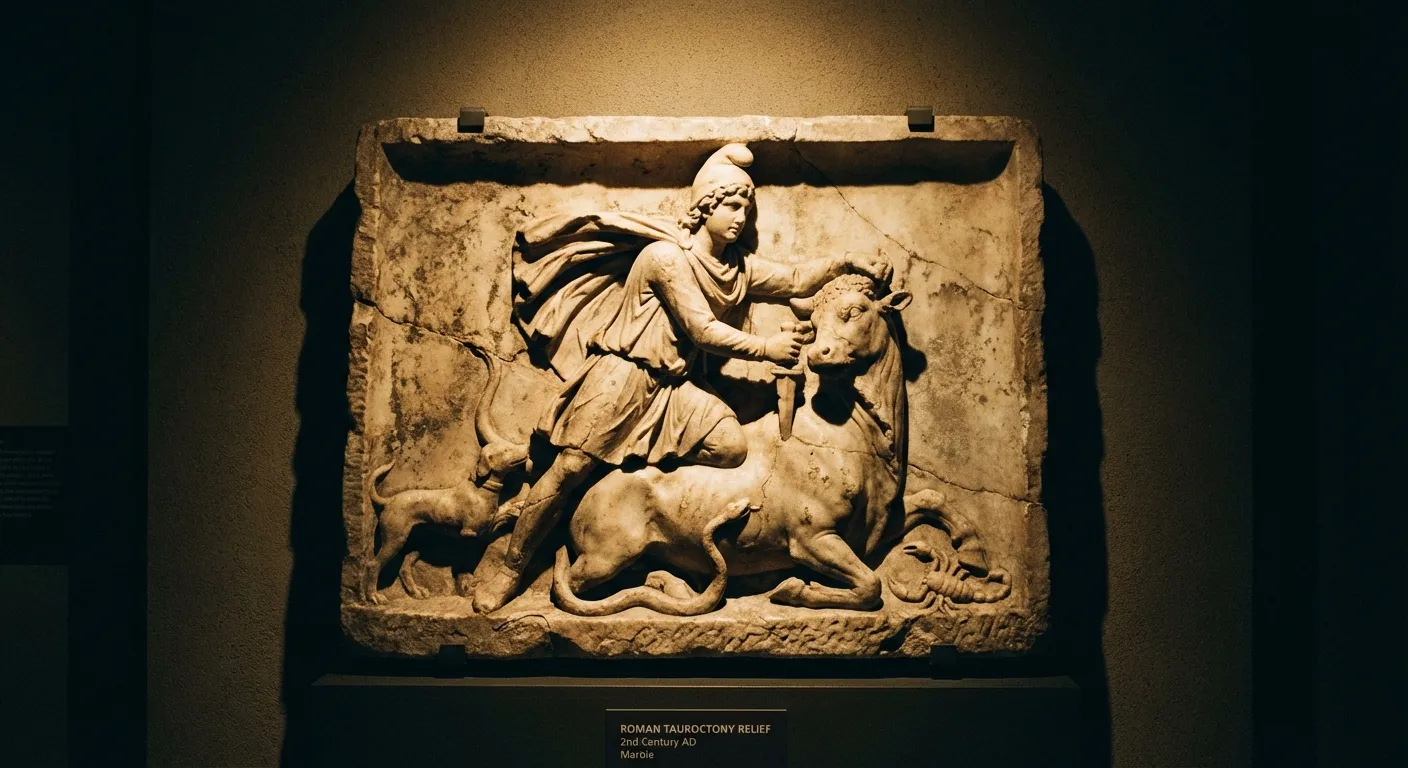
After Horus, Mithras is the second most popular deity invoked in claims that Christianity plagiarized pagan mythology. The Roman god appears in countless internet arguments, always with the same supposedly devastating parallels:
- Born on December 25
- Born of a virgin
- Had twelve disciples
- Died to atone for sins
- Rose from the dead
If these claims were accurate, they would suggest Christianity borrowed its core narrative from a competing Roman cult. Jesus would be just another mystery god, his story recycled from earlier tradition.
But scholars of ancient religion—including those with no Christian commitments—reject these parallels as fabrications, misinterpretations of iconography, and anachronisms that project Christian theology onto pagan silence.
Let us examine each claim against what we actually know about the Mithraic mysteries.
The Virgin Birth Claim
The Claim: Mithras was born of a virgin on December 25, providing the template for Jesus’ nativity.
What the Evidence Shows: Mithras was not born of a woman at all—virgin or otherwise. He was born from a rock.
Roman Mithraic iconography consistently depicts Mithras emerging fully grown from a stone mass, known as the petra genetrix (“birth-giving rock”). In these images, Mithras rises from the rock holding a torch and a dagger, often with a Phrygian cap on his head. There is no mother. There is no woman. There is stone.
Maurice Casey, citing Mithraic scholar John Hinnells, emphasizes this point: the “virgin birth” claim is factually incorrect regarding Mithraic mythology. Some mythicists point to figures in Mithraic art who appear to witness this emergence, claiming these are “shepherds” parallel to the nativity story. But the identification of these figures as shepherds is debated among specialists, and more importantly, they are witnessing a man emerging from rock—not a birth involving a mother of any kind.
The Mithras birth narrative has nothing in common with the Gospel accounts. Matthew and Luke describe a human woman conceiving through the Holy Spirit and giving birth in Bethlehem. Mithraic iconography depicts a god emerging fully formed from stone. These are not parallel stories—they are fundamentally different categories of origin narrative.
As for December 25: even if Mithras were celebrated on that date (which is uncertain), December 25 is not in the New Testament. The December celebration of Christmas was adopted in the fourth century. The Gospel writers knew nothing of it.
The Twelve Disciples Claim
The Claim: Mithras had twelve disciples, just like Jesus.
What the Evidence Shows: There is no textual evidence in Mithraic literature of Mithras having twelve disciples. The claim is based on a misinterpretation of visual art.
Roman Mithraic sanctuaries (mithraea) sometimes feature carvings depicting Mithras surrounded by the twelve signs of the zodiac. Mythicists look at these images and count twelve figures around Mithras, concluding he had “twelve disciples.”
This is a category error. The zodiac signs are not disciples—they are not students, followers, or apostles who accompanied Mithras on his journeys. They are astrological symbols representing the cosmos. Depicting a deity surrounded by cosmic imagery is not the same as depicting him with a band of followers.
Furthermore, as we established in earlier articles, the number twelve in the Jesus tradition has a clear origin in Jewish restoration theology. Jesus’ twelve disciples symbolize the twelve tribes of Israel. In Matthew 19:28, Jesus explicitly states that the Twelve will “sit on twelve thrones, judging the twelve tribes of Israel.”
This symbolism was ubiquitous in Second Temple Judaism. The Qumran community (the Dead Sea Scrolls sect) organized itself around twelve-tribe imagery. The hope for a restored Israel pervaded Jewish eschatology. Jesus’ choice of twelve was a prophetic sign-act about Israel’s restoration—not a borrowing from Roman astrological iconography.
John P. Meier and E.P. Sanders, both rigorous historical-critical scholars, affirm this Jewish context. The twelve disciples make sense within Judaism. They require no pagan explanation.
The Death and Resurrection Claim
The Claim: Mithras died to atone for the sins of the world and was resurrected, just like Jesus.
What the Evidence Shows: We have no evidence that Mithras died at all.
The central mythic act of Mithraism is not the death of the god—it is the god killing a bull. This scene, known as the tauroctony (bull-slaying), appears in virtually every Mithraic sanctuary. Mithras is depicted in his Phrygian cap, kneeling on a bull, plunging a dagger into its neck while various animals (a dog, a snake, a scorpion) interact with the dying animal.
This is Mithras’ defining act. He is the slayer, not the slain.
Bart Ehrman addresses this directly: “We have no evidence that Mithras was crucified, or that he died at all, or that he was resurrected.” The claim that Mithras “died to atone for sins” is, in Ehrman’s words, “simply imagining things.” Dying to atone for human sin was not part of ancient pagan mythology. It is a distinctly Christian theological concept.
The “Refuting Solar Deity Jesus Claims” source is equally explicit: Mithras is “born from a rock” and there is “no resurrection” in his mythology.
Some mythicists point to a late Roman tradition of the taurobolium—a ritual in which a bull was sacrificed and the initiate was bathed in its blood—as evidence of Mithraic “atonement.” But the taurobolium was primarily associated with the cult of Cybele, not Mithras. And more importantly, the ritual as described in later sources postdates Christianity. If there was any borrowing, it may have gone in the opposite direction.
The Chronology Problem
This brings us to the most devastating problem for the Mithras-Jesus parallel argument: chronology.
The Roman cult of Mithras flourished at the same time as—or slightly after—the rise of Christianity. The earliest archaeological evidence for Roman Mithraism dates to the late first century CE, roughly contemporary with the writing of the Gospels. The cult reached its peak in the second and third centuries.
This timeline makes it impossible for early Christianity to have copied from Roman Mithraism. The letters of Paul—our earliest Christian documents—were written in the 50s CE, before we have any evidence of the Roman Mithraic mysteries existing in their developed form.
If there was any borrowing between these traditions, the chronology suggests Mithraism may have adopted elements from Christianity (or from the broader religious milieu both traditions shared), not the reverse.
Iranian Mitra vs. Roman Mithras
Some mythicists appeal to the much older Iranian deity Mitra (note the different spelling) as the true source for Christianity. Iranian Mitra appears in texts dating back over a thousand years before Christ.
But Iranian Mitra and Roman Mithras are not the same deity. They share a name and some conceptual overlap, but their mythologies differ significantly. The specific parallels alleged by Zeitgeist—virgin birth, twelve disciples, death and resurrection—are not found in Iranian sources any more than in Roman ones.
The older Iranian deity does not rescue the mythicist argument. It simply adds another layer of confusion.
The Mystery Religion Problem
There is a deeper methodological problem with claims about Mithraism: we don’t know what Mithraists actually believed.
Mithraism was a mystery religion. Its adherents were sworn to secrecy. They left no written texts explaining their theology. What we know about Mithraism comes from:
- Archaeological evidence (sanctuaries, iconography, inscriptions)
- Hostile or dismissive comments from outsiders (including early Christian writers)
- Later speculation by scholars attempting to reconstruct beliefs from fragmentary evidence
This creates a fundamental evidential problem. Mythicists confidently assert what Mithraists believed—virgin birth, atonement theology, resurrection—but we have no Mithraic texts confirming any of this. The claims are speculation dressed as fact.
Bart Ehrman emphasizes this point. Mythicists frequently rely on the polemical writings of later Church Fathers (like Tertullian or Justin Martyr) to reconstruct Mithraic beliefs. But these Christian writers had their own agendas. They sometimes claimed that pagan religions were demonic imitations of Christianity—which tells us about Christian apologetic strategy, not about what pagans actually believed.
When mythicists assert that Mithras was born of a virgin, had disciples, and rose from the dead, they are filling the gaps in our knowledge with Christian categories. They are projecting the Jesus story onto Mithraic silence.
What We Actually Know About Mithras
Let us summarize what the evidence actually supports:
Birth: Mithras was born from a rock (petra genetrix), not from a virgin woman.
Disciples: There is no textual or iconographic evidence of Mithras having disciples. Zodiac symbols in Mithraic art are cosmic imagery, not followers.
Central Myth: The defining Mithraic narrative is the tauroctony—Mithras slaying a bull. The god is the killer, not the victim.
Death and Resurrection: There is no evidence that Mithras died or rose from the dead.
Atonement: There is no evidence of Mithraic “atonement theology.” The concept of a god dying for human sins is distinctly Christian.
Chronology: Roman Mithraism flourished after Christianity was established. If borrowing occurred, the direction of influence is unclear—and may have gone from Christianity to Mithraism.
Sources: Mithraism was a mystery religion that left no explanatory texts. Claims about Mithraic theology are largely speculation.
| Claim | Evidence |
|---|---|
| Virgin birth | No—born from rock |
| Born December 25 | Uncertain, and irrelevant (Dec 25 not in NT) |
| Twelve disciples | No—zodiac signs are not disciples |
| Died for sins | No—Mithras kills the bull, doesn’t die |
| Rose from dead | No evidence of death or resurrection |
The Appeal of the Mithras Argument
Why does the Mithras parallel persist despite the lack of evidence?
Part of the appeal is the mystery itself. Because we know so little about Mithraism, mythicists can project whatever they want onto it. The gaps in our knowledge become a canvas for speculation.
Part of the appeal is the visual similarity of some Mithraic iconography to Christian themes. Underground sanctuaries feel like catacombs. Ritual meals look like communion. A god surrounded by cosmic imagery feels vaguely messianic. These surface resemblances can feel significant—even when the underlying theologies are completely different.
And part of the appeal is the desire for a simple explanation. If Christianity is just recycled paganism, its claims can be dismissed without serious engagement. The Mithras argument offers a shortcut around the harder questions about history, evidence, and truth.
But shortcuts often lead nowhere. The Mithras parallel, when examined carefully, collapses into speculation, anachronism, and wishful thinking.
Conclusion
The claim that Jesus was copied from Mithras fails on multiple levels:
-
The specific parallels are fabricated. Mithras was not born of a virgin, did not have disciples, did not die, and did not rise.
-
The chronology is backwards. Roman Mithraism flourished after Christianity was established.
-
The sources don’t exist. Mithraism left no explanatory texts. Claims about Mithraic theology are speculation projected onto silence.
-
The methodology is flawed. Mythicists misinterpret iconography (zodiac signs as disciples) and project Christian categories onto pagan religions.
Christianity emerged from first-century Palestinian Judaism, not from Roman mystery cults. The evidence for this is overwhelming. The Mithras parallel is not a serious historical argument—it is a popular myth about ancient myths.
Author’s Note (2026): This article was originally written in 2013 but was never published at the time. Prior to publication in 2026, it has been carefully reviewed and updated to ensure that historical references, scholarly claims, and source material are accurate, current, and properly represented.