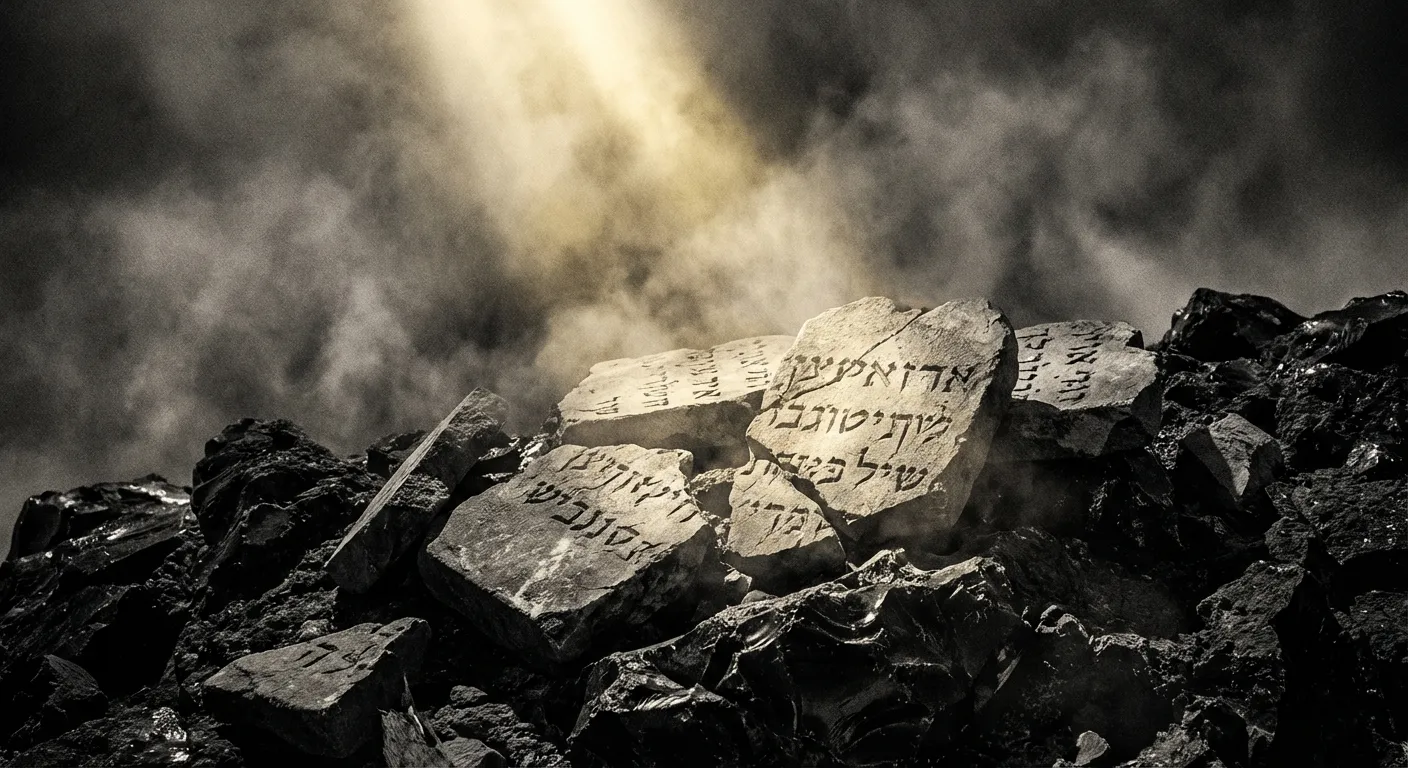
The Golden Calf is one of the most dramatic episodes in the Hebrew Bible. While Moses communes with God on Mount Sinai, receiving the tablets of the Law, the Israelites below grow restless. They pressure Aaron to make them a god they can see. He fashions a golden calf from their jewelry, and the people celebrate before it. When Moses descends and sees the idolatry, he shatters the tablets in fury, destroys the calf, and executes judgment on the people.
For nearly three thousand years, Jews and Christians have understood this story as a warning about idolatry—a dramatic illustration of how quickly the human heart turns from the true God to false substitutes.
Zeitgeist offers a radically different interpretation.
According to the film, Moses wasn’t angry about idolatry at all. He was angry that the Israelites were worshipping the wrong zodiac sign. The Golden Calf represents Taurus, the Bull—the astrological age that was passing away. Moses, representing the new Age of Aries (the Ram), destroys the symbol of the old age. This is why, the film claims, Jews blow the ram’s horn (shofar): it commemorates the zodiacal transition from Taurus to Aries.
It’s a clever reframing. But does it survive contact with historical and textual evidence?
The Claim Examined
Let’s state the argument precisely:
- The Golden Calf represents Taurus, the astrological sign of the Bull
- Moses destroying the calf symbolizes the transition from the Age of Taurus to the Age of Aries
- The prominence of ram imagery in Hebrew religion (especially the shofar) commemorates this new astrological age
- Ancient Israelites understood their religious narratives as astronomical allegories
For this interpretation to work, several things must be true: the twelve-sign zodiac must have existed in Israelite culture when these texts were composed, ancient Israelites must have been tracking the Precession of the Equinoxes, and there must be evidence that they interpreted their scriptures astrologically.
None of these conditions are met.
The Chronological Problem: When Did the Zodiac Arrive?
The most fundamental problem with the astrological interpretation is chronological: the twelve-sign zodiac didn’t exist in Israelite culture when the Exodus narratives were composed.
The Development of the Zodiac
The zodiac as we know it—a twelve-part division of the ecliptic into equal 30-degree segments, each associated with a constellation—was a Babylonian innovation that developed gradually over centuries.
The earliest Babylonian star catalogues (the MUL.APIN tablets, dating to around 1000 BCE) list constellations along the path of the sun but don’t yet constitute a true zodiac. The standardized twelve-sign system emerged in Babylon during the 5th century BCE and was transmitted to the Greek world following Alexander’s conquests in the 4th century BCE.
This means the zodiacal framework Zeitgeist assumes was unavailable to anyone composing or reading the Exodus narrative during the time periods scholars assign to its composition.
The Exodus Dating Problem
Even scholars who date the Exodus traditions late (to the Persian or early Hellenistic period) face a problem: there’s no evidence that Judean writers of this period interpreted their texts astrologically.
The first clear evidence of zodiacal symbolism in Jewish contexts comes from much later—synagogue mosaics featuring zodiac wheels date to the Byzantine period (4th–6th centuries CE). These mosaics demonstrate that Jews eventually incorporated zodiacal imagery, but they appear nearly a millennium after the composition of Exodus, and even then, the zodiac is decorative rather than interpretive.
What About Josephus?
The first-century Jewish historian Josephus was aware of the zodiac and occasionally drew symbolic connections between Jewish practices and cosmic elements. However, his testimony actually undermines the Zeitgeist thesis.
In Jewish War 5.214, Josephus describes the veil of the Jerusalem Temple as depicting “a panorama of the heavens, the signs of the Zodiac excepted.” The Temple veil portrayed the universe—except for the zodiac signs. This deliberate exclusion suggests that even in the Hellenistic period, when zodiacal symbolism was culturally pervasive, Jewish temple worship maintained distance from astrological imagery.
If first-century Jews were consciously omitting zodiacal signs from their most sacred space, it’s implausible that their ancestors had encoded zodiacal transitions into their foundational narratives.
The Textual Problem: What Does Exodus Actually Say?
Setting aside the chronological issues, let’s examine what the Golden Calf narrative actually says. Does the text support an astrological reading?
The Context of Idolatry
The Golden Calf episode (Exodus 32) follows immediately after the giving of the Ten Commandments, which begin: “You shall have no other gods before me. You shall not make for yourself a carved image” (Exodus 20:3–4).
The narrative is structured to present the calf incident as a direct violation of these freshly given commands. The Israelites break the covenant before it’s even ratified. This is the point of Moses shattering the tablets—the covenant has been invalidated by the people’s disobedience.
The text gives no indication that the problem is astronomical. The issue is worship—specifically, worship directed toward something other than Yahweh.
Why a Calf?
Zeitgeist assumes the calf must represent Taurus. But bull worship was ubiquitous in the ancient Near East, and the text provides a much simpler explanation: Egyptian influence.
The Israelites had just left Egypt, where bull worship was prominent. The Apis bull was a major deity in Egyptian religion, worshipped at Memphis as a manifestation of Ptah and later Osiris. The Mnevis bull was venerated at Heliopolis. Bull imagery permeated the religious culture the Israelites had inhabited for generations.
When the people demand “gods who will go before us” (Exodus 32:1), they’re not requesting an updated zodiac symbol. They’re reverting to the familiar religious forms of Egypt. The text itself suggests this connection—Aaron fashions the calf and the people declare, “These are your gods, O Israel, who brought you up out of the land of Egypt!” (Exodus 32:4).
The bull represents Egyptian idolatry, not Babylonian astrology.
The Absence of Aries
If Moses represents the “Age of Aries,” we’d expect ram imagery to dominate the Exodus narrative. But it doesn’t.
The Passover lamb (Exodus 12) isn’t specified as a ram—it’s a year-old male sheep or goat. The Hebrew word seh is generic for small livestock. The sacrificial system includes rams but also bulls, goats, and birds. There’s no special emphasis on ram symbolism that would indicate a zodiacal agenda.
Moreover, if the point were to establish Aries worship, why does Israelite religion so thoroughly reject animal images altogether? The second commandment prohibits carved images of any kind. The entire Mosaic system militates against the symbolic frameworks Zeitgeist wants to impose on it.
The Shofar Problem: Why the Ram’s Horn?
The film claims Jews blow the ram’s horn to celebrate the Age of Aries. This requires us to believe that a liturgical practice developed in antiquity and maintained for millennia is secretly commemorating an astrological transition that no Jewish sources ever mention.
The actual explanations for the shofar are far more straightforward.
The Binding of Isaac
Jewish tradition consistently connects the shofar to the Akedah—the binding of Isaac in Genesis 22. When Abraham proves willing to sacrifice Isaac, God provides a ram caught in a thicket as a substitute. The ram’s horn recalls this moment of divine provision and substitutionary sacrifice.
This theological connection appears throughout rabbinic literature. The Talmud (Rosh Hashanah 16a) explicitly links the shofar to the ram of Isaac’s binding: “Why do we sound the shofar? The Holy One, blessed be He, said: Sound before Me a ram’s horn so that I may remember on your behalf the binding of Isaac.”
This explanation predates any zodiacal interpretation and is embedded in the internal logic of the Hebrew scriptures themselves.
The Sinai Theophany
The shofar first appears in Exodus 19, at the giving of the Law at Sinai: “On the morning of the third day there were thunders and lightnings and a thick cloud on the mountain and a very loud trumpet [shofar] blast” (Exodus 19:16).
The shofar signals the awesome presence of God. It’s the sound of theophany—divine self-disclosure. This liturgical association with God’s presence at Sinai has nothing to do with zodiacal ages.
Eschatological Gathering
In prophetic and post-biblical Jewish tradition, the shofar becomes associated with the eschatological ingathering of Israel. Isaiah 27:13 declares: “And in that day a great trumpet [shofar] will be blown, and those who were lost in the land of Assyria and those who were driven out to the land of Egypt will come and worship the Lord on the holy mountain at Jerusalem.”
The shofar calls scattered Israel home. This is a political and theological hope—restoration of the nation under God’s kingship—not an astrological commemoration.
The Shemoneh Esreh (Eighteen Benedictions), a prayer dating to the Second Temple period, includes the petition: “Proclaim our liberation with the great shofar, and raise a banner to gather our exiles.” The shofar is the instrument of redemption, not of zodiacal celebration.
The Methodological Problem: Parallelomania
The astrological interpretation of the Golden Calf exhibits what biblical scholar Samuel Sandmel famously called “parallelomania”—the tendency to find connections between texts or traditions based on superficial similarities while ignoring context, chronology, and contrary evidence.
The reasoning runs like this:
- There’s a bull in Exodus
- Taurus is a bull
- Therefore, the Exodus bull must represent Taurus
This is pattern recognition run amok. Bulls were common religious symbols throughout the ancient Near East for reasons entirely unrelated to the zodiac. The Apis bull of Egypt, the bull of El in Canaanite religion, the winged bulls of Assyria—none of these required zodiacal frameworks to explain their significance.
Similarly:
- There are rams in Hebrew religion
- Aries is a ram
- Therefore, Hebrew rams must represent Aries
But rams were valuable livestock, used for sacrifice because of their economic and symbolic value, not because of Babylonian astronomical developments that hadn’t yet reached Israelite culture.
The Zeitgeist interpretation works only if you start with the conclusion and cherry-pick evidence to support it. It ignores:
- The absence of zodiacal knowledge in early Israel
- The explicit anti-idolatry context of the Exodus narrative
- The Egyptian (not Babylonian) background of the calf
- The covenantal and eschatological explanations for the shofar
- The complete silence of Jewish sources about astrological age symbolism
What Scholars Actually Say
The astrological interpretation of the Golden Calf is not taken seriously in academic biblical studies. It’s worth understanding why.
Bart Ehrman, no friend to Christian apologetics, directly addresses the Zeitgeist claims: “The Law of Moses was given to provide guidance on worship and communal life, not to serve as a coded astrological map.” He notes that the “astrotheology” interpretation is “a modern invention” without primary source support.
The reason is simple: the claim requires evidence that ancient Israelites (1) knew the twelve-sign zodiac, (2) tracked the Precession of the Equinoxes, and (3) encoded astronomical ages into their religious texts. No such evidence exists.
This isn’t a case of scholars dismissing an interpretation because it challenges orthodoxy. It’s a case of scholars dismissing an interpretation because it lacks any historical foundation.
A Pattern of Projection
The astrological ages thesis, like the other Zeitgeist claims we’ve examined, works by projecting modern or foreign frameworks onto ancient texts.
The solar deity claims projected Greco-Roman sun worship onto Jewish messianism. The pagan parallel claims projected 19th-century comparative religion theories onto ancient mythology. Now the astrological ages claims project Hellenistic astrology onto texts composed before that astrology reached Israelite culture.
In each case, the method is the same: assume the conclusion, find superficial similarities, ignore context and chronology, declare victory.
This isn’t historical analysis. It’s eisegesis—reading into the text what you want to find there.
The Real Story
The Golden Calf narrative is powerful precisely because it’s not about zodiacal ages. It’s about the human heart.
The Israelites had just witnessed the plagues of Egypt, the parting of the sea, the provision of manna and water. They’d heard the voice of God from the mountain. And within forty days, they turned to worship a golden image.
The story confronts us with how fickle human devotion really is. How quickly we turn from the God who delivers us to the gods we can see and control. How easily we exchange glory for an image.
Moses’ fury isn’t about outdated astronomy. It’s about covenant betrayal. The tablets shatter because the relationship they represented has been violated.
And the shofar? It calls us back. Back to Sinai, where God spoke. Back to the ram caught in the thicket, where God provided. Forward to the day when God gathers his people home.
These meanings are embedded in the texts, explained by the traditions, and available to anyone who reads carefully.
The astrological interpretation isn’t just historically wrong. It drains the narrative of its actual meaning—replacing covenant theology with celestial mechanics, and the living God with the grinding wheel of the zodiac.
Conclusion
The claim that Moses destroying the Golden Calf represents a transition from the Age of Taurus to the Age of Aries fails on every level:
Chronologically: The twelve-sign zodiac didn’t exist in Israelite culture when the Exodus narratives were composed. The claim is anachronistic.
Textually: The narrative presents the calf as idolatry, not astronomy. The Egyptian background of bull worship explains the image without recourse to Babylonian astrology.
Liturgically: The shofar’s meaning is rooted in the Binding of Isaac, the Sinai theophany, and eschatological hope—not zodiacal commemoration.
Methodologically: The claim exemplifies parallelomania—superficial pattern-matching that ignores context, chronology, and contrary evidence.
The Golden Calf story is about the danger of idolatry and the cost of covenant unfaithfulness. These themes are too important to be buried under baseless astrological speculation.
Author’s Note (2026): This article was originally written in 2013 but was never published at the time. Prior to publication in 2026, it has been carefully reviewed and updated to ensure that historical references, scholarly claims, and source material are accurate, current, and properly represented.