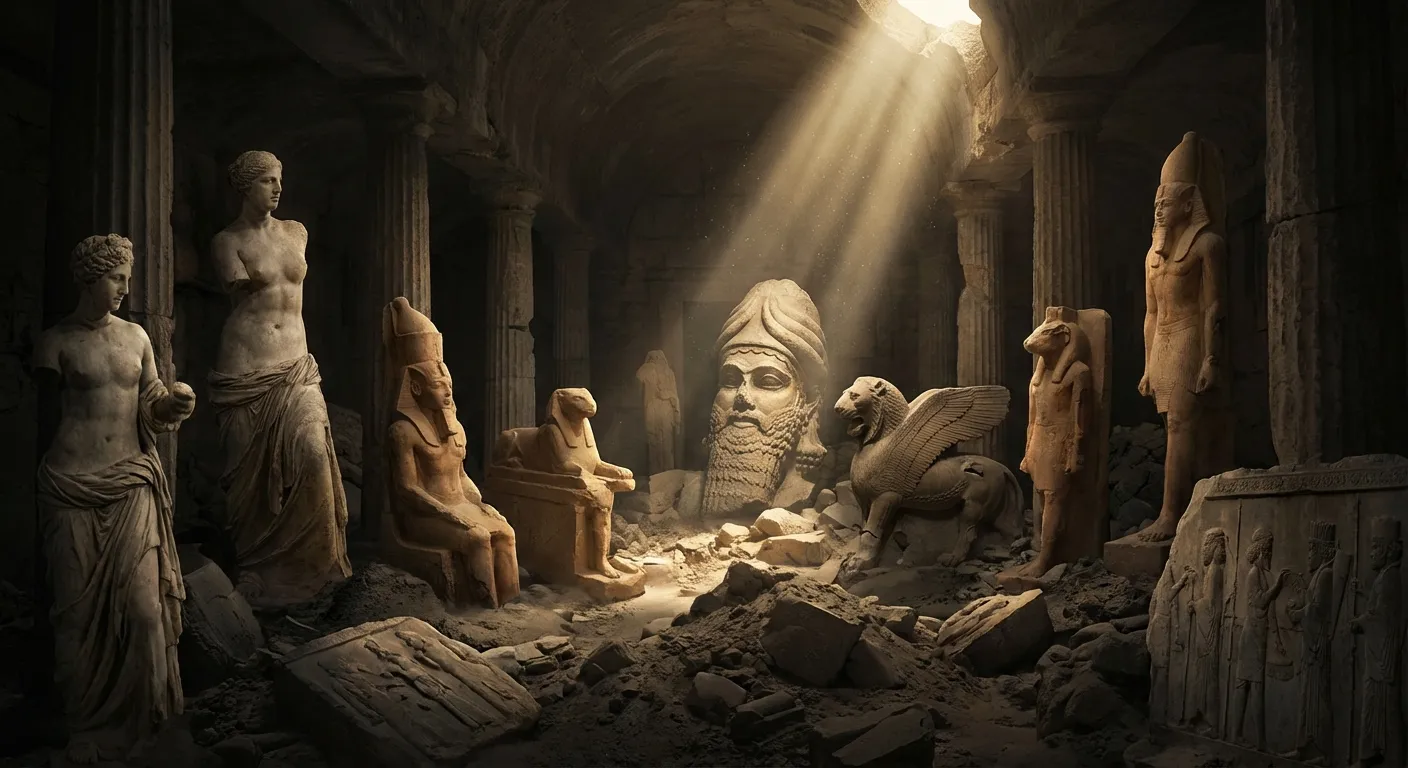
We began this section of our Zeitgeist review with a question: Was Christianity plagiarized from pagan mythology?
The film’s second major claim presents a parade of pre-Christian deities—Horus, Mithras, Attis, Dionysus—alongside Old Testament figures allegedly borrowed from Mesopotamian and Egyptian sources. The argument seems overwhelming: if all these parallels exist, Christianity must be derivative mythology dressed in Jewish clothing.
But after seven articles examining each claim in detail, a very different picture has emerged.
The parallels are largely fabricated. The methodology is fundamentally flawed. And the sources Zeitgeist relies upon have been rejected by scholars for over a century. What remains is not evidence of plagiarism but evidence of how badly the film misrepresents ancient religion.
Let’s review what we’ve found.
Part 9: The Horus Claims
The Claim: Horus was born of a virgin on December 25, had twelve disciples, was crucified, and rose from the dead—just like Jesus.
What the Evidence Shows: Nearly every claim is fabricated.
- Virgin birth: Isis conceived Horus by hovering over Osiris’s reassembled corpse and extracting his seed. This is sexual conception with a dead body—the opposite of virginal conception.
- December 25: No ancient Egyptian text associates Horus with this date.
- Twelve disciples: Horus had four semi-divine followers (the “Sons of Horus”), not twelve human disciples.
- Crucifixion: Crucifixion was a Roman execution method that didn’t exist in ancient Egypt. No Egyptian text describes Horus being crucified.
- Resurrection: Horus doesn’t die and rise in Egyptian mythology. His father Osiris dies but remains lord of the underworld—he doesn’t return to earthly life.
The Source Problem: These claims trace to Gerald Massey (1828–1907), a self-taught amateur whose work was rejected by Egyptologists in his own lifetime. Modern scholars like Bart Ehrman and Ronald Nash have thoroughly debunked the Horus parallels.
Part 10: The Mithras Claims
The Claim: Mithras was born of a virgin on December 25, had twelve disciples, died and rose again, and his followers practiced baptism and communion—all before Christianity.
What the Evidence Shows: The claims are anachronistic or invented.
- Virgin birth: Mithras was born from a rock (petra genetrix), fully formed and armed. There is no mother, virgin or otherwise.
- December 25: The earliest evidence for Mithras being celebrated on this date comes from the 4th century CE—after Christians had already adopted the date for Christmas.
- Twelve disciples: No ancient source mentions disciples of Mithras. The “twelve” claim appears to be invented wholesale.
- Death and resurrection: No Mithraic text describes Mithras dying. He kills a bull; he doesn’t get killed.
- Baptism and communion: Mithraic initiation rites involved different practices. More importantly, most evidence for Mithraism dates to the 2nd–4th centuries CE, making Christianity the earlier tradition.
The Direction Problem: If influence occurred between Mithraism and Christianity, the chronology suggests Mithraism borrowed from Christianity, not the reverse.
Part 11: The Attis Claims
The Claim: Attis was born of a virgin, died by crucifixion, and rose from the dead on the third day.
What the Evidence Shows: The claims misrepresent the mythology and ignore chronology.
- Virgin birth: Attis was conceived when the goddess Cybele (or Nana) was impregnated by an almond or pomegranate from the castrated god Agdistis. This is miraculous conception, but it involves divine sexual material—not virginal conception in the Christian sense.
- Death: Attis dies by self-castration and bleeding out under a pine tree, or by being killed by a boar. Neither version involves crucifixion.
- Resurrection: In the earliest versions of the myth, Attis simply dies. The “resurrection” motif appears only in later texts (2nd–4th century CE), likely influenced by Christianity. The emperor Julian (4th century CE) is our earliest clear source for Attis rising—centuries after the Gospels.
The Anachronism: Claims of Attis’s resurrection that parallel Jesus appear after Christianity was established, making Christianity the potential source, not the borrower.
Part 12: The Dionysus Claims
The Claim: Dionysus was born of a virgin on December 25, turned water into wine, and rose from the dead. The name “Jesus” derives from a Dionysian title.
What the Evidence Shows: The parallels are forced or fabricated.
- Virgin birth: Dionysus was conceived when Zeus had sexual relations with Semele (or Persephone, in variant traditions). Both versions involve intercourse, not virgin conception.
- December 25: No ancient source connects Dionysus to this date.
- Water to wine: Dionysus was the god of wine, so wine miracles appear in his cult. But the Gospel of John’s account functions as competition with Dionysian claims, not copying—Jesus is presented as superior to the wine god.
- Resurrection: The “dying and rising god” category has been largely abandoned by scholars. Dionysus undergoes dismemberment in some myths but does not experience death and bodily resurrection for the sins of others.
- The “IES” etymology: The claim that “Jesus” derives from a Dionysian epithet is a linguistic fabrication. “Jesus” (Iēsous) is simply the Greek form of the Hebrew name Yeshua (Joshua), meaning “Yahweh saves.”
The Competition Model: Where genuine similarities exist (wine symbolism), scholars explain them as religious competition, not plagiarism. Early Christians asserted Jesus’s superiority over rival deities.
Part 13: The Gilgamesh Flood
The Claim: Noah’s flood was plagiarized from the Epic of Gilgamesh.
What the Evidence Shows: The relationship is real but mischaracterized.
- Genuine parallels exist: Both texts feature a divine warning, a boat, preserved animals, birds released, and post-flood sacrifice. Unlike the deity comparisons, this parallel involves actual textual connections.
- “Plagiarism” is rejected: Even scholars who believe Genesis depends on Mesopotamian tradition reject the crude “copying” label. They describe the relationship as “theological transformation” or “polemical subversion.”
- The Wiseman Hypothesis: From a Christian presuppositional standpoint, P.J. Wiseman’s “Tablet Theory” offers a compelling alternative: Genesis preserves the original eyewitness account (recorded by Noah’s family on cuneiform tablets), while Gilgamesh represents later mythological distortion.
- Theological inversion: The differences are more significant than the similarities. In Gilgamesh, the gods destroy humanity because humans are too noisy; they cower in fear during the flood; they swarm “like flies” around the sacrifice because they’re starving. In Genesis, God judges humanity for moral corruption; He remains sovereign throughout; the sacrifice establishes a covenant of peace.
The Key Insight: Even if literary dependence exists, the biblical author radically transformed the tradition—replacing a capricious pantheon with a sovereign, moral God.
Part 14: Moses and Sargon
The Claim: Moses’ birth story was copied from the Legend of Sargon of Akkad.
What the Evidence Shows: The chronology and function undermine the plagiarism claim.
- The dating problem: Zeitgeist assumes the Sargon legend dates to 2300 BCE (Sargon’s lifetime). But the actual text—the Sargon Birth Legend—was likely composed around 700 BCE during the reign of Sargon II, a usurper who needed legitimizing propaganda. This makes it roughly contemporary with the biblical tradition.
- The exposed infant archetype: The “basket in the river” motif appears in over 70 cultures worldwide (Oedipus, Romulus, Karna, etc.). It’s a universal literary convention signaling heroic destiny, not evidence of direct copying.
- Political inversion: Sargon’s legend legitimizes royal power (hidden royalty → commoner → king). Moses’ story subverts it (slave → royalty → destroys the empire). The narratives have opposite political functions.
- The tebah connection: The Hebrew word for Moses’ basket (tebah) appears only one other place in the Bible: Noah’s Ark. The author links Moses to Genesis, not to Akkad.
The Key Insight: If the biblical author engaged with the Sargon tradition at all, he inverted its meaning—transforming royal propaganda into a liberation narrative.
Part 15: The Ten Commandments and the Book of the Dead
The Claim: The Ten Commandments were “taken outright” from Spell 125 of the Egyptian Book of the Dead.
What the Evidence Shows: The texts belong to incompatible genres with opposing functions.
- Genre confusion: The Book of the Dead is funerary magic—a script for corpses to recite in the afterlife to pass a supernatural test. The Decalogue is covenant law—prescriptive commands for the living. One is incantation; the other is legislation.
- Structural divergence: The Egyptian “Negative Confessions” include 42 denials, many involving ritual concerns (“I have not waded in water,” “I have not snared birds of the preserves”). The Decalogue is 10 concentrated ethical and theological principles.
- The Mosaic Distinction: The first two commandments—“no other gods” and “no images”—are explicitly anti-Egyptian. Egypt was the land of the pantheon and the idol. The Decalogue defines Israel against Egyptian religion.
- Unique content: The Sabbath commandment has no Egyptian precedent whatsoever.
- Universal ethics: Prohibitions against murder and theft appear in every functioning society. Finding them in both Egypt and Israel proves only that both were human civilizations.
The Key Insight: The Decalogue doesn’t borrow from Egyptian magic; it repudiates Egyptian worldview at its theological core.
The Pattern of Failure
Across all seven examinations, the same problems recur:
1. Fabricated Claims
Many of the alleged parallels simply don’t exist in the ancient sources. Horus wasn’t born on December 25. Mithras didn’t have twelve disciples. Attis wasn’t crucified. These claims are modern inventions, often traceable to discredited 19th-century writers like Gerald Massey.
2. Discredited Sources
Zeitgeist relies on a network of pseudo-scholarly sources that mainstream academics rejected long ago. The film presents Massey, Kersey Graves, and D.M. Murdock (Acharya S) as authorities, while ignoring the consensus of actual Egyptologists, classicists, and historians.
3. Methodological Errors
The film commits what scholars call “parallelomania”—the overstatement of superficial similarities while ignoring context, function, and chronology. Finding that two cultures both prohibited murder doesn’t prove one copied the other; it proves both were human societies.
4. Chronological Problems
Several alleged “sources” for Christianity actually postdate it. The resurrection of Attis, the December 25 celebration of Mithras, and the Sargon Birth Legend all appear in forms that are contemporary with or later than Christianity. The direction of influence, if any, may run the opposite way.
5. Ignored Differences
In every case, the differences between the alleged parallels dwarf the similarities. The theological content, narrative function, and historical context diverge dramatically. Isolating a single motif while ignoring everything else is not comparative religion; it’s cherry-picking.
What This Means
The “pagan parallels” claim is the heart of Zeitgeist’s attack on Christianity. If Jesus is just another dying-and-rising god, if the Bible is just recycled mythology, then the faith collapses.
But the evidence tells a different story.
When we examine the actual sources—not the claims of internet documentaries, but the Egyptian, Greek, Persian, and Mesopotamian texts themselves—the parallels either disappear or reveal something other than plagiarism. What remains is a Christian tradition that engaged with its cultural environment, sometimes in competition, sometimes in polemic, but never in simple imitation.
The gospel accounts present a specific man, Jesus of Nazareth, who lived in a specific time and place, whose death by crucifixion under Pontius Pilate is attested by multiple independent sources, and whose followers proclaimed his resurrection from the earliest days of the movement. This is not the stuff of timeless myth recycled from generation to generation. It is a historical claim, subject to historical investigation.
Zeitgeist wants to dissolve that historical claim into a fog of mythological parallels. But the fog clears when you look at the evidence.
An Invitation
If you came to this series skeptical of Christianity because of Zeitgeist, I hope these articles have at least complicated that skepticism. The film’s claims don’t hold up to scrutiny. The sources are unreliable. The methodology is flawed. The parallels are exaggerated or invented.
That doesn’t prove Christianity is true. But it removes an obstacle that shouldn’t have been there in the first place.
The question of whether Jesus rose from the dead deserves serious examination—not dismissal based on fabricated comparisons to Egyptian mythology. If you’re genuinely interested in that question, I invite you to continue with us as we turn, in the next section of this series, to Zeitgeist’s claims about the historical evidence for Jesus.
The pagan parallels have collapsed. But the investigation is far from over.
Next in the series: We begin examining Claim 3—the assertion that the Bible is astrological allegory.