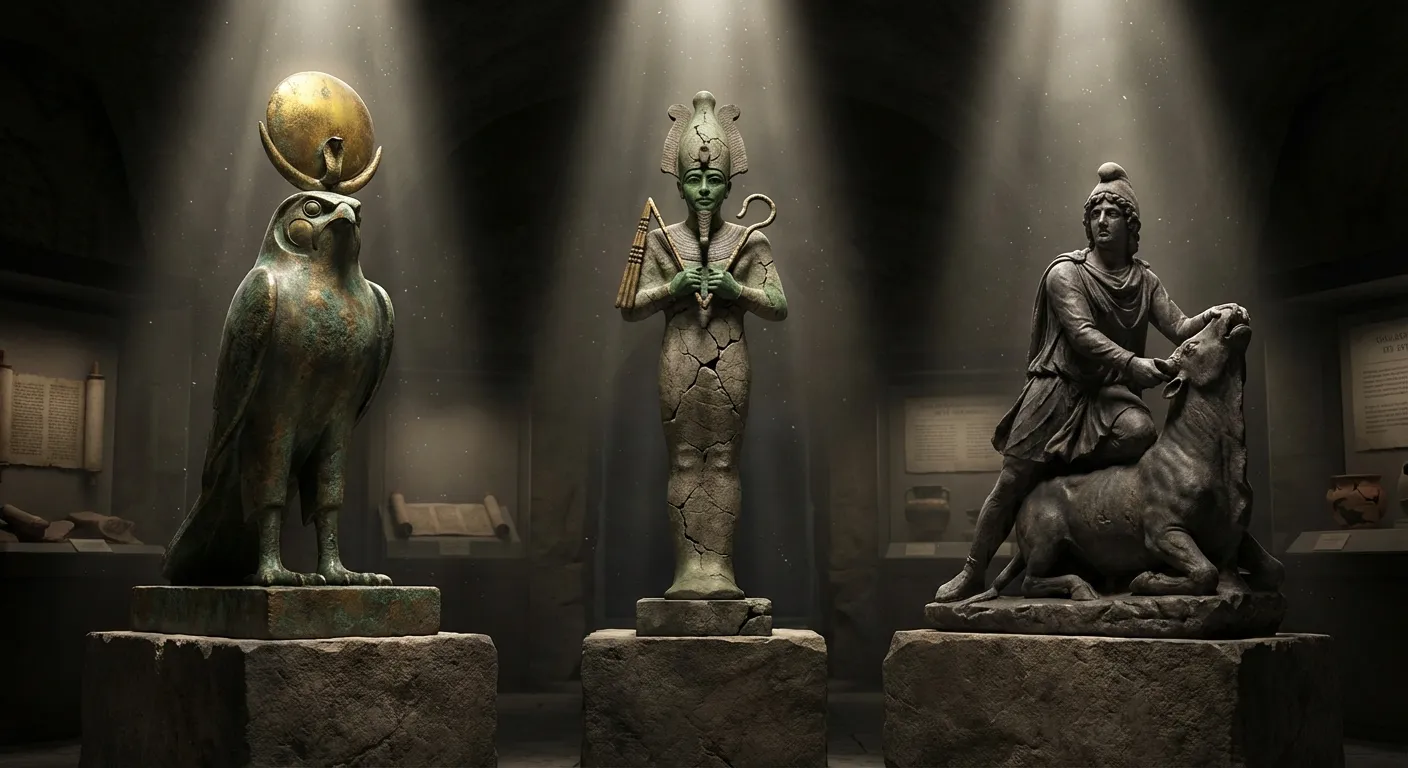
Having dismantled the “solar deity” claims in the previous section, we now turn to the second major argument in Zeitgeist: The Movie: that the Bible—both Old and New Testaments—is a patchwork of plagiarized material stolen from older pagan sources.
This claim operates on two fronts:
New Testament Plagiarism: The story of Jesus was copied from ancient “dying and rising gods” like Horus, Mithras, Attis, and Dionysus. Virgin birth, twelve disciples, crucifixion, resurrection—all allegedly borrowed from pre-Christian mythology.
Old Testament Plagiarism: The foundational narratives of the Hebrew Bible were lifted from even older sources. Noah’s flood from the Epic of Gilgamesh. Moses in the basket from the legend of Sargon of Akkad. The Ten Commandments from the Egyptian Book of the Dead.
If these claims are true, the implications are severe. Christianity would be exposed as derivative mythology. The Hebrew Scriptures would be unmasked as literary theft. The entire biblical tradition—from Genesis to the Gospels—would collapse into a web of borrowed stories with no claim to divine revelation or historical truth.
The claims are emotionally potent. They promise to expose millennia of deception with a few well-placed comparisons.
But are they true?
In the following articles, we will examine each alleged parallel in detail. We will consult what Egyptologists actually say about Horus, what Assyriologists say about Gilgamesh, and what the primary sources reveal when examined on their own terms.
The Pagan Deity Parallels
Zeitgeist presents a parade of pre-Christian deities who allegedly share Jesus’ biographical details:
Horus (Egypt): Born on December 25 to a virgin, birth announced by a star, visited by three wise men, had twelve disciples, performed miracles, walked on water, was crucified, and rose from the dead after three days.
Mithras (Persia/Rome): Born on December 25 to a virgin, had twelve disciples, died and rose after three days.
Attis (Phrygia): Born of a virgin, crucified, rose after three days.
Dionysus (Greece): Born of a virgin, turned water into wine, rose from the dead.
Krishna (India): Born of a virgin, crucified, rose from the dead.
The pattern seems obvious: Christianity copied a pre-existing template. Jesus is just one more “dying and rising god” in a long mythological tradition.
The Old Testament Plagiarism Claims
The film extends its plagiarism thesis back into the Hebrew Scriptures:
Noah’s Ark and the Epic of Gilgamesh: The biblical flood narrative (Genesis 6–9) is presented as a direct copy of the flood story in the Mesopotamian Epic of Gilgamesh (circa 2600 BCE). Both feature a god sending a catastrophic flood, one righteous man warned to build a boat, animals brought aboard, the boat resting on a mountain, birds released to test the waters, and a sacrifice offered afterward.
Moses and Sargon of Akkad: The story of baby Moses—placed in a basket of reeds and set afloat on a river, discovered by royalty—is claimed to be lifted from the legend of Sargon of Akkad (circa 2334–2279 BCE), who was similarly placed in a reed basket, set upon a river, and rose to become a great leader.
The Ten Commandments and the Book of the Dead: The Ten Commandments (Exodus 20) are stated to be “taken outright” from Spell 125 of the Egyptian Book of the Dead. The spell contains negative confessions—“I have not stolen,” “I have not killed,” “I have not told lies”—which sound remarkably similar to “Thou shalt not steal,” “Thou shalt not kill,” and so on.
Why These Claims Matter
These plagiarism claims strike at the heart of biblical authority in a way that purely theological objections do not.
If the flood story is borrowed, Genesis is not divine revelation—it’s adapted mythology. If Moses’ birth narrative is recycled from Sargon, the Exodus may be literary construction rather than historical memory. If the Ten Commandments are Egyptian in origin, the Sinai theophany becomes a fraud.
And if Jesus’ story is merely another dying-and-rising god myth, Christianity loses its claim to uniqueness. The resurrection becomes one more variation on an ancient theme, not a singular historical event.
For skeptics, these claims offer vindication: religion is human invention all the way down. For believers, they pose genuine challenges that deserve serious engagement, not dismissal.
Our Approach
In evaluating these claims, we will follow standard historical and literary methodology:
Primary Sources First. What do the actual ancient texts say? Not modern summaries or internet memes—the texts themselves, in translation by qualified scholars.
Chronology Matters. When were these texts written? The direction of potential influence depends entirely on dating.
Context Over Similarity. Superficial resemblance does not prove dependence. Similar stories can arise independently. We need evidence of actual contact and transmission.
Differences Matter Too. Cherry-picking similarities while ignoring differences is methodological malpractice. The differences between texts often tell us more than the similarities.
Expert Consensus. What do Egyptologists, Assyriologists, and biblical scholars actually conclude?
Looking Ahead
The claims are bold. The evidence deserves examination. In the articles that follow, we will work through each alleged parallel—testing Zeitgeist’s assertions against what the ancient sources and modern scholarship actually reveal.
The truth has nothing to fear from investigation.
Author’s Note (2026): This article was originally written in 2013 but was never published at the time. Prior to publication in 2026, it has been carefully reviewed and updated to ensure that historical references, scholarly claims, and source material are accurate, current, and properly represented.