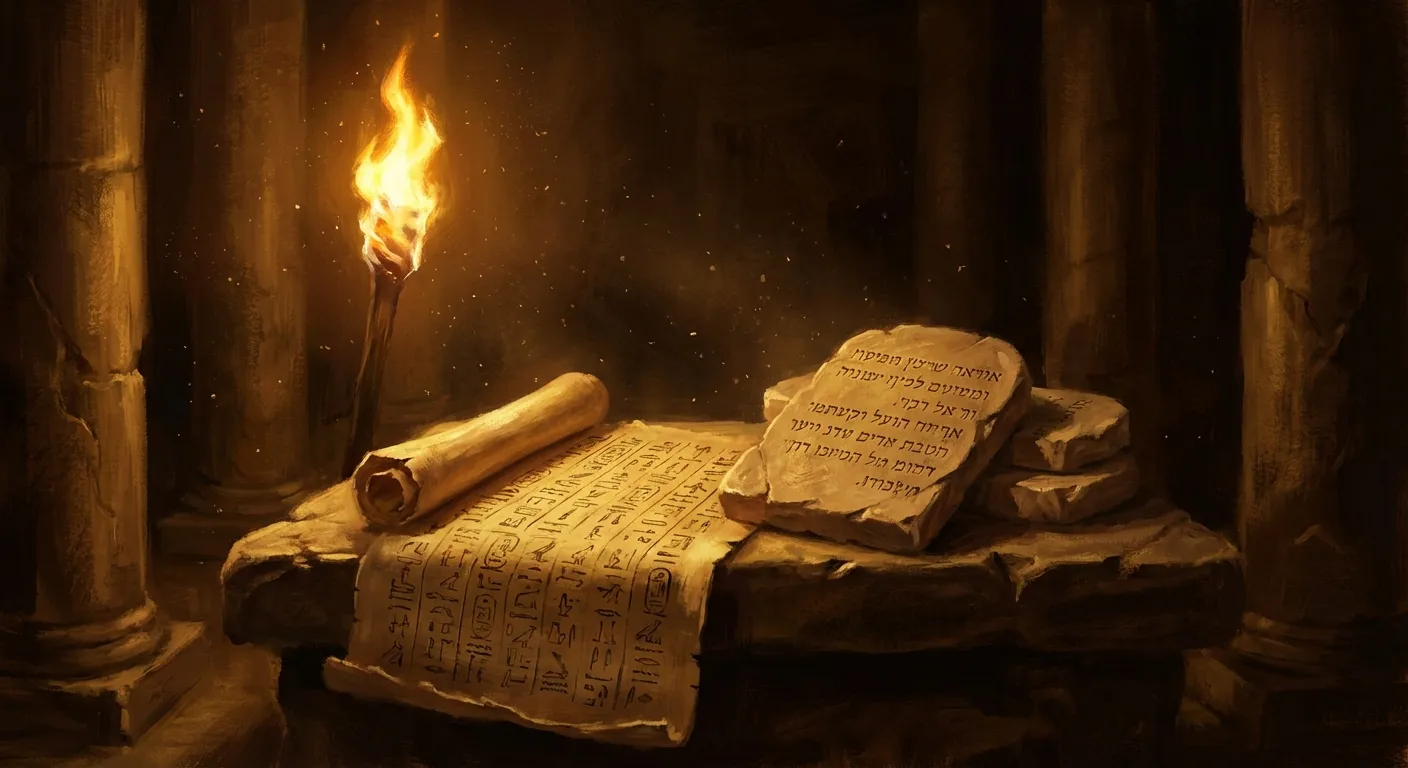
“I have not killed.” “Thou shalt not kill.”
The similarity seems damning. Zeitgeist presents the Egyptian Book of the Dead alongside the Ten Commandments and concludes that Moses plagiarized his moral code from Egyptian religion. The film claims the Decalogue was “taken outright” from Spell 125—the famous “Negative Confessions” recited by the Egyptian dead in the Hall of Judgment.
At first glance, the parallels appear significant. Both texts address murder, theft, and lying. Both come from the ancient Near East. If the Egyptian text is older, doesn’t that prove the Bible is derivative?
No. And the reasons why reveal a fundamental misunderstanding of what these texts actually are.
The Book of the Dead is a magical script for corpses, designed to help the deceased navigate the afterlife by claiming (often falsely) to have lived a pure life. The Ten Commandments are covenant law for the living, establishing the terms of Israel’s relationship with their God. One is funerary magic; the other is constitutional ethics. The comparison collapses the moment you understand the genre.
More tellingly, the theology of the Decalogue is explicitly anti-Egyptian. The first two commandments—no other gods, no images—are direct rejections of everything Egyptian religion stood for. Far from copying Egypt, Moses defined Israel against it.
The Claim We Must Examine
The Zeitgeist Claim: The Ten Commandments were plagiarized from Spell 125 of the Egyptian Book of the Dead. The similarities prove that biblical ethics are borrowed Egyptian ideas dressed in monotheistic clothing.
The film presents phrases from both texts side by side:
- “I have not stolen” / “Thou shalt not steal”
- “I have not killed” / “Thou shalt not kill”
- “I have not told lies” / “Thou shalt not bear false witness”
The implication is clear: Moses (or whoever wrote Exodus) simply copied an Egyptian checklist and called it divine revelation.
But this argument depends on ignoring everything about these texts except isolated phrases. When we examine genre, function, structure, and theology, the plagiarism claim disintegrates.
Genre Confusion: Magic vs. Law
The most fundamental error in the Zeitgeist argument is the failure to distinguish between the literary genres of the two texts. They serve completely different functions.
The Book of the Dead: Funerary Magic
The Egyptian Book of the Dead (more accurately, “The Book of Coming Forth by Day”) is a collection of spells, prayers, and instructions designed to help the deceased navigate the afterlife. It was placed in tombs, written on coffins, or inscribed on papyrus to accompany the dead on their journey.
Spell 125, the section Zeitgeist cites, contains the famous “Negative Confessions” (or “Declaration of Innocence”). In this spell, the soul (Ba) of the deceased stands in the Hall of Ma’at before Osiris and 42 divine judges. The soul recites a series of denials: “I have not done X, I have not done Y.”
The purpose is magical, not moral. The deceased is not confessing sins or committing to ethical behavior. He is reciting a script to pass a supernatural test. Whether or not he actually lived ethically is irrelevant—the spell functions as a magical defense, allowing the soul to avoid being devoured by the monster Ammit.
This is incantation, not ethics. It describes (or claims) what one has done, not what one should do.
The Decalogue: Covenant Law
The Ten Commandments (Exodus 20, Deuteronomy 5) are apodictic law—absolute, unconditional commands addressed to Israel as a nation. They are prescriptive, not descriptive: “You shall not murder” is a command for future behavior, not a claim about past conduct.
The setting is also completely different. The Decalogue is given at Sinai as part of a covenant between God and Israel. It establishes the terms of their relationship—the stipulations that Israel must follow as God’s people. It is addressed to the living, governing their conduct on earth, not helping the dead navigate judgment.
The function is legal and relational, not magical. Breaking the commandments has consequences within the covenant community (judicial penalties, social consequences, alienation from God). There is no incantation to bypass the requirements.
Why This Distinction Matters
The Zeitgeist comparison is like claiming that a criminal defense attorney’s closing argument (“My client did not steal”) proves he plagiarized traffic law (“You shall not speed”). The phrases may overlap, but the genres are incompatible. One is a performative claim; the other is a prescriptive rule.
Finding similar ethical content in a funerary spell and a legal code proves nothing about literary dependence. It proves only that both Egypt and Israel recognized certain behaviors as wrong—which any functioning society must do.
Structural Divergence: 42 vs. 10
Beyond genre, the structural differences between the texts make direct copying implausible.
The Negative Confessions: A Sprawling Ritual List
The Egyptian Negative Confessions consist of 42 denials, corresponding to 42 divine judges. The list is repetitive, including multiple variations on similar themes:
- “I have not stolen” appears in various forms (stealing from the gods, stealing from offerings, stealing property)
- Ritual concerns dominate: “I have not waded in water,” “I have not caught fish in their lagoons,” “I have not snared birds of the preserves”
- Trivial actions are included: “I have not been impatient,” “I have not winkled”
The list is tailored to Egyptian temple culture and the specific concerns of their afterlife mythology. Many items have no ethical significance at all—they relate to ritual purity or offenses against specific gods.
The Decalogue: Concentrated Ethical Principles
The Ten Commandments are precisely that: ten. They are not a sprawling list of ritual taboos but a concentrated statement of ethical and theological principle.
The structure is elegant:
- Commandments 1–4: Duties toward God (exclusive worship, no images, no misuse of God’s name, Sabbath observance)
- Commandments 5–10: Duties toward neighbor (honor parents, no murder, no adultery, no theft, no false witness, no coveting)
This is ethical distillation, not ritual enumeration. To claim that Moses “lifted” this compact code from a 42-item list of funerary denials (most of which have no parallel in the Decalogue) is methodologically absurd.
The Mosaic Distinction: Counter-Identity
The most devastating refutation of the plagiarism claim comes from Egyptologist Jan Assmann, who argues that the Decalogue represents a deliberate counter-identity against Egyptian religion.
Anti-Polytheism
The first commandment—“You shall have no other gods before me”—is explicitly anti-Egyptian. Egypt was the land of the pantheon: Ra, Osiris, Isis, Horus, Anubis, and dozens more. The Negative Confessions presuppose this polytheistic framework; the soul addresses 42 different deities.
The Decalogue demands the opposite: exclusive loyalty to one God. This isn’t borrowed from Egypt; it’s a rejection of Egypt.
Anti-Iconism
The second commandment—“You shall not make for yourself a carved image”—strikes at the heart of Egyptian religion. Egypt was the land of the image: temples filled with statues, tombs painted with divine figures, the Pharaoh himself considered a living god.
The biblical prohibition of images has no precedent in Egyptian thought. It represents a theological revolution, not a continuation.
The Sabbath: Uniquely Israelite
The fourth commandment—Sabbath observance—has no parallel in Egyptian religion or culture. While Egypt had feast days tied to agricultural cycles and divine mythology, the concept of a weekly day of rest grounded in God’s rest at creation is unique to Israel.
If Moses were copying Egyptian ethics, where did the Sabbath come from? It appears nowhere in the Book of the Dead.
Ma’at vs. Covenant
At the deepest level, the theological frameworks are incompatible:
Egyptian ethics were based on Ma’at—the cosmic order that the individual must uphold to maintain harmony. The goal was to fit into the status quo, to preserve the existing order of things.
Israelite ethics were based on Berit—covenant with a personal God whose will is revealed and who calls His people to be distinct from the nations. The God of Israel disrupts the status quo: He liberates slaves, overturns empires, demands justice for the poor.
These are opposing worldviews. The Decalogue doesn’t borrow from Ma’at; it replaces it with something fundamentally different.
The Fallacy of Universal Ethics
The Zeitgeist argument ultimately reduces to this: both Egypt and Israel prohibited murder, theft, and lying; therefore one must have copied from the other.
This commits what scholars call the fallacy of universal ethics. Every functioning human society prohibits murder, theft, and perjury. These prohibitions are not the invention of any single culture; they are the minimum requirements for social cooperation.
Consider: the Code of Hammurabi (Babylon) prohibits murder and theft. Roman law prohibits murder and theft. Chinese law prohibits murder and theft. Does this prove that Rome plagiarized Babylon, or that China copied Egypt?
The presence of universal moral prohibitions in both the Book of the Dead and the Decalogue proves only that both Egypt and Israel were human societies that recognized basic ethical requirements. To claim Moses needed an Egyptian spell to realize that murder was wrong is not scholarship; it’s absurdity.
What the Texts Actually Share—And Don’t Share
For the sake of completeness, let’s examine the actual overlap:
Genuine Parallels (Universal Ethics)
Both texts address:
- Murder
- Theft
- Lying/false witness
- Adultery (in some formulations)
These are universal moral concerns, present in virtually every ancient law code.
Present in the Decalogue, Absent in the Book of the Dead
- Exclusive monotheism (“no other gods”)
- Prohibition of images
- Sabbath observance
- Honoring parents (as a distinct commandment)
- Prohibition of coveting (internal disposition, not just external action)
Present in the Book of the Dead, Absent in the Decalogue
- “I have not waded in water” (ritual purity)
- “I have not caught fish in the lagoons” (temple regulations)
- “I have not snared birds of the preserves” (sacred wildlife)
- “I have not driven away the cattle from the pasture of the gods” (temple property)
- “I have not stopped the flow of water” (Nile regulations)
- References to 42 specific deities
The lists have minimal overlap, and that overlap consists entirely of universal ethical norms. The distinctive content of each text has no parallel in the other.
The Christian Response
From a Christian perspective, the relationship between the Decalogue and Egyptian ethics—whatever its nature—confirms rather than undermines biblical faith.
Common Grace and Natural Law
Christians have historically recognized that God’s moral law is written on the human heart (Romans 2:14-15). All peoples, regardless of special revelation, have some knowledge of right and wrong. When Egyptians prohibited murder, they were responding to this natural law—the same moral reality that the Decalogue codifies.
Finding ethical overlap between Israel and Egypt doesn’t prove plagiarism; it proves that God’s moral order is universal.
The Distinctiveness of Revelation
At the same time, the Decalogue contains elements that transcend natural law:
- The demand for exclusive worship of one God
- The prohibition of images
- The institution of the Sabbath
- The grounding of ethics in covenant relationship
These distinctives have no Egyptian precedent. They represent special revelation—truths that could not be derived from natural observation or borrowed from neighboring cultures.
Exodus as Counter-Narrative
The entire Exodus narrative positions Israel against Egypt. The plagues systematically humiliate the Egyptian gods. The crossing of the Red Sea destroys Pharaoh’s army. Moses, raised in Pharaoh’s court, becomes the instrument of Egypt’s judgment.
In this context, the Decalogue functions as a counter-constitution. It defines Israel as everything Egypt was not: monotheistic rather than polytheistic, aniconic rather than image-saturated, Sabbath-keeping rather than enslaved to constant labor. The law given at Sinai doesn’t copy Egyptian religion; it repudiates it.
Addressing Common Objections
“But the Book of the Dead is older!”
Yes, and so is every other ancient law code. The Code of Ur-Nammu (Sumerian) dates to 2100-2050 BCE and includes laws against murder and robbery. Does this prove the Decalogue copied Sumerian law? Chronological priority doesn’t establish literary dependence.
“The similarities are too specific to be coincidental.”
The similarities are not specific at all. “Don’t kill” and “don’t steal” are the most generic ethical principles imaginable. Finding them in two ancient texts is like finding “the sun rises in the east” in two geography books.
“You’re just defending the Bible.”
I’m applying basic principles of literary comparison that any scholar would use. Genre matters. Function matters. Theological framework matters. The Zeitgeist argument ignores all three and focuses only on isolated phrases stripped of context.
What This Means for Faith
The Book of the Dead comparison illustrates a pattern we’ve seen throughout this series: superficial parallels presented as proof of plagiarism, collapsing under scrutiny.
The Decalogue is not borrowed Egyptian magic. It is covenant law—a revolutionary theological document that defined Israel’s identity against the polytheistic, image-worshipping culture of Egypt. Its ethical content reflects universal moral knowledge; its theological content represents distinctive revelation.
If anything, the contrast between the two texts highlights what makes the biblical tradition unique: a personal God who liberates slaves, enters into covenant with a people, and calls them to holiness.
An Invitation
If the Zeitgeist claim about the Ten Commandments troubled you, I encourage you to read both texts for yourself. Spell 125 of the Book of the Dead is widely available online; so is Exodus 20.
Note the similarities—they’re real, but generic. Then note the differences: the structure, the function, the theology. Ask yourself whether “don’t kill” appearing in two ancient texts proves one copied the other, or whether it proves that human beings everywhere recognize murder as wrong.
And consider that the distinctive elements of the Decalogue—the demand for exclusive worship, the prohibition of images, the institution of the Sabbath—point to something that cannot be explained by cultural borrowing: a God who reveals Himself to a people and calls them to be different.
Next in the series: We examine the claim that there is no historical evidence for Jesus outside the Bible.