
This is Part Three of our series on Christians and AI. In Part One, we examined how the human heart forges idols from silicon and code. In Part Two, we distinguished slavish terror from filial vigilance. Now we turn to the positive question: What does Scripture mean by “the fear of the Lord,” and how does this ancient wisdom reorder the soul in an age of artificial intelligence?
The phrase appears over 300 times in Scripture: the fear of the Lord. It is called “the beginning of wisdom” (Proverbs 9:10), that which “applies to every person” (Ecclesiastes 12:13), and the defining mark of true religion. The early church “walked in the fear of the Lord and in the comfort of the Holy Spirit” (Acts 9:31). Christ Himself was heard “because of His reverent submission” (Hebrews 5:7).
Yet for many modern Christians, “fear of God” sounds archaic—even troubling. We have been told that God is love (which He is), and we have concluded that love and fear are opposites (which they are not). The result is a faith without trembling, a worship without awe, and a discipleship without the gravity that Scripture everywhere assumes.
This matters for the digital age because fear is the currency of algorithmic manipulation. Social media platforms profit from outrage and anxiety. AI systems are designed to capture attention through emotional arousal. If Christians do not know what proper fear looks like, we will be endlessly susceptible to improper fear—the slavish dread that treats technology as fate, or the ambient anxiety that scrolling both creates and numbs.
The antidote is not fearlessness. It is rightly ordered fear.
The Biblical Vocabulary of Fear
Before we can understand the fear of the Lord, we must recognize that Scripture uses “fear” language to describe multiple distinct realities.
Hebrew: Yirah and Pachad
The Old Testament’s dominant fear vocabulary comes from the Hebrew root ירא (yr’), yielding the verb yare (“to fear/revere”) and the noun yirah (“fear/reverence”). These terms span a semantic range from visceral terror to covenantal piety—and context determines which sense applies.
When God tells Abraham, “Now I know that you fear God” (Genesis 22:12), the word is not describing panic but faithful submission. When Proverbs declares that “the fear of the LORD is the beginning of wisdom” (9:10), it describes an orienting principle of life, not a passing emotion. When Deuteronomy commands Israel to “fear the LORD your God, to walk in all His ways, to love Him, to serve the LORD your God with all your heart and with all your soul” (10:12), fear is integrated with love, walking, and service as a comprehensive covenantal posture.
A second Hebrew term, pachad (פחד), often connotes startled dread—the trembling that comes with night terrors, existential anxiety, or sudden alarm. This is the fear of Job’s nightmares (Job 3:25), the terror that shakes the wicked. It is real, but it is not the “fear of the Lord” that Scripture commends.
The distinction matters: Scripture does not call us to live in perpetual dread. It calls us to a reverence that relativizes all lesser fears.
Greek: Phobos and Eulabeia
The New Testament primarily uses phobos (φόβος) and its verbal form phobeo (φοβέω) for fear language. Like the Hebrew yirah, phobos can denote anything from stark terror to reverential awe, depending on context.
When Jesus says, “Do not fear those who kill the body but cannot kill the soul. Rather fear him who can destroy both soul and body in hell” (Matthew 10:28), He is not abolishing fear but reordering it. Fear of God trumps fear of man. The one ultimate fear relativizes all penultimate fears.
The book of Hebrews introduces a rarer term: eulabeia (εὐλάβεια), typically translated “reverent awe” or “godly fear.” Christ Himself is described as being heard “because of His reverent submission” (Hebrews 5:7)—the same word used to describe acceptable worship “with reverence and awe, for our God is a consuming fire” (Hebrews 12:28-29).
This term carries particular weight: if the sinless Son of God exhibited eulabeia in His human life, then reverent fear is not a deficiency to be overcome but a virtue to be cultivated.
The Twofold Nature of Godly Fear
Throughout church history, theologians have distinguished between two fundamentally different kinds of fear in relation to God. The Latin terminology—timor servilis (servile fear) and timor filialis or timor castus (filial or chaste fear)—captures a distinction that runs through Scripture itself.
Servile Fear: The Fear of a Prisoner
Servile fear is the fear of punishment. It dreads the consequences of sin—pain, death, hell—rather than the offense of sin itself. Its relational dynamic is that of a prisoner before an executioner.
This fear is not entirely useless. Augustine taught that fear can “make a beginning” in the soul, preparing it for love. The terror of judgment can drive a person to seek mercy. But servile fear alone cannot produce holiness. A slave who refrains from theft only because he fears the whip will steal the moment the master’s back is turned.
Servile fear says: I must not sin, or I will be punished.
Filial Fear: The Fear of a Child
Filial fear is qualitatively different. It is the fear of a child who dreads offending a beloved Father—not because of punishment, but because of love. Its object is not the consequences of sin but the offense of sin itself.
John Bunyan called this “son-like fear” and traced its sources: distinguishing love, a new heart, the impress of God’s Word, faith, repentance, and—crucially—forgiveness. “There is forgiveness with You,” the Psalmist writes, “that You may be feared” (Psalm 130:4). Grace produces reverence, not presumption.
Filial fear says: I must not sin, because I love the One against whom I would sin.
Jonathan Edwards captured the dynamic precisely: as servile fear diminishes under true hope and assurance, reverential fear can actually increase. The object shifts from fear of punishment to fear of displeasing God. The regenerate heart does not become bold and casual; it becomes tender and watchful.
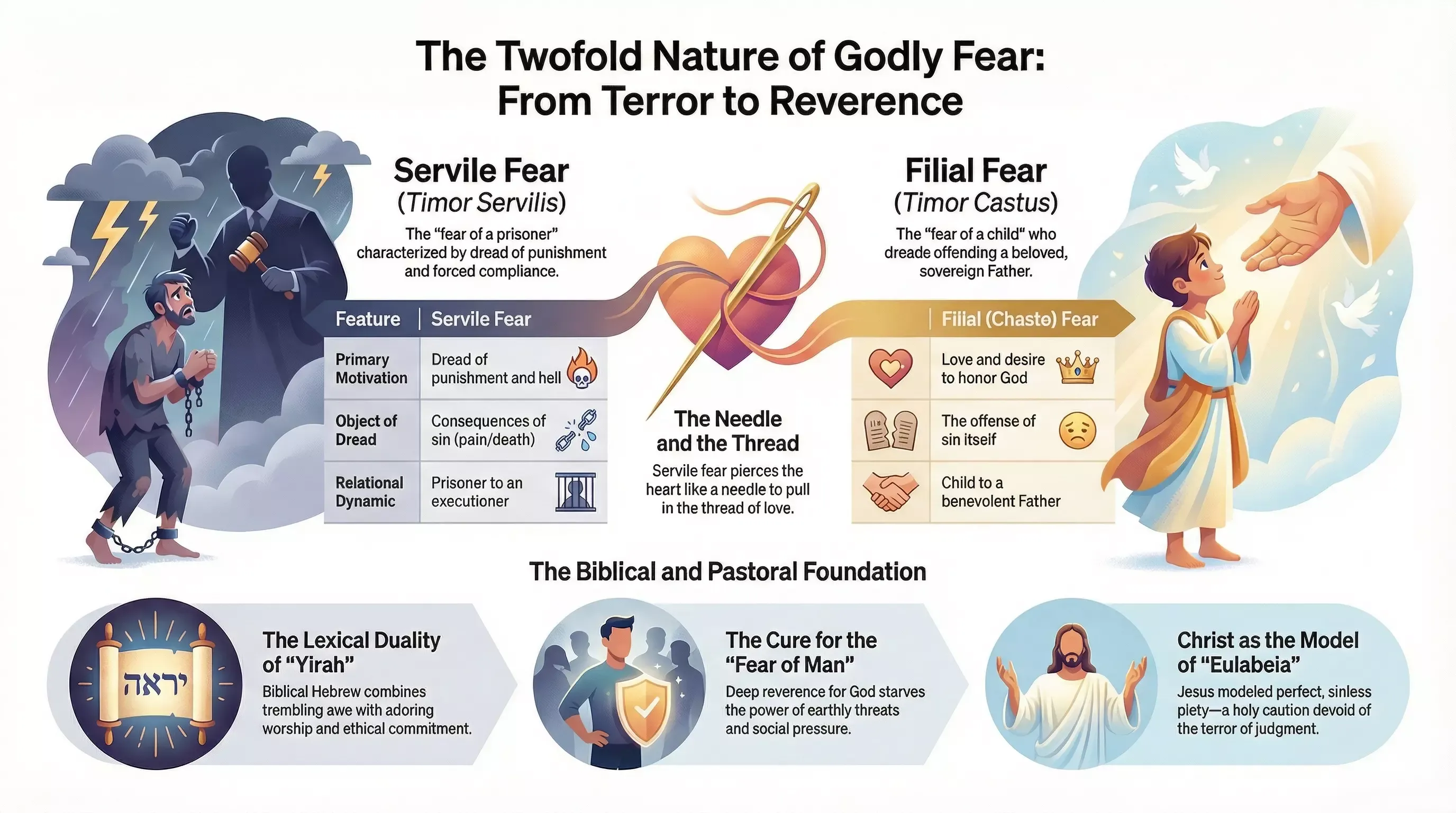
The Needle and the Thread
Augustine used a memorable image: servile fear is like a needle that pierces the heart, making way for the thread of love to follow. The needle is not the goal—the thread is. But without the needle’s work, the thread cannot enter.
This means that the “fear of God” Scripture commends is not a perpetual state of dread but a settled reverence that flows from relationship. It is compatible with—indeed, inseparable from—joy, gratitude, and assurance. The early church walked “in the fear of the Lord and in the comfort of the Holy Spirit” (Acts 9:31). These are not opposites. They are companions.
What the Fear of the Lord Produces
If filial fear is the goal, what does it look like in practice? The Puritans were particularly attentive to this question, and their answers remain instructive.
Watchfulness Over the Heart
Bunyan wrote that godly fear produces “a tenderness and softness of spirit” that makes the soul alert to temptation. The one who fears God does not presume upon grace; he watches over his heart because he knows its treachery.
In the digital age, this translates directly: the one who fears God does not mindlessly scroll, does not carelessly consume, does not outsource moral judgment to algorithms. Watchfulness is the antidote to the passive consumption that platforms cultivate.
Hatred of Sin
“The fear of the LORD is to hate evil” (Proverbs 8:13). Notice: fear is defined by its moral fruit. It produces not merely avoidance of punishment but active hatred of what offends God.
This is the opposite of what algorithmic culture produces. Platforms are designed to maximize engagement, not moral formation. They habituate users to outrage, envy, and lust—not hatred of these things, but participation in them. Filial fear cuts against this grain.
Reverent Worship
Hebrews 12:28 commands believers to “offer to God acceptable worship, with reverence and awe, for our God is a consuming fire.” The fear of the Lord is not merely ethical; it is doxological. It shapes how we approach God in prayer, praise, and sacrament.
The casualness that pervades much contemporary worship—the assumption that God is our “buddy” who asks nothing of us—is a symptom of lost fear. The God of Scripture is not safe. He is holy. And the appropriate response to holiness is reverent awe, not comfortable familiarity.
Freedom from the Fear of Man
Perhaps most practically: the fear of God liberates from the fear of man. “The fear of man brings a snare, but he who trusts in the LORD will be exalted” (Proverbs 29:25).
This is the great paradox. The one who fears God properly is freed from the tyranny of human opinion—including the algorithmic manipulation of social approval. The dopamine hit of likes, the anxiety of being “canceled,” the compulsion to perform for an audience—all of these lose their power when a greater fear is in place.
You cannot serve two masters. You cannot fear two ultimate authorities. The fear of the Lord, rightly cultivated, starves the fear of man.
Fear and Love: The Reformed Integration
A common objection arises: Doesn’t 1 John 4:18 say that “perfect love casts out fear”? How can we be called to fear God if love abolishes fear?
The answer lies in recognizing which fear is cast out.
John writes: “There is no fear in love, but perfect love casts out fear. For fear has to do with punishment, and whoever fears has not been perfected in love.” The fear that love casts out is explicitly linked to punishment—servile fear, bondage-fear, the dread of the slave.
But this is precisely what the Reformed tradition has always said: the gospel frees the conscience from dread without producing irreverence. The Belgic Confession links Christ’s satisfaction with “confidence in drawing near to God, freeing the conscience from fear, terror, and dread.” Yet the same Reformed tradition emphasizes worship “with holy fear and reverence” as the fitting response to God’s presence.
Luther’s catechism captures the integration perfectly: the First Commandment means “we should fear, love, and trust in God above all things.” Fear is not opposed to love and trust; it is coordinated with them as a single Godward posture.
Calvin defines piety itself as “a union of reverence and love toward God.” True knowledge of God, he argues, produces both—and one without the other is malformed religion. Fear without love is bondage. Love without fear is presumption.
The Fear of the Lord in the Silicon Age
We return now to our original question: How does this ancient wisdom apply to an age of artificial intelligence?
The Reordering of Fear
The fundamental move is not to eliminate fear but to reorder it. The one who fears God properly cannot treat AI with the slavish dread that treats it as fate. Nor can he treat AI with the uncritical embrace that ignores its dangers. Both responses reflect disordered fear.
Proper fear says: God governs all things, including every algorithm. I need not dread the machine as though it were sovereign. But I must be watchful, because my heart is prone to idolatry, and this technology offers new occasions for old sins.
The Relativizing of Algorithmic Anxiety
Social media platforms are designed to cultivate anxiety. The endless scroll, the notification dopamine, the fear of missing out—all of these depend on a heart that fears the wrong things.
The fear of the Lord relativizes these lesser fears. The one who trembles before the Almighty will not tremble before the algorithm. The one whose identity is secured in Christ will not need the validation of likes. The one who fears displeasing God will not be mastered by the compulsion to please the crowd.
This is not mere willpower. It is the fruit of rightly ordered worship.
The Preservation of Moral Agency
Perhaps the most pressing danger of AI is the temptation to outsource moral judgment. “The system recommended it.” “The algorithm optimized for it.” “The AI decided it.” Each of these phrases represents an abdication of human responsibility.
Filial fear cuts against this. The one who fears God knows that he will give account—not the machine. He cannot shift responsibility to an artifact. He remains a moral agent, answerable to his Maker, regardless of what tools he employs.
The Practice of Digital Watchfulness
Finally, the fear of the Lord produces concrete practices of watchfulness in digital engagement:
Examining what we consume. Does this content draw me toward God or away from Him? Does it cultivate virtue or vice? The one who fears God does not consume carelessly.
Guarding the heart from envy. Social media is an envy machine. The fear of the Lord recognizes envy as sin—not merely a feeling to manage, but an offense against the God who assigns every lot.
Refusing manipulation. Algorithmic systems are designed to manipulate through emotional arousal. The one who fears God maintains a sober mind, not swept along by manufactured outrage or curated anxiety.
Preserving Sabbath. The always-on digital culture knows no rest. The fear of the Lord recovers the rhythm of work and rest, connection and silence, engagement and withdrawal.
Conclusion: The Beginning and the End
We began this series by diagnosing algorithmic idolatry—the human tendency to forge gods from silicon. We continued by distinguishing slavish terror from filial vigilance—showing that the question is not whether to fear, but what and how.
Now we arrive at the positive vision: the fear of the Lord as the reordering principle of life in a digital age.
This fear is not dread. It is not anxiety. It is not the paralyzing terror that treats technology as fate. It is reverent awe before the Holy One—awe that produces watchfulness, hatred of sin, freedom from the fear of man, and sober engagement with whatever tools providence provides.
Ecclesiastes concludes: “The conclusion, when all has been heard, is: fear God and keep His commandments, because this applies to every person” (12:13). This ancient word remains the wisest counsel for the silicon age.
The algorithms will change. The platforms will rise and fall. The technologies that seem world-shaking today will be forgotten tomorrow. But the fear of the Lord endures forever—and those who cultivate it will navigate every technological revolution with wisdom, humility, and unshakeable hope.
Soli Deo Gloria.
This concludes our three-part series on Christians and AI. For further reading on the fear of God, see John Bunyan’s “A Treatise of the Fear of God,” Jonathan Edwards’ “Religious Affections,” and the wisdom literature of Scripture (Proverbs, Job, Ecclesiastes).